Blog

HS2. Recogida y evacuación de residuos. Documento básico de salubridad

Editado por: Junkwon Won

fuente: Ministerio de vivienda y agenda urbana

1 Generalidades

1.1 Ámbito de aplicación
1 Esta sección se aplica a los edificios de viviendas de nueva construcción, tengan o no locales desti-nados a otros usos, en lo referente a la recogida de los residuos ordinarios generados en ellos.

2 Para los edificios y locales con otros usos la demostración de la conformidad con las exigencias básicas debe realizarse mediante un estudio específico adoptando criterios análogos a los establecidos en esta sección.

1.2 Procedimiento de verificación
1 Para la aplicación de esta sección debe seguirse la secuencia de verificaciones que se expone a continuación.

2 Cumplimiento de las condiciones de diseño y dimensionado del apartado 2 relativas al sistema de almacenamiento y traslado de residuos:
a) la existencia del almacén de contenedores de edificio y las condiciones relativas al mismo, cuando el edificio esté situado en una zona en la que exista recogida puerta a puerta de alguna de las fracciones de los residuos ordinarios;
La recogida puerta a puerta se considera el sistema de recogida de residuos ordinarios más eficiente desde el punto de vista de separación de las fracciones de los residuos. Por ello, uno de los objetivos de este DB es facilitar su implantación.
b) la existencia de la reserva de espacio y las condiciones relativas al mismo, cuando el edificio esté situado en una zona en la que exista recogida centralizada con contenedores de calle de superficie de alguna de las fracciones de los residuos ordinarios;
c) las condiciones relativas a la instalación de traslado por bajantes, en el caso de que se haya dispuesto ésta;
d) la existencia del espacio de almacenamiento inmediato y las condiciones relativas al mismo.
3 Cumplimiento de las condiciones de mantenimiento y conservación del apartado 3.

2 Diseño y dimensionado
2.1 Almacén de contenedores de edificio y espacio de reserva
1 Cada edificio debe disponer como mínimo de un almacén de contenedores de edificio para las fracciones
de los residuos que tengan recogida puerta a puerta, y, para las fracciones que tengan recogida centralizada con contenedores de calle de superficie, debe disponer de un espacio de reserva en el que pueda construirse un almacén de contenedores cuando alguna de estas fracciones pase a tener recogida puerta a puerta.


Este espacio de reserva se puede utilizar para cualquier otro uso provisional: zona de paso, almacén de
bicicletas, etc., hasta que se construya el almacén de contenedores.


No es necesario disponer un almacén de contenedores de edificio ni un espacio de reserva en el caso de las
fracciones que cuenten con recogida neumática.


2 En el caso de viviendas aisladas o agrupadas horizontalmente, el almacén de contenedores de edificio
y el espacio de reserva pueden disponerse de tal forma que sirvan a varias viviendas.


2.1.1 Situación
1 El almacén y el espacio de reserva, en el caso de que estén fuera del edificio, deben estar situados a una distancia del acceso del mismo menor que 25 m.
2 El recorrido entre el almacén y el punto de recogida exterior debe tener una anchura libre de 1,20 m como mínimo, aunque se admiten estrechamientos localizados siempre que no se reduzca la anchura libre a menos de 1 m y que su longitud no sea mayor que 45 cm. Cuando en el recorrido existan puertas de apertura manual éstas deben abrirse en el sentido de salida. La pendiente debe ser del 12 % como máximo y no deben disponerse escalones. La condición del sentido de apertura de las puertas satisface el objetivo de facilitar la maniobra de extracción de los contenedores de residuos llenos desde el almacén hasta el punto de recogida en zonas estrechas. Por ello, esta condición podría no ser necesaria en el caso de que una de estas puertas coincida con la puerta de
acceso general al edificio, al ser en este caso habitualmente las condiciones espaciales favorables. El texto del DB no menciona explícitamente la posibilidad de la situación en un sótano. Por ello, se entiende que, mientras cumpla las condiciones anteriores, sería válida la situación en un sótano, utilizándose para el traslado de los contenedores hasta el punto de recogida exterior un medio de transporte mecánico o una rampa.


2.1.2 Superficie

2.1.2.1 Superficie útil del almacén
1 La superficie útil del almacén debe calcularse mediante la fórmula siguiente:
S = 0,8 · P · ∑ (Tf · Gf · Cf · Mf)

siendo

S la superficie útil [m2];
P el número estimado de ocupantes habituales del edificio que equivale a la suma del número total de dormitorios sencillos y el doble de número total de dormitorios dobles;
Se considera que el dormitorio principal es doble y el resto de dormitorios, sencillos.
Tf el período de recogida de la fracción [días];
Gf el volumen generado de la fracción por persona y día [dm3/(persona·día)], que equivale a los siguientes valores:
Papel / cartón 1,55
Envases ligeros 8,40
Materia orgánica 1,50
Vidrio 0,48
Varios 1,50
Cf el factor de contenedor [m2/l], que depende de la capacidad del contenedor de edificio que el
servicio de recogida exige para cada fracción y que se obtiene de la tabla 2.1;

Tabla 2.1 Factor de contenedor

Capacidad del contenedor de edificio
en l
Cf
en m2/l
1200,0050
2400,0042
3300,0036
6000,0033
8000,0030
1.1000,0027

2.1.2.2 Superficie del espacio de reserva
1 La superficie de reserva debe calcularse mediante la fórmula siguiente:

SR = P · ∑ (Ff · Mf) (2.2)

siendo
SR la superficie de reserva [m2];
P el número estimado de ocupantes habituales del edificio que equivale a la suma del número total de dormitorios sencillos y el doble de número total de dormitorios dobles;
Ff el factor de fracción [m2/persona], que se obtiene de la tabla 2.2

Tabla 2.2 Factor de fracción:

FracciónFf
en m2/persona
Papel / cartón0,039
Envases ligeros0,060
Materia orgánica0,005
Vidrio0,012
Varios0,038

Mf un factor de mayoración que se utiliza para tener en cuenta que no todos los ocupantes del edificio separan los residuos y que es igual a 4 para la fracción varios y a 1 para las demás fracciones.
2 Con independencia de lo anteriormente expuesto, la superficie útil del almacén debe ser como mínimo la que permita el manejo adecuado de los contenedores.

2.1.3 Otras características
1 El almacén de contenedores debe tener las siguientes características:
a) su emplazamiento y su diseño deben ser tales que la temperatura interior no supere 30º;
b) el revestimiento de las paredes y el suelo debe ser impermeable y fácil de limpiar; los encuentros entre las paredes y el suelo deben ser redondeados;
c) debe contar al menos con una toma de agua dotada de válvula de cierre y un sumidero sifónico antimúridos en el suelo;
d) debe disponer de una iluminación artificial que proporcione 100 lux como mínimo a una altura respecto del suelo de 1 m y de una base de enchufe fija 16A 2p+T según UNE 20.315:2017;

e) satisfará las condiciones de protección contra incendios que se establecen para los almacenes de residuos en el apartado 2 de la Sección SI-1 del DB-SI Seguridad en caso de incendio;
f) en el caso de traslado de residuos por bajante, si se dispone una tolva intermedia para almacenar los residuos hasta su paso a los contenedores, ésta debe ir provista de una compuerta para su vaciado y limpieza, así como de un punto de luz que proporcione 1.000 lúmenes situado en su interior sobre la compuerta, y cuyo interruptor esté situado fuera de la tolva.

2.2 Instalaciones de traslado por bajantes

2.2.1 Condiciones generales

1 Las compuertas de vertido deben situarse en zonas comunes y a una distancia de las viviendas menor que 30 m, medidos horizontalmente.
2 El traslado del vidrio no se debe realizar mediante el sistema de traslado
por bajantes.

2.2.2 Condiciones particulares de las bajantes

1 Las bajantes deben ser metálicas o de cualquier material de clase de reacción al fuego A1, impermeable, anticorrosivo, imputrescible y resistente a
los golpes. Las superficies interiores deben ser lisas.

2 Las bajantes deben separarse del resto de los recintos del edificio mediante muros que en función de las características de resistencia a fuego
sean de clase EI-120.

3 Las bajantes deben disponerse verticalmente, aunque pueden realizarse
cambios de dirección respecto a la vertical no mayores que 30º. Para evitar los ruidos producidos por una velocidad excesiva en la caída de los residuos, cada 10 m de conducto debe disponerse una acodadura con cuatro codos de 15º cada uno como máximo según la figura 2.1, o adoptarse otra solución que produzca el mismo efecto.

4 Las bajantes deben tener un diámetro de 450 mm como mínimo.

5 Las bajantes de los sistemas de traslado por gravedad deben ventilarse por el extremo superior con un aspirador estático y, en dicho extremo, debe disponerse una toma de agua con racor para manguera y una compuerta para limpieza dotada de cierre hermético y cerradura.

6 Las bajantes de los sistemas neumáticos deben conectarse a un conducto de ventilación de una sección no menor que 350 cm2.

7 El extremo superior de la bajante en los sistemas de traslado por gravedad y del conducto de ventilación en los sistemas neumáticos deben desembocar en un espacio exterior adecuado de tal manera que (véase la figura 2.2) el tramo exterior sobre la cubierta tenga una altura de 1 m como mínimo y supere las siguientes alturas en función de su emplazamiento:
a) la altura de cualquier obstáculo que esté a una distancia comprendida entre 2 y 10 m;
b) 1,3 veces la altura de cualquier obstáculo que esté a una distancia menor o igual que 2 m.

Figura 2.2 Ejemplos de altura libre del extremo superior de la bajante sobre la cubierta

8 En el extremo inferior de la bajante en los sistemas de traslado por gravedad debe disponerse una compuerta de cierre y un sistema que impida que, como consecuencia de la acumulación de los residuos en el tramo de la bajante inmediatamente superior a la compuerta de cierre, los residuos alcancen la compuerta de vertido más baja.

2.2.3 Condiciones particulares de las compuertas de vertido

1 Las compuertas de vertido deben ser metálicas o de material con clase de reacción al fuego A1, impermeable, anticorrosivo, imputrescible y resistente a los golpes. En función de las características de resistencia a fuego deben ser de clase EI-60. Las superficies interiores deben ser lisas.

2 Para que la unión de las compuertas con las bajantes sea estanca, debe disponerse un cierre con burlete elástico o adoptarse otra solución que produzca el mismo efecto.

3 Las compuertas deben ser de tal forma que permitan
a) el vertido de los residuos con facilidad;
b) su limpieza interior con facilidad;
c) el acceso para eliminar los atascos que se produzcan en las bajantes.

4 Las compuertas deben ir provistas de cierre hermético y silencioso. Para evitar que cuando haya una compuerta abierta se pueda abrir otra, debe disponerse un sistema de enclavamiento eléctrico o adoptarse otra solución que produzca el mismo efecto.

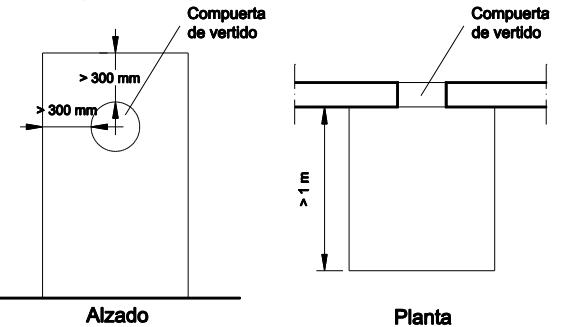
5 Cuando las compuertas sean circulares deben tener un diámetro comprendido entre 300 y 350 mm y, cuando sean rectangulares, deben tener unas dimensiones comprendidas entre 300×300 y
350×350 mm.

6 La zona situada alrededor de la compuerta y el suelo adyacente de acuerdo con la figura 2.3 deben
revestirse con un acabado impermeable que sea fácilmente lavable:

Figura 2.3 Zona de acabado impermeable y lavable

2.2.4 Condiciones particulares de las estaciones de carga de los sistemas neumáticos

1 La estación de carga debe disponer de un tramo vertical de 2,5 m de bajante para almacenamiento de los residuos, una válvula de residuos situada en el extremo inferior del tramo vertical y una válvula de aire situada a la misma altura que la válvula de residuos.

2 Las estaciones de carga deben situarse en un recinto que tenga las siguientes características:
a) los cerramientos deben dimensionarse para una depresión de 2,95 kPa como mínimo;
b) debe disponer de una iluminación artificial que proporcione 100 lux como mínimo a una altura respecto del suelo de 1 m y de una base de enchufe fija 16A 2p+T según UNE 20.315:2017;
c) debe disponer de una puerta de acceso batiente hacia fuera;
d) el revestimiento de las paredes y el suelo debe ser impermeable y fácil de limpiar y el de aquel último debe ser además antideslizante; los encuentros entre las paredes y el suelo deben ser redondeados;
e) debe contar al menos con una toma de agua dotada de válvula de cierre y un desagüe antimúridos.

2.3 Espacios de almacenamiento inmediato en las viviendas

1 Deben disponerse en cada vivienda espacios para almacenar cada una de las cinco fracciones de los residuos ordinarios generados en ella.

2 En el caso de viviendas aisladas o agrupadas horizontalmente, para las fracciones de papel / cartón y vidrio, puede utilizarse como espacio de almacenamiento inmediato el almacén de contenedores de edificio.

3 La capacidad de almacenamiento para cada fracción debe calcularse mediante la siguiente fórmula:
C=CA . Pv
siendo
C la capacidad de almacenamiento en la vivienda por fracción [dm3];
CA el coeficiente de almacenamiento [dm3/persona] cuyo valor para cada fracción se obtiene en la tabla 2.3;

Pv el número estimado de ocupantes habituales de la vivienda que equivale a la suma del número total de dormitorios sencillos y el doble de número total de dormitorios dobles.

4 Con independencia de lo anteriormente expuesto, el espacio de almacenamiento de cada fracción debe tener una superficie en planta no menor que 30×30 cm y debe ser igual o mayor que 45 dm3.

5 Los espacios destinados a materia orgánica y envases ligeros deben disponerse en la cocina o en zonas anejas auxiliares.

6 Estos espacios deben disponerse de tal forma que el acceso a ellos pueda realizarse sin que haya necesidad de recurrir a elementos auxiliares y que el punto más alto esté situado a una altura no mayor que 1,20 m por encima del nivel del suelo.

7 El acabado de la superficie de cualquier elemento que esté situado a menos de 30 cm de los límites del espacio de almacenamiento debe ser impermeable y fácilmente lavable.

3 Mantenimiento y conservación

3.1 Almacén de contenedores de edificio

1 Deben señalizarse correctamente los contenedores, según la fracción correspondiente, y el almacén de contenedores. En el interior del almacén de contenedores deben disponerse en un soporte indeleble, junto con otras normas de uso y mantenimiento, instrucciones para que cada fracción se vierta en el contenedor correspondiente.

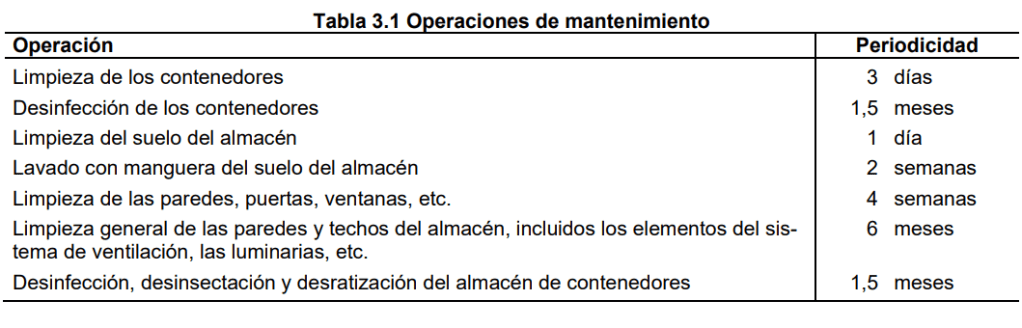
2 Deben realizarse las operaciones de mantenimiento que, junto con su periodicidad, se incluyen en la tabla 3.1.

3.2 Instalaciones de traslado por bajantes

1 Las compuertas deben estar correctamente señalizadas según la fracción correspondiente.

2 En los recintos en los que estén situadas las compuertas deben disponerse, en un soporte indeleble, junto a otras normas de uso y mantenimiento, las instrucciones siguientes:
a) cada fracción debe verterse en la compuerta correspondiente;b) no se deben verter por ninguna compuerta residuos líquidos, objetos cortantes o punzantes ni vidrio;
c) los envases ligeros y la materia orgánica deben verterse introducidos en envases cerrados;
d) los objetos de cartón que no quepan por la compuerta deben introducirse troceados y no deben plegarse.
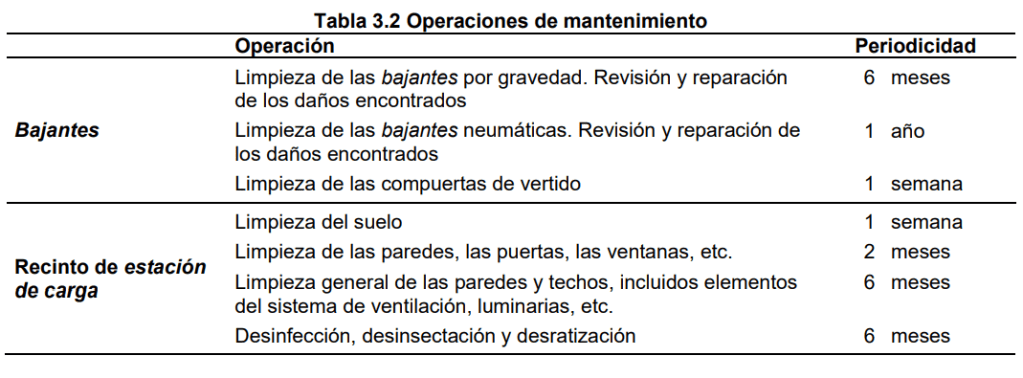
3 Deben realizarse las operaciones de mantenimiento que, junto con su periodicidad, se incluyen en la tabla 3.2.

La nueva ley europea es el Reglamento (UE) 2025/40 sobre envases y residuos de envases (conocido como PPWR)

REGLAMENTO (UE) 2025/40 entró en vigor el 11 de febrero de 2025. Este reglamento sustituye a la antigua directiva para armonizar las reglas en toda la Unión Europea y será de aplicación obligatoria a partir del 12 de agosto de 2026

Las claves que afectan directamente a las empresas son:

  • Reciclabilidad Obligatoria (2030): Para el año 2030, todos los envases comercializados en la UE deberán ser reciclables de forma económicamente viable. Se introducirá una escala de rendimiento (grados A, B o C) y solo se permitirán los envases que cumplan estos criterios.
  • Contenido Reciclado en Plásticos: Se fijan objetivos progresivos para el uso de plásticos reciclados en nuevos envases, comenzando con requisitos específicos para 2030 y aumentando para 2040.
  • Reducción y Reutilización: Establece objetivos vinculantes para reducir el volumen de residuos (5% para 2030, 10% para 2035 y 15% para 2040). Además, obliga a ofrecer opciones de rellenado o reutilización en sectores como la comida para llevar y el e-commerce.
  • Restricciones a Químicos: Se prohíbe el uso de sustancias químicas permanentes (PFAS) en envases en contacto con alimentos a partir de agosto de 2026 debido a sus riesgos para la salud.
  • Etiquetado Armonizado: Se introducirán etiquetas y códigos QR estándar en toda la UE para facilitar la clasificación por parte del consumidor y mejorar la trazabilidad.
  • Sistemas de Retorno (SDDR): Los Estados miembros deberán garantizar la recogida separada del 90% de las botellas de plástico y latas de bebidas mediante sistemas de depósito, devolución y retorno para 2029. 

Esta normativa complementa a nivel europeo lo ya establecido en España por el Real Decreto 1055/2022, reforzando la Responsabilidad Ampliada del Productor.

Gestión de residuos asimilables urbanos global. Agenda 2030. ODS

Editado por: Junkwon Won

AMAS21 desde el año 2025 en colaboración con universidades del continente Asiático, comenzamos un nuevo periplo en la investigación de la gestión de residuos asimilables urbanos.

Corea 2025-26

CHAPTER I GENERAL PROVISIONS

Article 1 (Purpose) The purpose of this Act is to contribute to environmental conservation and the enhancement of the people’s quality of life by reducing the generation of wastes to the maximum extent possible and treating generated wastes in an environment-friendly manner.  <Amended on Jul. 23, 2010>

Article 2 (Definitions) The terms used in this Act are defined as follows:  <Amended on May 17, 2007; Jun. 9, 2009; Jan. 13, 2010; Jul. 23, 2010; Jan. 20, 2015; Jan. 17, 2017>

1. The term «wastes» means such materials as garbage, burnt refuse, sludge, waste oil, waste acid, waste alkali, and carcasses of animals, which have become no longer useful for human life or business activities;

2. The term «household wastes» means any wastes other than industrial wastes;

3. The term «industrial wastes» means any wastes generated from places of business with discharge or emission facilities installed and managed in accordance with the Clean Air Conservation Act, the Water Environment Conservation Act, or the Noise and Vibration Control Act, or any other places of business prescribed by Presidential Decree;

4. The term «designated wastes» means the industrial wastes prescribed by Presidential Decree as harmful substances, such as waste oil and waste acid which may contaminate the surrounding environment, or medical wastes which may cause harm to human bodies;

5. The term «medical wastes» means the wastes prescribed by Presidential Decree among the wastes discharged from public health and medical institutions, veterinary clinics, testing and inspection institutions and other similar institutions, which may cause harm to human bodies by infection or otherwise and need to be specially controlled for public health and environmental conservation such as parts and extracts of human bodies and carcasses of laboratory animals;

5-2. The term «medical waste-only container» means a container used to collect, transport, or store any medical wastes to prevent infection or other hazards caused by medical wastes;

5-3. The term «treatment» means the collection, transportation, storage, recycling, and disposal of wastes;

6. The term «disposal» means both interim disposal, such as incineration, neutralization, fragmentation and solidification, and terminal disposal, such as landfill and discharging into the sea;

7. The term «recycling» means any of the following activities:

(a) Reusing or reclaiming wastes or making wastes reusable or reclaimable;

(b) Recovering energy prescribed in subparagraph 1 of Article 2 of the Energy Act or making such energy recoverable from wastes, or using wastes as fuel, as prescribed by Ordinance of the Ministry of Environment;

8. The term «waste treatment facilities» means both interim and terminal waste disposal facilities and waste recycling facilities, as prescribed by Presidential Decree;

9. The term «waste minimization facilities» means facilities prescribed by Presidential Decree for minimizing discharge of wastes by reducing the quantity of wastes generated in a manufacturing process and by recycling wastes within a place of business.

Article 2-2 (Detailed Classification of Wastes) Detailed classification of wastes concerning the kinds and recycling types of wastes shall be prescribed by Ordinance of the Ministry of Environment in consideration of the generation source, constituents, harmfulness, etc. of wastes.

[This Article Newly Inserted on Jul. 20, 2015]

Article 3 (Scope of Application) (1) This Act shall not apply to any of the following substances:  <Amended on May 17, 2007; Dec. 21, 2007; Jul. 23, 2010; Jul. 21, 2011; Jul. 25, 2011; Jan. 20, 2015; Jan. 17, 2017; Apr. 26, 2022>

1. A radioactive substance prescribed in the Nuclear Safety Act or a material contaminated by such substance;

2. A gaseous substance not contained in a container;

3. Wastewater flowing into, or discharged into public waters from, a facility established for the prevention of water contamination prescribed in the Water Environment Conservation Act;

4. Livestock excreta prescribed in the Act on the Management and Use of Livestock Excreta;

5. Sewage and excreta prescribed in the Sewerage Act;

6. A livestock carcass, a polluted thing, a thing subject to ban on importation, or a thing rejected in a quarantine inspection under Article 22 (2), 23, 33 or 44 of the Act on the Prevention of Contagious Animal Diseases;

7. A carcass of an aquatic animal, a polluted facility or thing, a thing subject to ban on importation, and a thing rejected in a quarantine inspection, to which Articles 17 (2), 18 and 34 (1) and each subparagraph of Article 25 (1) of the Aquatic Life Disease Control Act apply;

8. Ammunitions scrapped pursuant to Article 13-2 of the Act on the Management of Military Supplies;

9. A carcass of an animal treated at an animal cemetery established and operated by a person with permission for animal funeral service business under Article 69 (1) of the Animal Protection Act.

(2) Discharging wastes into the sea under this Act shall be governed by the Management of Marine Garbage and Contaminated Marine Sediment Act.  <Amended on Dec. 3, 2019>

(3) This Act shall apply where fishery byproducts under the Act on Fishery Byproducts Recycling Promotion are mixed with other wastes, and this Act shall not apply where only fishery byproducts not mixed with other wastes are discharged, collected, transported, or recycled.  <Newly Inserted on Jul. 20, 2021>

Article 3-2 (Basic Principles of Waste Management) (1) Every business entity shall reduce the generation of wastes to the maximum extent possible by improving the manufacturing process, etc. of products and minimize the discharge of wastes by recycling his or her own wastes.

(2) Every person shall take prior appropriate measures with respect to the discharge of wastes to prevent any harm to environs or the health of residents.

(3) Waste treatment shall be properly managed in a manner that reduces their quantities and degree of hazard or otherwise is consistent with environmental conservation and the protection of the people’s health.

(4) Any person who causes environmental pollution by discharging wastes shall be responsible for restoring the affected environs and bear the expenses incurred in restoring the damage caused by such pollution.

(5) To the extent possible, wastes generated domestically shall be treated within the Republic of Korea and the importation of wastes shall be restrained.

(6) Wastes shall be recycled rather than incinerated, buried, or disposed of in another way, in order to contribute to the improvement of resource productivity.

[This Article Newly Inserted on Jul. 23, 2010]

Article 4 (Responsibilities of the State and Each Local Government) (1) A Special Self-Governing City Mayor, a Special Self-Governing Province Governor, or the head of a Si/Gun/Gu (the head of a Gu refers to the head of an autonomous Gu; hereinafter the same shall apply) shall verify the current status of wastes discharged and treated within his or her jurisdiction; install and operate waste treatment facilities so that wastes can be properly treated; conduct affairs relating to waste treatment efficiently by improving the methods of treating wastes and raising the skills and quality of the persons in charge; and endeavor to remind residents and business entities of the importance of protecting the environment and to restrain the generation of wastes.  <Amended on Aug. 3, 2007; Jul. 23, 2010; Jul. 16, 2013>

(2) The Special Metropolitan City Mayor, a Metropolitan City Mayor, and a Do Governor shall provide the heads of Sis/Guns/Gus with technical and financial assistance to help them fulfill their duties prescribed in paragraph (1) and shall also coordinate waste treatment services within their jurisdiction.  <Amended on Aug. 3, 2007>

(3) The State shall verify the current status of designated wastes discharged and treated, and take measures necessary for proper treatment of such wastes.

(4) The State shall support research on and development of technology for waste treatment, provide the Special Metropolitan City Mayor, a Metropolitan City Mayor, a Special Self-Governing City Mayor, a Do Governor, and a Special Self-Governing Province Governor (hereinafter referred to as «Mayor/Do Governor») and the head of each Si/Gun/Gu with technical and financial assistance necessary for them to fulfill their duties prescribed in paragraphs (1) and (2), and shall also coordinate waste treatment services with the Special Metropolitan City, Metropolitan Cities, Special Self-Governing Cities, Dos, and Special Self-Governing Provinces (hereinafter referred to as «City/Do»).  <Amended on Aug. 3, 2007; Jul. 16, 2013>

Article 5 (Multi-Regional Waste Management) (1) If the Minister of Environment, the Mayor/Do Governor or the head of a Si/Gun/Gu deems it necessary to treat wastes generated from at least two Cities/Dos or Sis/Guns/Gus with an integrated system for a multiple number of regions, he or she may solely or jointly install and operate multi-regional waste treatment facilities (including public treatment facilities for designated wastes).

(2) The Minister of Environment, the Mayor/Do Governor, or the head of a Si/Gun/Gu may entrust a person designated by Ordinance of the Ministry of Environment to install or manage the multi-regional treatment facilities prescribed in paragraph (1).

Article 5-2 (Treatment of Household Waste within Area of Waste Generation) (1) A Special Self-Governing City Mayor, a Special Self-Governing Province Governor, or the head of a Si/Gun/Gu shall take measures necessary to treat household waste generated within the jurisdictional district in the waste treatment facility within the jurisdictional district or in the multi-regional waste treatment facility referred to in Article 5 covering the jurisdictional district.

(2) Notwithstanding the measures taken under paragraph (1), where it is impracticable to treat all the household wastes generated in his or her jurisdictional district, a Special Self-Governing City Mayor, a Special Self-Governing Province Governor, or the head of a Si/Gun/Gu may ship out household wastes to the jurisdictional district of the competent local government for treatment, in consultation with the competent Special Self-Governing City Mayor, Special Self-Governing Province Governor, or the head of a Si/Gun/Gu.

[This Article Newly Inserted on Dec. 27, 2022]

[Enforcement Date: Dec. 28, 2024] Article 5-2

Article 5-3 (Collection of Cooperation Charges for Inbound Shipping) (1) The Special Self-Governing City Mayor, the Special Self-Governing Province Governor, or the head of a Si/Gun/Gu who brings in and treats household wastes prescribed by Ordinance of the Ministry of Environment pursuant to Article 5-2 (2) may collect the amount calculated in consideration of the quantity of the relevant household wastes brought in (hereinafter referred to as «cooperation charges for inbound shipping») from the Special Self-Governing City Mayor, the Special Self-Governing Province Governor, or the head of a Si/Gun/Gu, who ships out the relevant household wastes. In such cases, the additional dues under Article 8 of the Promotion of Installation of Waste Disposal Facilities and Assistance to Adjacent Areas Act shall be deemed collected.

(2) Cooperation charges for inbound shipping shall be prescribed by ordinance of the relevant local government which brings in and treats household wastes pursuant to paragraph (1) within the scope prescribed by Ordinance of the Ministry of Environment.

(3) Cooperation charges for inbound shipping shall be used for the following purposes:

1. Improvement of the neighboring environment of waste treatment facilities and support for residents;

2. Establishment, operation, and improvement of the waste treatment facilities;

3. Research on and development of the methods to curb the generation of wastes and to properly treat such wastes;

4. Other projects prescribed by Ordinance of the Ministry of Environment to curb the generation of wastes and properly treat such wastes.

[This Article Newly Inserted on Dec. 27, 2022]

[Enforcement Date: Dec. 28, 2024] Article 5-3

Article 6 (Charges for Waste Treatment in Waste Treatment Facilities) (1) An institution that has installed and operated a waste treatment facility prescribed in Article 4 (1) or 5 (1) may charge expenses incurred in treating wastes brought into the facility (hereinafter referred to as the «waste treatment charge») on persons who bring wastes into such facility.

(2) In cases falling under paragraph (1), where a waste treatment facility has been installed and is operated jointly by at least two local governments, the waste treatment charge shall be determined by an agreement between the local governments.

(3) The amount of waste treatment charge shall be prescribed by Ordinance of the Ministry of Environment if the State is responsible for collecting it, while such amount shall be prescribed by municipal ordinance if a local government is responsible for collecting it.

Article 7 (Responsibilities of Citizens) (1) Every citizen shall keep natural and living environments clean and endeavor to reduce and recycle wastes.

(2) Every owner, occupant, and manager of a parcel of land or a building shall endeavor to keep clean the parcel of land or building owned, occupied, or managed by him or her, and shall implement general clean-up in accordance with the plan prepared by a Special Self-Governing City Mayor, a Special Self-Governing Province Governor, or the head of a Si/Gun/Gu.  <Amended on Aug. 3, 2007; Jul. 16, 2013>

Article 8 (Prohibition against Dumping Wastes) (1) No one shall dump wastes in any area other than the places and facilities provided for the collection of wastes by a Special Self-Governing City Mayor, a Special Self-Governing Province Governor, the head of a Si/Gun/Gu, or the manager of a facility, such as a public park or road, or dump household wastes not in accordance with the methods prescribed by ordinance of a Special Self-Governing City, a Special Self-Governing Province, or a Si/Gun/Gu or the methods designated by the manager of a facility, such as a public park or road.  <Amended on Aug. 3, 2007; Jul. 16, 2013; Jan. 5, 2021>

(2) No one shall bury or incinerate wastes in any area other than the landfill sites permitted, approved or reported under this Act: Provided, That the foregoing shall not apply to incineration at places specified under the proviso to Article 14 (1), as prescribed by ordinance of the competent Special Self-Governing City, Special Self-Governing Province, or Si/Gun/Gu.  <Amended on Aug. 3, 2007; Jul. 16, 2013>

(3) A Special Self-Governing City Mayor, a Special Self-Governing Province Governor, or the head of a Si/Gun/Gu may order the owner, occupant, or manager of a parcel of land or building to take necessary measures in compliance with the relevant ordinance of the competent local government, if the owner, occupant, or manager fails to keep clean the property under his or her control pursuant to Article 7 (2).  <Amended on Aug. 3, 2007; Jul. 16, 2013>

Article 9 Deleted.  <Nov. 28, 2017>

Article 10 Deleted.  <Nov. 28, 2017>

Article 11 Deleted.  <Nov. 28, 2017>

Article 12 Deleted.  <Jan. 20, 2015>

CHAPTER II DISCHARGE AND TREATMENT OF WASTES

Article 13 (Standards for Waste Treatment) (1) Anyone who intends to treat wastes shall comply with the standards and methods prescribed by Presidential Decree: Provided, That with respect to wastes that are made readily recyclable in view of the principles of recycling wastes and matters to be observed under Article 13-2 (hereinafter referred to as «intermediately processed wastes»), relaxed standards and methods may separately be prescribed by Presidential Decree.  <Amended on Jul. 23, 2010; Jul. 20, 2015>

(2) Medical wastes shall be treated only by using medical waste-only containers that have passed inspections conducted in accordance with Article 25-2 (6) (hereinafter referred to as «exclusive container»).  <Newly Inserted on Jul. 23, 2010; Jan. 20, 2015; Apr. 18, 2017>

Article 13-2 (Principles of Recycling Wastes and Matters to Be Observed) (1) Anyone may recycle wastes unless he or she violates any of following:

1. The wastes shall not cause harm to living environment by discharging fugitive dust, bad odor, volatile organic compounds, air pollutants, etc.;

2. The wastes shall not contaminate soil, hydroecological system, or underground water by leaking harmful substances, such as leachate, or heavy metals;

3. The wastes shall not cause harm to humans by generating noise or vibration;

4. he or she shall comply with the matters prescribed by Presidential Decree, such as the prevention of harm to humans or the environment, in the course of using wastes as recycling products or raw materials by eliminating or stabilizing harmful substances including heavy metals;

5. he or she shall comply with the recycling standards prescribed by Ordinance of the Ministry of Environment.

(2) Notwithstanding paragraph (1), any of the following wastes shall be prohibited or restricted from recycling:  <Amended on May 26, 2020>

1. Asbestos wastes;

2. Wastes containing polychlorinated biphenyls (PCBs) in at least the concentration prescribed by Ordinance of the Ministry of Environment;

3. Medical wastes (excluding placenta);

4. Wastes prescribed by Presidential Decree among the wastes highly likely to cause harm to human bodies and the environment, such as toxic wastes.

(3) The types and level of methods to prevent and reduce contamination and the matters to be observed, such as the standards, methods, etc. of dealing with wastes, to comply with the principles prescribed in the subparagraphs of paragraph (1) and (2) shall be prescribed by Ordinance of the Ministry of Environment.

[This Article Wholly Amended on Jul. 20, 2015]

Article 13-3 (Environmental Assessment when Recycling Wastes) (1) Notwithstanding Article 13-2 (1), any of the following persons shall undergo assessment of the methods to evade or eliminate harmful effects caused by recycling of the relevant wastes on human health or the environment by examining and predicting such effects and of the adequacy of recycling technology (hereinafter referred to as «environmental assessment of recycling»), conducted by an environmental assessment institute under Article 13-4 (1). The same shall also apply where he or she modifies any of the significant matters prescribed by Ordinance of the Ministry of Environment, including the kinds of wastes and the types of recycling:

1. A person who intends to recycle wastes or any material made from mixing wastes with soil, etc., in the amount of at least that prescribed by Ordinance of the Ministry of Environment, for any of the uses, including cover soil, fill material, and road substratum material, or by any of the methods prescribed by Ordinance of the Ministry of Environment, by bring them into contact with soil, underground water, surface water, etc. (including where at least two persons intend to recycle them jointly);

2. A person who intends to recycle wastes for which such principles of recycling wastes and matters to be observed as prescribed in Article 13-2 are not determined.

(2) Notwithstanding paragraph (1), a person who intends to manufacture any fertilizers, the legal standards for which have been formulated under Article 4 of the Fertilizer Control Act, or a person who intends to recycle wastes by the methods prescribed by Ordinance of the Ministry of Environment, may recycle the relevant wastes without undergoing an environmental assessment of recycling.

(3) A person who has undergone an environmental assessment of recycling under paragraph (1) shall submit the results thereof to the Minister of Environment and obtain approval for the recycling of the relevant wastes.

(4) After examining whether the applicant meets the requirements for approval prescribed by Presidential Decree in consideration of the results of the environmental assessment of recycling received pursuant to paragraph (3), the Minister of Environment may grant approval under paragraph (3).

(5) In granting approval pursuant to paragraph (4), the Minister of Environment may impose conditions prescribed by Ordinance of the Ministry of Environment, such as the term of validity of the approval and the quantity of wastes, to reduce harm, etc. to be caused to public health or the environment.

(6) Where a person who has obtained approval under paragraph (3) falls under any of the following, the Minister of Environment shall revoke such approval. In such cases, if the approval is revoked, the recycling of the relevant wastes shall be suspended without delay:

1. Where he or she recycles the relevant wastes differently from the matters approved pursuant to paragraph (3);

2. Where he or she submits the results of an environmental assessment of recycling pursuant to paragraph (3) by fraud or other improper means;

3. Where he or she violates any condition of approval imposed pursuant to paragraph (5).

(7) Except as provided in paragraphs (1) through (6), matters necessary for procedures and methods of environmental assessment of recycling, procedures for approval, etc. shall be prescribed by Ordinance of the Ministry of Environment.

[This Article Newly Inserted on Jul. 20, 2015]

[Previous Article 13-3 moved to Article 13-5  <Jul. 20, 2015>]

Article 13-4 (Designation of Environmental Assessment Institutes) (1) The Minister of Environment shall, for the specialized and technical environmental assessment of recycling, designate an environmental assessment institute, from among the following institutions or organizations and issue a certificate of designation:

1. National or public research institutes;

2. The Korea Environment Corporation under the Korea Environment Corporation Act;

3. Other institutes or organizations prescribed by Presidential Decree.

(2) A person who intends to be designated as an environmental assessment institute shall file an application with the Minister of Environment meeting the requirements for technical personnel, facilities, equipment, etc. prescribed by Ordinance of the Ministry of Environment. The same shall also apply where he or she intends to modify any of the significant matters prescribed by Ordinance of the Ministry of Environment.

(3) Upon receipt of a request for an environmental assessment of recycling, an environmental assessment institute shall prepare a report on environmental assessment of recycling, including the following matters, in accordance with the standards and methods prescribed by Ordinance of the Ministry of Environment:

1. Current status of the area subject to environmental assessment;

2. Prediction and assessment of environmental effects pertaining to the recycling of wastes, including the effects of wastes or materials made by adding wastes on soil, underground water, surface water, etc. when they leach out;

3. Means for preventing and eliminating environmental risks;

4. Plans for monitoring environmental change;

5. Matters prescribed by Ordinance of the Ministry of Environment for the environmental assessment of recycling of wastes for which such principles or matters to be observed as prescribed in Article 13-2 are not formulated.

(4) No environmental assessment institute shall allow a third party to conduct any environmental assessment of recycling using its name or trade name or lend its certificate of designation as an environmental assessment institute.

(5) The Minister of Environment shall periodically examine whether the operation of an environmental assessment institute is appropriate.

(6) Where an environmental assessment institute falls under any of the following, the Minister of Environment may revoke the designation or order to suspend business fixing a period not exceeding six months: Provided, That in cases falling under subparagraph 1 or 2, such designation shall be revoked:

1. Where it has obtained the designation or designation with modification by fraud or other improper means;

2. Where it has conducted any environmental assessment of recycling during the business suspension period;

3. Where it has failed to meet the requirements for designation prescribed in the former part of paragraph (2);

4. Where it has modified any significant matters without obtaining designation with modification, in violation of the latter part of paragraph (2);

5. Where it has prepared a report on environmental assessment of recycling under paragraph (3) by fraud or other improper means;

6. Where it has allowed a third party to conduct any environmental assessment of recycling using its name or trade name or has lent its certificate of designation as an environmental assessment institute, in violation of paragraph (4).

(7) Except as provided in paragraphs (1) through (6), necessary matters concerning the standards and procedures for designation of an environmental assessment institute, periodic inspection, etc. shall be prescribed by Ordinance of the Ministry of Environment.

(8) Subparagraphs 1 through 4 and 6 of Article 26 shall apply mutatis mutandis to the grounds for disqualification of an environmental assessment institute referred to in paragraph (1). In such cases, «waste management business» shall be construed as «environmental assessment institute» and «permission» as «designation».

[This Article Newly Inserted on Jul. 20, 2015]

Article 13-5 (Hazard Criteria of Recycled Products or Materials) (1) Where the Minister of Environment deems that any products or materials that are produced by recycling wastes may cause harm to human health or the environment, he or she shall formulate and publicly notify the hazard criteria of such recycled products or materials (hereinafter referred to as «hazard criteria») after consulting with the heads of relevant central administrative agencies.

(2) No person shall manufacture or distribute recycled products or materials using wastes that fail to meet the hazard criteria.

(3) The Minister of Environment may test, analyze, or investigate the actual conditions of manufacturing or distribution of any products or materials produced by recycling wastes in order to verify whether they are in compliance with the hazard criteria.

(4) Matters necessary for the testing, analysis, and investigation of actual conditions under paragraph (3) shall be prescribed by Ordinance of the Ministry of Environment.

(5) If, as a result of the testing, analysis or investigation of actual conditions under paragraph (3), a person is found to have manufactured or distributed any products or materials in violation of the hazard criteria, the Minister of Environment may order him or her to take necessary measures, such as the recalling and destruction of the relevant products or materials.

(6) Where the Minister of Environment deems that any products or materials, the hazard criteria of which are publicly notified pursuant to paragraph (1) and which are manufactured by recycling wastes require a certain control, he or she may enter into an agreement with the head of the relevant local government, the manufacturer, etc. of the said products or materials that requires them to disclose the purposes of use and quantities of each type of wastes, the heavy metal contents of such wastes, and other relevant information.

[This Article Newly Inserted on Jul. 23, 2010]

[Moved from Article 13-3  <Jul. 20, 2015>]

Article 14 (Treatment of Household Wastes) (1) A Special Self-Governing City Mayor, a Special Self-Governing Province Governor, or the head of a Si/Gun/Gu shall be responsible for treating household wastes discharged within his or her jurisdiction: Provided, That a specific area designated by a Special Self-Governing City Mayor, a Special Self-Governing Province Governor, or the head of a Si/Gun/Gu, as prescribed by Ordinance of the Ministry of Environment, shall be excluded from his or her jurisdictional areas.  <Amended on Aug. 3, 2007; Jul. 23, 2010; Jul. 16, 2013>

(2) A Special Self-Governing City Mayor, a Special Self-Governing Province Governor, or the head of a Si/Gun/Gu may authorize a person prescribed by Presidential Decree to treat household wastes prescribed in paragraph (1) on his or her behalf, as prescribed by ordinance of the competent local government.  <Amended on Aug. 3, 2007; Jul. 23, 2010; Jul. 16, 2013>

(3) Notwithstanding the main clause of paragraph (1), and paragraph (2), any person who has filed a report on waste treatment pursuant to Article 46 (1) (hereinafter referred to as «person who has filed a report on waste treatment») may collect, transport, or recycle the wastes prescribed by Ordinance of the Ministry of Environment, such as waste paper, scrap metal, and waste cooking oil (only permitted where waste cooking oil classified as household wastes is collected and transported by a special storage tank or container sealed with no chance of leakage), among household wastes.  <Newly Inserted on Jul. 23, 2010; Jul. 16, 2013>

(4) A person who collects and transports household wastes prescribed in paragraph (3) may transfer the wastes prescribed by Ordinance of the Ministry of Environment, among household wastes collected by him or her, to any of the following persons:  <Newly Inserted on Jul. 16, 2013>

1. A person who directly collects and recycles wastes generated from products and packing materials manufactured, imported, or sold by him or her (including persons prescribed by Ordinance of the Ministry of Environment, among persons entrusted with recycling), among manufacturers or importers of products and packing materials specified in Article 16 (1) of the Act on the Promotion of Saving and Recycling of Resources;

2. A person who has obtained permission for waste recycling business specified in Article 25 (5) 5 or 7;

3. A person who has filed a report on waste treatment;

4. Any other persons prescribed by Ordinance of the Ministry of Environment.

(5) A Special Self-Governing City Mayor, a Special Self-Governing Province Governor, or the head of a Si/Gun/Gu may collect service charges for the treatment of household wastes pursuant to paragraph (1), depending on the kind, quantity, etc. of the household wastes discharged. In such cases, the service charges shall be collected in the manner of selling standard waste bags, waste marks, etc. (hereinafter referred to as «standard waste bags and marks»), as prescribed by ordinance of the competent local government; but the service charges for food wastes may be collected in the manner of charging an amount calculated according to the discharged quantity.  <Amended on Aug. 3, 2007; Jul. 23, 2010; Jun. 1, 2012; Jul. 16, 2013>

(6) When a Special Self-Governing City Mayor, a Special Self-Governing Province Governor, or the head of a Si/Gun/Gu intends to impose and collect service charges for the treatment of food wastes pursuant to paragraph (5), he or she may use the electronic information processing program under Article 45 (2). In such cases, information required for calculating service charges shall be entered in the electronic information processing program prescribed in Article 45 (2), as prescribed by Ordinance of the Ministry of Environment.  <Newly Inserted on Jul. 16, 2013>

(7) A Special Self-Governing City Mayor, a Special Self-Governing Province Governor, or the head of a Si/Gun/Gu may authorize a person to produce, distribute, or sell standard waste bags and marks on his or her behalf, as prescribed by municipal ordinances.  <Newly Inserted on Jul. 23, 2010; Jul. 16, 2013>

(8) When a Special Self-Governing City Mayor, a Special Self-Governing Province Governor, or the head of a Si/Gun/Gu intends to authorize a person to collect and transport household wastes on his or her behalf pursuant to paragraph (2), he or she shall comply with the following:  <Newly Inserted on Jul. 23, 2010; Jul. 16, 2013; Jan. 21, 2014; Jan. 20, 2015; May 26, 2020>

1. The cost shall be calculated in accordance with the standards prescribed by Ordinance of the Ministry of Environment, and the initial calculation thereof shall be entrusted to any cost accounting service agency provided for in Article 9 of the Enforcement Rule of the Act on Contracts to which a Local Government Is a Party;

2. The standards for evaluating the performance of persons authorized to collect and transport household wastes on behalf of local authorities (including the levels of resident satisfaction and the working conditions of street cleaners) shall be prescribed by ordinance of each local government, and the performance shall be evaluated at least once a year according to the evaluation standards. In such cases, each local government shall organize an evaluation team with civilian experts, etc. to evaluate the performance of such persons;

3. If the evaluation of performance is completed pursuant to subparagraph 2, the results shall be posted on the website of the relevant local government for at least six months from the date of such evaluation, and if the results of such evaluation reveal that the standards prescribed by ordinance of the relevant local government are not met, measures, such as business suspension and the cancellation of the contract for collection and transportation of household wastes on behalf of local authorities shall be taken, as prescribed by Ordinance of the Ministry of Environment;

4. If a contract for collection and transportation of household wastes on behalf of local authorities is concluded, the terms and conditions of such contract shall be posted on the website of the relevant local government for at least six months from the date of such conclusion;

5. Upon the expiration of a contract for collection and transportation of household wastes on behalf of local authorities under subparagraph 4, the details of expenditure incurred in such collection and transportation shall be posted on the website of the relevant local government within six months from the date of such expiration, for at least six months;

6. If a person (including the representative of a corporation) who collects and transports household wastes on behalf of local authorities is sentenced to any of the following punishments, the contract for vicarious execution shall be cancelled without delay:

(a) Where he or she is sentenced to a fine or greater punishment by committing a crime that falls under Article 133 of the Criminal Act;

(b) Where he or she is sentenced to a fine or greater punishment (in cases of punishment of a fine, limited to a fine of at least three million won) by committing a crime that falls under Article 347, 347-2, 356, or 357 of the Criminal Act (in cases falling under Article 347 or 356, including cases where he or she is aggravatingly punished under Article 3 of the Act on the Aggravated Punishment of Specific Economic Crimes);

7. No person who has been sentenced to punishment that falls under any item of subparagraph 6 in relation to a contract to collect and transport household wastes on behalf of local authorities, and for whom three years have yet to elapse from the date of such sentence shall not be entitled to enter into any contract to collect and transport household wastes.

(9) If the Minister of Environment deems it necessary in relation to disposal of household wastes, he or she may require a Special Self-Governing City Mayor, a Special Self-Governing Province Governor, or the head of a Si/Gun/Gu to submit necessary data or to take corrective measures, and may inspect and verify whether standards for the disposal of household wastes are complied with. Upon receipt of a request from the Minister of Environment to submit necessary data or to take corrective measures in such cases, a Special Self-Governing City Mayor, a Special Self-Governing Province Governor, or the head of a Si/Gun/Gu shall comply therewith, in the absence of special circumstances.  <Newly Inserted on Jul. 23, 2010; Jul. 16, 2013; Jan. 21, 2014; Nov. 26, 2019>

(10) Where a Special Self-Governing City Mayor, a Special Self-Governing Province Governor, or the head of a Si/Gun/Gu fails to comply with a request under paragraph (9), the Minister of Environment may take measures, such as suspending or curtailing financial support.  <Newly Inserted on Nov. 26, 2019>

Article 14-2 (Imposition of Penalty Surcharges on Persons Authorized to Collect and Transport Household Wastes) (1) Where a Special Self-Governing City Mayor, a Special Self-Governing Province Governor, or the head of a Si/Gun/Gu intends to order any person authorized to collect and transport household wastes on behalf of local authorities to suspend the business under Article 14 (8) 3, he or she may impose a penalty surcharge not exceeding 100 million won on such person in lieu of the suspension of business, as prescribed by Presidential Decree, if the suspension of business is likely to result in the accumulation of wastes not properly treated, and consequently causes or is likely to cause harm to the health of local residents.

(2) Where a person liable to pay a penalty surcharge under paragraph (1) fails to do so by the payment deadline, a Special Self-Governing City Mayor, a Special Self-Governing Province Governor, or the head of a Si/Gun/Gu shall revoke the imposition of the penalty surcharge and make a disposition of business suspension under Article 14 (8) 3 or shall collect a penalty surcharge pursuant to the Act on the Collection of Local Non-Tax Revenue: Provided, That where it is impracticable to make a disposition of business suspension under Article 14 (8) 3 due to business closure, etc. under Article 37, the penalty surcharge shall be collected in accordance with the Act on the Collection of Local Non-Tax Revenue.  <Amended on Nov. 26, 2019>

(3) Penalty surcharges collected under paragraphs (1) and (2) shall become the revenues of the relevant Special Self-Governing City, Special Self-Governing Province, or Si/Gun/Gun, and shall be used for the purposes of use prescribed by Presidential Decree, including the expansion of multi-regional waste treatment facilities.

[This Article Newly Inserted on Jul. 16, 2013]

Article 14-3 (Formulation of Plans to Restrain Generation of Food Wastes) (1) In order to reduce the generation of food wastes (including agricultural, fishery, and livestock wastes; hereinafter the same shall apply) to the maximum extent possible within the jurisdiction of a Special Self-Governing City Mayor, a Special Self-Governing Province Governor, or the head of a Si/Gun/Gu, and properly treat food wastes generated, he or she shall formulate and implement a plan to restrain the generation of food wastes, including the following matters, and shall annually evaluate the outcomes of implementation thereof:

1. The current status of the generation and treatment of food wastes;

2. The estimated quantity of food wastes generated in the future and a plan for proper treatment of the wastes;

3. The targets goals for restraining the generation of food wastes and a strategic plan for achieving the target goals;

4. The current status of food wastes treatment facilities installed and a plan to install such facilities;

5. A strategic plan for technical and financial assistance in restraining the generation of food wastes and properly treating such wastes (including a plan for securing funds therefor).

(2) The interval for formulating a plan under paragraph (1), the method of evaluation, and other necessary matters shall be prescribed by Ordinance of the Ministry of Environment.

[This Article Newly Inserted on Jul. 16, 2013]

Article 14-4 (Formulation of Plans for Treatment of Daily-Life Hazardous Wastes) (1) The Special Metropolitan City Mayor, the Special Self-Governing Province Governor, and the heads of Sis/Guns/Gus shall formulate and implement plans for treatment of daily-life hazardous waste including the following matters to safely and appropriately treat wastes that may cause damage to human health, such as causing illness or bodily injury (hereinafter referred to as «daily-life hazardous wastes»), and surrounding environment among the household wastes in the district under their respective jurisdictions; and shall evaluate the outcomes of the promotion thereof:

1. Status of generation and treatment of daily-life hazardous wastes;

2. Status of installation of facilities for collecting daily-life hazardous wastes and plans for future installation;

3. Technological and financial support measures for the appropriate treatment of daily-life hazardous wastes (including plans for securing financial resources).

(2) Types of daily-life hazardous wastes, cycles and procedures for formulating treatment plans under paragraph (1), methods of evaluating the outcomes of the promotion, and other relevant matters shall be prescribed by Ordinance of the Ministry of the Environment.  <Amended on Nov. 26, 2019>

[This Article Newly Inserted on Nov. 28, 2017]

Article 14-5 (Safety Standards for Collecting and Transporting Household Wastes) (1) The Minister of Environment shall prepare safety standards that shall be complied with by a person who collects and transports household wastes to prevent safety accidents, such as standards for motor vehicles that collect and transport household wastes and for safety equipment and work safety rules (hereafter in this Article referred to as «safety standards»), and shall conduct a safety inspection and a fact-finding survey every year.

(2) A person who collects and transports household wastes shall comply with the safety standards.

(3) The safety standards, subject matters, and other necessary matters shall be prescribed by Ordinance of the Ministry of Environment.

[This Article Newly Inserted on Apr. 16, 2019]

Article 14-6 (Agency Business for Specific Items among Household Wastes) (1) Where a Special Self-Governing City Mayor, a Special Self-Governing Province Governor, or the head of a Si/Gun/Gu intends to authorize any person to treat household wastes on his or her behalf pursuant to Article 14 (2), he or she may conclude a contract (hereinafter referred to as «agency contract») to separately authorize any person to collect, transport, or recycle wastes prescribed by ordinance of the relevant local government, such as wastes, scrap metal, or waste synthetic resin (hereinafter referred to as «specific item»).

(2) A Special Self-Governing City Mayor, a Special Self-Governing Province Governor, or the head of a Si/Gun/Gu may terminate an agency contract if an agent which concludes an agency contract falls under any of the following subparagraphs:

1. Where the agent evades or refuses the collection, transportation, or recycling of some items among the specific items for which an agency contract is concluded;

2. Where the agent collects, transports, or stores by mixing the items separately discharged;

3. Where the agent fails to perform an agency contract without good cause, such as excess processing capacity, etc.;

4. Any other cases prescribed by Ordinance of the Ministry of Environment.

(3) If it is necessary to adjust the contract amount due to changes in the recycling market or any other reasons upon concluding an agency contract, a Special Self-Governing City Mayor, a Special Self-Governing Province Governor, or the head of a Si/Gun/Gu may adjust the contract amount, as prescribed by Ordinance of the Ministry of Environment.

(4) A Special Self-Governing City Mayor, a Special Self-Governing Province Governor, or the head of a Si/Gun/Gu shall distribute proceeds of an agency contract to the dischargers of specific items, as prescribed by Ordinance of the Ministry of Environment.

(5) Upon concluding an agency contract (including modification of an agency contract) or adjusting the contract amount under paragraph (3), the Special Self-Governing City Mayor, the Special Self-Governing Province Governor, or the head of a Si/Gun/Gu shall publish the details thereof on the website of the relevant local government, as prescribed by Ordinance of the Ministry of Environment.

[This Article Newly Inserted on Dec. 27, 2022]

Article 14-7 (Separate Sentence of Punishment of Fines) Notwithstanding Article 38 of the Criminal Act, where a fine is imposed for concurrent crimes that involve a crime prescribed in Article 14 (8) 6 (b) and any other crime, the person shall be sentenced separately to the punishment for crimes.

[This Article Newly Inserted on Dec. 27, 2022]

Article 15 (Cooperation of Household Waste Dischargers in Treatment) (1) The owner, occupant, or manager of a parcel of land or a building from which household wastes are discharged (hereinafter referred to as «household waste discharger») shall either treat such wastes directly in a manner to avoid any harm to the conservation of the living environment or reduce the discharged quantity of wastes, as prescribed by ordinance of the competent Special Self-Governing City, Special Self-Governing Province, or Si/Gun/Gu.  <Amended on Aug. 3, 2007; Jul. 16, 2013>

(2) A household waste discharger shall install a storage facility necessary to separate and store household wastes that he or she is unable to treat directly under paragraph (1) and shall separately keep such wastes by type, nature, and condition, and the competent Special Self-Governing City, Special Self-Governing Province, or Si/Gun/Gu shall prescribe the detailed matters concerning separation and storage by municipal ordinance.  <Amended on Aug. 3, 2007; Jul. 16, 2013; Nov. 26, 2019>

(3) Where a household waste discharger treats household wastes directly pursuant to paragraph (1), he or she shall report to the Special Self-Governing City Mayor, a Special Self-Governing Province Governor, and the head of a Si/Gun/Gu the records of waste treatment entrusted, methods of waste treatment, matters concerning contracts, etc., as prescribed by Ordinance of the Ministry of Environment, by the end of February each year.  <Newly Inserted on Nov. 26, 2019>

(4) A Special Self-Governing City Mayor, a Special Self-Governing Province Governor, or the head of a Si/Gun/Gu shall manage the records of treatment by a person who treats household wastes directly pursuant to paragraph (3), such as the inclusion of such records in the records of the generation and treatment of household wastes within his or her jurisdiction.  <Newly Inserted on Nov. 26, 2019>

(5) A Special Self-Governing City Mayor, a Special Self-Governing Province Governor, and the head of a Si/Gun/Gu may fully or partially subsidize the expenses incurred by household waste dischargers who intend to install a facility for discharging food wastes after reducing their quantities pursuant to paragraph (1) or to install a facility necessary to separate and store household wastes pursuant to paragraph (2); and may prescribe detailed matters concerning the types of facilities to be supported, standards for installation and management, scope of support, and other relevant matters by municipal ordinance.  <Newly Inserted on Nov. 28, 2017; Nov. 26, 2019>

[Title Amended on Jul. 16, 2013]

Article 15-2 (Obligations of Persons Discharging Food Wastes) (1) Any of the persons prescribed by Presidential Decree, among persons who discharge large quantities of food wastes, shall comply with rules prescribed by ordinance of the competent Special Self-Governing City, Special Self-Governing Province, or Si/Gun/Gu, for restraining the generation of food wastes and properly treating such wastes.

(2) A person discharging food wastes under paragraph (1) shall report on his or her plan to restrain the generation of food wastes and properly treat such wastes to the competent local authority, such as a Special Self-Governing City Mayor, a Special Self-Governing Province Governor, or the head of a Si/Gun/Gu, as prescribed by Ordinance of the Ministry of Environment. The foregoing shall also apply to modifications to any reported matters prescribed by Ordinance of the Ministry of Environment.

(3) Notwithstanding Article 14 (1) or 18 (1), a person discharging food wastes under paragraph (1) shall collect, transport, or recycle generated food wastes directly or entrust any of the following persons with the collection, transportation, or recycling of such wastes in accordance with the standards and procedures for entrustment prescribed by Ordinance of the Ministry of Environment:  <Amended on Nov. 26, 2019>

1. A person who has installed and operated a waste treatment facility under Article 4 or 5;

2. A person who has obtained permission for waste collection and transportation business under Article 25 (5) 1;

3. A person who has obtained permission for waste recycling business under any provision of Article 25 (5) 5 through 7;

4. A person who has filed a report on waste treatment (limited to the persons who have filed a report on the treatment of food wastes for recycling).

(4) Persons discharging food wastes under paragraph (1) may jointly collect, transport, or recycle food wastes generated from each place of business, as prescribed by Ordinance of the Ministry of Environment, or may jointly install and operate waste treatment facilities. In such cases, they shall establish a joint operating organization, and appoint one representative of the organization.

(5) Where a person prescribed by Ordinance of the Ministry of Environment in consideration of the type and scale of his or her business, the quantity of the wastes discharged, etc. among persons discharging food wastes under paragraph (1) entrusts the treatment of food wastes pursuant to paragraph (3), he or she shall take necessary measures, such as the verification of whether the process for treating the relevant wastes is in compliance with the standards and methods for waste treatment under Article 13 or the principles of recycling wastes and matters to be observed under Article 13-2 as prescribed by Ordinance of the Ministry of Environment: Provided, That the same shall not apply where he or she entrusts waste treatment to a person who has installed and operated waste treatment facilities pursuant to Article 4 or 5.  <Newly Inserted on Nov. 26, 2019; Aug. 16, 2023>

[This Article Newly Inserted on Jul. 16, 2013]

Article 16 (Conclusion of Agreements) (1) The Mayor/Do Governor or the head of a Si/Gun/Gu may enter into agreements with persons who discharge wastes within his or her jurisdiction or an organization of such persons in order to restrain the generation of wastes and properly treat such wastes.

(2) Matters necessary for the objectives of the agreement under paragraph (1) and the method of and procedure for performance of such agreements shall be prescribed by ordinance of the competent local government.

(3) The Mayor/Do Governor or the head of a Si/Gun/Gu may provide a person who enters into agreements with the competent local government under paragraph (1) with such support as necessary for performing such agreements.

Article 17 (Obligations of Industrial Waste Dischargers) (1) A person who discharges wastes from his or her place of business (hereinafter referred to as «industrial waste discharger») shall comply with the following provisions:  <Amended on Jul. 23, 2010; Jan. 20, 2015; Jul. 20, 2015; Nov. 26, 2019; Aug. 16, 2023>

1. He or she shall request an official test facility of wastes prescribed in Article 17-2 (1) to verify in advance whether any wastes which can be classified as designated wastes depending on the content of toxic substances prescribed by Ordinance of the Ministry of Environment, among wastes generated from his or her place of business, fall under designated wastes;

1-2. He or she shall treat all wastes generated from his or her place of business in compliance with the standards and methods for waste treatment under Article 13 and the principles of recycling wastes and matters to be observed under Article 13-2;

2. The generation of industrial wastes shall be reduced to the maximum extent possible by installing waste-reducing facilities in a manufacturing process, developing technology, recycling wastes, and in any other way;

3. Where he or she entrusts waste treatment to someone under Article 18 (1), he or she shall comply with the standards and procedures for entrustment prescribed by Ordinance of the Ministry of Environment, and a person prescribed by Ordinance of the Ministry of Environment in consideration of the type and scale of his or her business, the quantity of the wastes discharged, etc. among industrial waste dischargers shall take necessary measures, such as the verification of whether the process for treating the relevant waste is in compliance with the standards and methods for waste treatment under Article 13 or the principles of recycling wastes, and matters to be observed under Article 13-2 as prescribed by Ordinance of the Ministry of Environment: Provided, That the same shall not apply where he or she entrusts waste treatment to a person who has installed and operated waste treatment facilities under Article 4 or 5.

(2) Industrial waste dischargers prescribed by Ordinance of the Ministry of Environment shall report on the types and quantity of industrial wastes generated, to a Special Self-Governing City Mayor, a Special Self-Governing Province Governor, or the head of a Si/Gun/Gu, as prescribed by Ordinance of the Ministry of Environment. The foregoing shall also apply to any modification to reported matters prescribed by Ordinance of the Ministry of Environment.  <Amended on Aug. 3, 2007; Jul. 16, 2013>

(3) A Special Self-Governing City Mayor, a Special Self-Governing Province Governor, or the head of a Si/Gun/Gu shall notify a person who has filed a report or a report on modification, of whether his or her report is accepted, within 20 days from the date his or her report is received pursuant to paragraph (2).  <Newly Inserted on Apr. 18, 2017>

(4) If a Special Self-Governing City Mayor, a Special Self-Governing Province Governor, or the head of a Si/Gun/Gu fails to notify a person who has filed a report of whether his or her report is accepted or whether the processing period is extended pursuant to statutes or regulations related to processing of civil petitions within the period prescribed in paragraph (3), the report shall be deemed accepted on the day following the last day of such period.  <Newly Inserted on Apr. 18, 2017>

(5) A business entity that discharges designated wastes prescribed by Ordinance of the Ministry of Environment shall submit each of the following documents to the Minister of Environment for verification before processing such wastes under Article 18 (1): Provided, That where persons prescribed by Ordinance of the Ministry of Environment, including those operating a motor vehicle maintenance business as defined in subparagraph 8 of Article 2 of the Motor Vehicle Management Act, collect and transport designated wastes together with other persons, their representative shall submit such documents to the Minister of Environment for verification:  <Newly Inserted on Aug. 3, 2007; Jan. 20, 2015>

1. Waste treatment plans including the following matters:

(a) Trade name, locations of the places of business, and category of business;

(b) Types and volume of wastes to be discharged, and interval for discharge;

(c) Plan for transport and treatment of wastes;

(d) Plan for joint treatment of wastes (applicable only to cases of joint treatment);

(e) Other matters prescribed by Ordinance of the Ministry of Environment;

2. Waste analysis reports prepared by an official test facility of wastes prescribed in Article 17-2 (1);

3. If the treatment of designated wastes is entrusted, documents attesting the acceptance of entrustment from a person entrusted with such affairs.

(6) If a person who has obtained verification under paragraph (5) falls under any of the following cases, he or she shall submit relevant documents to the Minister of Environment and obtain the verification of such modification:  <Newly Inserted on Aug. 3, 2007; Jun. 1, 2012; Jan. 20, 2015; Apr. 18, 2017>

1. Where he or she intends to change his or her trade name;

2. Where he or she intends to change the location of his or her place of business;

3. Where the monthly average volume of designated wastes discharged (which shall be calculated based on the quantity discharged for one year after obtaining verification or verification of modification) is at least 10/100 and is increasing by at least the percentage prescribed by Ordinance of the Ministry of Environment;

4. Where the volume of designated wastes newly or additionally discharged (in cases of additional discharge, the quantity shall be calculated by adding the quantity previously discharged) falls under a case subject to the verification of a plan for treatment of controlled wastes referred to in paragraph (3);

5. Where he or she intends to change the treatment method by kind of designated wastes or a person who treats such wastes;

6. Where he or she intends to modify the number of places of business for joint treatment or the kinds of wastes jointly treated (applicable only to cases of joint treatment).

(7) Deleted.  <Aug. 16, 2023>

(8) If an industrial waste discharger transfers his or her business to another person or dies, or a corporation discharging industrial wastes is merged with another corporation or divided, the transferee or heir, or the corporation surviving the merger or division or the corporation incorporated following the merger or division shall succeed to the rights and obligations relating to such industrial wastes.  <Amended on Aug. 3, 2007; Nov. 26, 2019>

(9) A person who has taken over the whole or any part of the place of business of an industrial waste discharger by an auction under the Civil Execution Act; the realization of property under the Debtor Rehabilitation and Bankruptcy Act; the sale of seized property under the National Tax Collection Act, the Customs Act or the Local Tax Collection Act; or other procedures corresponding thereto, shall succeed to the rights and obligations relating to such industrial wastes.  <Newly Inserted on Aug. 3, 2007; Mar. 31, 2010; Jul. 23, 2010; Dec. 27, 2016>

(10) The legal liability of the previous industrial waste discharger for violation of any obligation under this Act shall not be extinguished, despite the succession to the rights and obligations under paragraph (8) or (9).  <Newly Inserted on Nov. 26, 2019>

Article 17-2 (Designation of Official Test Facilities of Wastes) (1) In order to perform specialized affairs relating to the testing and analysis of wastes, the Minister of Environment may designate any of the following institutes as a specialized agency for testing and analysis of wastes (hereinafter referred to as «official test facility of wastes»):

1. The Korea Environment Corporation under the Korea Environment Corporation Act (hereinafter referred to as the «Korea Environment Corporation»);

2. The Sudokwon Landfill Site Management Corporation under the Act on the Establishment and Management of Sudokwon Landfill Site Management Corporation;

3. The Public Health and Environment Research Institute under the Public Health and Environment Research Institute Act;

4. Other institutes deemed by the Minister of Environment as having capability in the testing and analysis of wastes.

(2) If any institute under paragraph (1) 4 intends to be designated as an official test facility of wastes, it shall file an application for designation with the Minister of Environment after being equipped with facilities, equipment, and technical capability prescribed by Presidential Decree.

(3) If an institute designated as an official test facility of wastes under paragraph (1) 4 intends to modify any of the significant matters prescribed by Ordinance of the Ministry of Environment, among the already designated matters, it shall obtain designation with modification of such matter from the Minister of Environment.

(4) When designating an institute referred to in any subparagraph of paragraph (1) as an official test facility of wastes, or designating with modification, the Minister of Environment shall issue a certificate of designation to the relevant agency and publicly announce the details thereof by publishing them in the Official Gazette or posting them on its website, etc.

(5) Article 26 shall apply mutatis mutandis to disqualifications for an official test facility of wastes referred to in paragraph (1) 4. In such cases, «waste management business» shall be construed as «official test facility of wastes», «permission» as «designation», and «Article 27 (excluding paragraphs (1) 2 and (2) 20)» as «Article 17-5 (excluding paragraphs (1) 2 and (2) 6)», respectively.

[This Article Newly Inserted on Jan. 20, 2015]

Article 17-3 (Matters to Be Observed by Professional Waste Analysis Agencies) (1) No official test facility of wastes shall allow another person to use its name or trade name in performing any affairs relating to the testing and analysis of wastes nor shall it lend its certificate of designation to another person.

(2) Each official test facility of wastes shall comply with the standards for fair testing of environmental pollution in the field of wastes under Article 6 of the Environmental Testing and Inspection Act.

(3) In addition to the matters to be observed under paragraphs (1) and (2), each official test facility of wastes shall comply with the matters to be observed, prescribed by Ordinance of the Ministry of Environment, including keeping records of, preservation, etc. of the results of testing and analysis.

[This Article Newly Inserted on Jan. 20, 2015]

Article 17-4 (Evaluation of Official Test Facilities of Wastes) (1) The Minister of Environment may evaluate testing and analysis capabilities of official test facilities of wastes.

(2) Items to be evaluated, standards, methods, etc. for the evaluation under paragraph (1) shall be prescribed by Ordinance of the Ministry of Environment.

[This Article Newly Inserted on Jan. 20, 2015]

Article 17-5 (Revocation of Designation of Official Test Facilities of Wastes) (1) If any official test facility of wastes falls under any of the following cases, the Minister of Environment shall revoke its designation:

1. Where the designation has been obtained by fraud or other improper means;

2. Where it falls under any of the disqualifications prescribed in subparagraphs of Article 26 which applies mutatis mutandis under Article 17-2 (5): Provided, That where any executive officers of a corporation falls under subparagraph 6 of Article 26, the same shall not apply if another executive officer is appointed to replace him or her within two months from the date the ground for disqualification has occurred;

3. Where it performs any affairs relating to testing or analysis during a period of business suspension.

(2) If any official test facility of wastes falls under any of the following cases, the Minister of Environment may revoke the designation or order to fully or partially suspend its business for a fixed period not exceeding six months:

1. Where it fails to meet the standards for facilities, equipment and technical capacity referred to in Article 17-2 (2);

2. Where it modifies any designated matter without obtaining designation with modification under Article 17-2 (3);

3. Where it violates any of the matters to be observed under Article 17-3;

4. Where the result of evaluation conducted under Article 17-4 fails to meet any of the standards prescribed by Ordinance of the Ministry of Environment;

5. Where it issues any waste analysis report, the content of which is different from the fact, by intention or gross negligence;

6. Where it fails to commence its business within one year after being designated, or suspends its business continuously for at least one year without good cause.

(3) Upon revoking designation or ordering business suspension under paragraph (1) or (2), the Minister of Environment shall publicly announce the details thereof in the way of publishing them in the Official Gazette, posting on website, etc.

[This Article Newly Inserted on Jan. 20, 2015]

Article 18 (Treatment of Industrial Wastes) (1) Every industrial waste discharger shall either treat wastes generated from his or her place of business by him or herself or entrust the treatment of such wastes to a person who has obtained permission for waste treatment business under Article 25 (3), a person who has filed a report on waste treatment, a person who has installed and operated a waste treatment facility under Article 4 or 5, a person who has obtained permission for construction waste treatment business under Article 21 of the Construction Waste Recycling Promotion Act, or a person who has filed for registration of the business of discharging wastes into the sea under Article 19 (1) 1 of the Management of Marine Garbage And Contaminated Marine Sediment Act.  <Amended on Jul. 23, 2010; Dec. 3, 2019>

(2) Deleted.  <Jul. 20, 2015>

(3) A person who discharges, collects, transports, recycles, or disposes of any industrial wastes prescribed by Ordinance of the Ministry of Environment shall record matters concerning the delivery and receipt of wastes and on-site information on waste treatment prescribed by Ordinance of the Ministry of Environment (hereinafter referred to as «on-site information on waste treatment»), such as the value of measurement, location information, and visual information, on the electronic information processing program under Article 45 (2), as prescribed by Ordinance of the Ministry of Environment, whenever he or she discharges, collects, transports, recycles, or disposes of such wastes: Provided, That in cases of medical wastes, such matters shall be recorded in the electronic information processing program under Article 45 (2), as prescribed by Ordinance of the Ministry of Environment, by means of radio frequency.  <Amended on Aug. 3, 2007; Jul. 23, 2010; Nov. 26, 2019>

(4) The Minister of Environment shall make information on delivery and receipt of wastes recorded under paragraph (3) available to, and printable by a person who discharges, collects, and transports, recycles, or disposes of such wastes, and the process of discharging, collecting and transporting, recycling, or treating such wastes searchable and verifiable by the head of the competent Si/Gun/Gu or the Mayor/Do Governor having jurisdiction over the person who discharges, collects and transports, recycles, or disposes of such wastes.  <Amended on Aug. 3, 2007; Jul. 23, 2010>

(5) At least two industrial waste dischargers as prescribed by Ordinance of the Ministry of Environment may jointly collect, transport, recycle or disposes of wastes generated from their places of business, as prescribed by Ordinance of the Ministry of Environment. In such cases, such industrial waste dischargers may establish a joint operating organization, appoint one of them as the representative of such joint operating organization, and jointly install and operate waste treatment facilities.  <Amended on Jul. 23, 2010>

(6) Deleted.  <Aug. 3, 2007>

Article 18-2 (Obligations to Prepare and Provide Hazards Information Data) (1) An industrial waste discharger who discharges any industrial waste prescribed by Ordinance of the Ministry of Environment, shall prepare hazards information data including the following matters (hereinafter referred to as «hazards information data») by himself or herself or by entrusting to a specialized institution designated by Ordinance of the Ministry of Environment, as prescribed by Ordinance of the Ministry of Environment:

1. Kinds of industrial wastes;

2. Physical and chemical properties of industrial wastes and handling precautions;

3. Measures to be taken to control, etc. a fire or any other accident when it occurs due to industrial wastes;

4. Other matters prescribed by Ordinance of the Ministry of Environment.

(2) Where any significant matter prescribed by Ordinance of the Ministry of Environment, such as the production process or the raw materials for use, is modified after preparing the hazards information data pursuant to paragraph (1), the hazards information data shall be re-prepared by the industrial waste discharger himself or herself or by entrusting to an institution prescribed by Ordinance of the Ministry of Environment, reflecting the matters modified, as prescribed by Ordinance of the Ministry of Environment.

(3) Where an industrial waste discharger treats the relevant industrial wastes by entrustment pursuant to Article 18 (1), he or she shall provide the entrusted person with the hazards information data prepared pursuant to paragraphs (1) and (2).

(4) An industrial waste discharger and the entrusted person shall post or keep hazards information data prepared or received pursuant to paragraphs (1), (2) and (3) in each motor vehicle that collects and transports industrial wastes, wastes storage places, and waste treatment facility.

[This Article Newly Inserted on Apr. 18, 2017]

Article 19 (Obligations of Industrial Waste Treatment Business Entities) (1) A person who transports industrial wastes pursuant to Article 18 (3) shall be well aware of a delivery number needed to verify information concerning the delivery and receipt of wastes recorded on the electronic information processing program under Article 45 (2) while transporting such wastes, and notify the competent administrative agencies or their public officials of such delivery number upon their request.  <Amended on Jul. 23, 2010>

(2) If a person who is entrusted to treat wastes is unable to industrial wastes prescribed by Ordinance of the Ministry of Environment due to business suspension, temporary shutdown, permanent closure of his or her business, prohibition, etc. from use of waste treatment facilities, he or she shall inform the waste dischargers who have entrusted him or her to treat such wastes of such fact, without delay, as prescribed by Ordinance of the Ministry of Environment.

[This Article Wholly Amended on Aug. 3, 2007]

Article 20 Deleted.  <Aug. 3, 2007>

Article 21 Deleted.  <Aug. 3, 2007>

Article 22 Deleted.  <Aug. 3, 2007>

Article 23 Deleted.  <Aug. 3, 2007>

Article 24 Deleted.  <Jul. 20, 2015>

Article 24-2 Deleted.  <Apr. 18, 2017>

Article 24-3 Deleted.  <Apr. 18, 2017>

CHAPTER III Deleted.

CHAPTER IV WASTE TREATMENT BUSINESSES

Article 25 (Waste Treatment Business) (1) Any person (excluding any person who intends to recycle household wastes, other than food wastes, and any person who has filed a report on waste treatment) who intends to engage in the collection, transportation, recycling, or treatment of wastes (hereinafter referred to as «waste treatment business») and to treat designated wastes shall submit a waste treatment business plan to the Minister of Environment, while such person who intends to treat any wastes, other than designated wastes, shall submit such plan to the competent Mayor/Do Governor, as prescribed by Ordinance of the Ministry of Environment. The foregoing shall also apply to any modification to the significant matters prescribed by Ordinance of the Ministry of Environment.  <Amended on Jul. 23, 2010>

(2) The Minister of Environment or the relevant Mayor/Do Governor shall examine a waste treatment business plan submitted under paragraph (1) in view of the following matters, and notify the person who has submitted such plan the acceptability thereof:  <Amended on Aug. 3, 2007; Jul. 23, 2010; Jan. 20, 2015>

1. Whether the person who intends to obtain permission for waste treatment business (including an executive officer, in cases of a corporation) is disqualified under Article 26;

2. Whether the location, etc. of waste treatment facilities violates other Acts;

3. Whether facilities, equipment or technical capability stated in the waste treatment business plan meets the criteria for permission under paragraph (3);

4. Whether the installation and operation of waste treatment facilities have an impact on human health or the surrounding environment, such as causing deterioration of the quality of water in a water-source protection area referred to in Article 7 of the Water Supply and Waterworks Installation Act or causing difficulty in fulfilling the Environmental Quality Standards established under Article 12 of the Framework Act on Environmental Policy.

(3) A person, in receipt of a notice of acceptability pursuant to paragraph (2) shall, within two years (six months, in cases of the waste collection and transportation business under paragraph (5) 1; three years, in cases of the waste treatment business that requires the installation of incinerators and landfill facilities) from the date of receipt of such notice, be equipped with such facilities, equipment, and technical capability in compliance with the standards prescribed by Ordinance of the Ministry of Environment, and shall thereby obtain permission for each business type, type of waste, and area of treatment from the Minister of Environment with respect to designated wastes, and from the Mayor/Do Governor with respect to other wastes. In such cases, if a person who has received a notice of acceptability pursuant to paragraph (2) files an application for permission upon being equipped with securing facilities, equipment, and technical human resources in compliance with the relevant business plan, the Minister of Environment or the Mayor/Do Governor shall grant such permission without delay.  <Amended on Aug. 3, 2007; Jul. 23, 2010>

(4) The Minister of Environment or the relevant Mayor/Do Governor may extend the period of application for permission up to one year (six months, in cases of the waste collection and transportation business under paragraph (5) 1; two years, in cases of the terminal waste treatment business under subparagraph 3 of that paragraph and the general waste treatment business under subparagraph 4 of that paragraph), upon request, for persons who have failed to file an application within the period referred to in paragraph (3) due to a natural disaster or any other unavoidable cause.  <Newly Inserted on Aug. 3, 2007; Jul. 23, 2010>

(5) The classification and operational details of waste treatment business shall be as follows:  <Amended on Jul. 23, 2010; Jul. 20, 2015>

1. Waste collection and transportation business: A business that either collects wastes and transports them to a recycling or treatment facility or collects and transports wastes to export them;

2. Interim waste disposal business: A business that specializes in interim disposal wastes, such as disposal by incineration, physical, chemical or biological disposal, or any other disposal in a manner acknowledged and publicly notified by the Minister of Environment as a safe way to intermediately dispose of wastes, with facilities for interim disposal of wastes;

3. Terminal waste disposal business: A business that specializes in final disposal of wastes, such as landfills (excluding discharging into the sea) with facilities for final disposal of wastes;

4. General waste disposal business: A business that performs both interim and final disposal of wastes with facilities for interim and final disposal of wastes;

5. Interim waste recycling business: A business that manufactures intermediately processed wastes with facilities for recycling of wastes;

6. Terminal waste recycling business: A business that performs the recycling of intermediately processed wastes in accordance with the principles of recycling wastes or matters to be observed under Article 13-2, with facilities for recycling of wastes;

7. General waste recycling business: A business that conducts both interim recycling business and terminal recycling business with facilities for recycling of wastes.

(6) A person who has obtained permission for waste treatment business under any of paragraph (5) 2 through 7 may directly collect and transport wastes for treatment without permission for waste collection and transportation business under subparagraph 1 of the said paragraph.  <Amended on Aug. 3, 2007; Jul. 23, 2010>

(7) When the Minister of Environment or a Mayor/Do Governor grants permission under paragraph (3) or permission for modification under paragraph (11), he or she may attach necessary conditions thereto in order to promote convenient living for residents, protect the neighboring environment, and efficiently manage the relevant waste treatment business: Provided, That the condition of restricting the business territory may be added to permission for the business of collecting and transporting household wastes, in which case the Mayor/Do Governor may not restrict the business territory to an administrative unit smaller than a Si/Gun/Gu.  <Amended on Aug. 3, 2007; Jul. 23, 2010; Dec. 27, 2022>

(8) Any person who has obtained permission for waste treatment business under paragraph (3) (hereinafter referred to as «waste treatment business entity») shall neither allow another person to use his or her name or trade name in waste treatment nor lend his or her permit to another person.  <Amended on Jul. 23, 2010>

(9) Each waste treatment business entity shall comply with the following matters to be observed:  <Amended on Jan. 20, 2015; Nov. 26, 2019; Jan. 5, 2021>

1. He or she shall store wastes at an adequate place, such as a storage facility located within its place of business permitted or temporary storage facility approved, as prescribed by Ordinance of the Ministry of Environment;

2. He or she shall not store wastes in excess of the volume or period prescribed by Ordinance of the Ministry of Environment;

3. He or she shall not accept entrustment of the treatment of wastes if it is impracticable to treat them at his or her own treatment facility or exceeds his or her disposal capacity;

4. He or she shall take measures for fire prevention prescribed by Ordinance of the Ministry of Environment, such as installing and managing visual data processing devices and collecting and storing visual information on wastes in storage and landfill (excluding persons conducting waste collection and transportation business);

5. He or she shall not transport wastes to a place in which an order for treatment, an order to suspend waste bringing-in, an order to take measures, etc. under Article 39-2, 39-3, 40 (2) or (3), 47-2, or 48 is issued;

6. In contracting for treatment of wastes, he or she shall comply with the matters to be observed, prescribed by Ordinance of the Ministry of Environment, such as the preparation and keeping of the contract.

(10) Any person who intends to engage in a business collecting, transporting, or disposing of medical wastes shall install and operate such facilities, equipment, and place of business as required for collecting, transporting, or disposing of such wastes separately from other wastes.  <Amended on Jul. 23, 2010>

(11) When a person who has obtained permission under paragraph (3) intends to modify any of the significant matters prescribed by Ordinance of the Ministry of Environment, he or she shall obtain permission for such modification, and shall also file a report on modification, if the modification involves any matter other than the significant matters prescribed by Ordinance of the Ministry of Environment.  <Amended on Aug. 3, 2007; Jul. 20, 2015>

(12) The Minister of Environment or a Mayor/Do Governor shall notify a person who has filed a report on modification of whether his or her report is accepted, within 20 days from the date such report on modification is received pursuant to paragraph (11).  <Newly Inserted on Apr. 18, 2017>

(13) If the Minister of Environment or a Mayor/Do Governor fails to notify a person who has filed a report on modification of whether his or her report is accepted or whether the processing period is extended pursuant to statutes or regulations related to processing of civil petitions within the period prescribed in paragraph (12), the report shall be deemed accepted on the day following the last day of such period.  <Newly Inserted on Apr. 18, 2017>

(14) If any of the following applies to a person who intends to treat both designated wastes and any wastes, other than designated wastes, in the same treatment facility, such person shall be deemed to have obtained a notice of acceptability, permission, or permission for modification from the Mayor/Do Governor or have filed a report on modification to the Mayor/Do Governor in relation to such non-designated wastes:  <Amended on Aug. 3, 2007; Apr. 18, 2017>

1. Where he or she has been notified by the Minister of Environment that his or her waste treatment plan is acceptable under paragraph (2);

2. Where he or she has obtained permission for waste treatment business granted by the Minister of Environment pursuant to paragraph (3);

3. Where he or she has obtained permission for modification of waste treatment business granted by the Minister of Environment or has filed a report on modification to the Minister of Environment pursuant to paragraph (11).

(15) Any person who seeks entitlement to the constructive notice of acceptability, permission, permission for modification, or report on modification from or to the Mayor/Do Governor under paragraph (14) in connection with any wastes other than designated wastes shall submit relevant documents prescribed by Ordinance of the Ministry of Environment simultaneously at the time he or she submits a waste treatment business plan or files an application for permission, permission for modification, or a report on modification to or with the Minister of Environment.  <Amended on Aug. 3, 2007; Apr. 18, 2017>

(16) The Minister of Environment shall, upon receiving the relevant documents under paragraph (15), hear the opinion of the competent Mayor/Do Governor, while he or she shall, upon dispatching a notice of acceptability, granting permission or permission for modification, or receiving a report on modification, inform the competent Mayor/Do Governor of the contents thereof.  <Amended on Aug. 3, 2007; Apr. 18, 2017>

(17) Any of the following persons who intends to operate a waste treatment business may file an application for permission under paragraph (3) without undergoing the procedures set forth in paragraphs (1) and (2):  <Newly Inserted on Jul. 23, 2010; Jul. 16, 2013>

1. A person who intends to operate a waste treatment business within an industrial complex as defined in subparagraph 8 of Article 2 of the Industrial Sites and Development Act;

2. A person who intends to operate a waste treatment business within a recycling complex under Article 34 of the Act on the Promotion of Saving and Recycling of Resources;

3. A person who intends to operate a waste recycling business under any of paragraph (5) 5 through 7.

Article 25-2 (Exclusive Container Manufacturing Business) (1) A person who intends to engage in manufacturing of exclusive containers as a business (hereinafter referred to as «exclusive container manufacturing business») shall file for registration with the Minister of Environment meeting the requirements for facilities, equipment, etc. enumerated in the standards prescribed by Ordinance of the Ministry of Environment; where he or she intends to modify any of the significant matters prescribed by Ordinance of the Ministry of Environment among the registered matters, he or she shall file for registration of modification; and where he or she intends to modify any of the matters prescribed by Ordinance of the Ministry of Environment among other matters, he or she shall file a report on modification.

(2) The Minister of Environment shall notify a person who has filed a report on modification of whether his or her report is accepted, within 20 days from the date his or her report is received pursuant to paragraph (1).  <Newly Inserted on Apr. 18, 2017>

(3) If the Minister of Environment fails to notify a person who has filed a report on modification of whether his or her report is accepted or whether the processing period is extended pursuant to statutes or regulations related to processing of civil petitions within the period prescribed in paragraph (2), the report shall be deemed accepted on the day following the last day of such period.  <Newly Inserted on Apr. 18, 2017>

(4) Matters necessary for the procedures, etc. for registration, registration of modification, or reporting on modification under paragraph (1) shall be prescribed by Ordinance of the Ministry of Environment.

(5) Matters necessary for the standards, etc. for the structure, specification, quality, and indication of exclusive containers that a person registered under paragraph (1) (hereinafter referred to as «exclusive container manufacturer») is eligible to manufacture shall be prescribed by Ordinance of the Ministry of Environment.  <Amended on Apr. 18, 2017>

(6) Each exclusive container manufacturer shall undergo an inspection on whether the structure, specification, quality, and indication of manufactured exclusive containers comply with the standards referred to in paragraph (5), as prescribed by Ordinance of the Ministry of Environment. In such cases, matters necessary for inspection institutions, methods and procedures for inspection, etc. shall be prescribed by Ordinance of the Ministry of Environment.  <Amended on Apr. 18, 2017>

(7) No exclusive container manufacturer shall allow another person to use his or her name or trade name in manufacturing exclusive containers nor lend his or her certificate of registration to another person.  <Amended on Apr. 18, 2017>

(8) Each exclusive container manufacturer shall comply with the matters to be observed, prescribed by Ordinance of the Ministry of Environment, such as manufacturing of the exclusive containers conforming to the standards referred to in paragraph (5).  <Amended on Apr. 18, 2017>

[This Article Newly Inserted on Jan. 20, 2015]

Article 25-3 (Conformity Confirmation of Waste Treatment Business) (1) A waste treatment business entity shall be confirmed by the Minister of Environment or a Mayor/Do Governor that he or she meets all of the following matters and has the conformity to continue the operation of his or her waste treatment business, whenever the period of validity of conformity confirmation for each type of business prescribed by Presidential Decree has passed:

1. He or she shall meet the conditions prescribed by Ordinance of the Ministry of Environment, such as the standards and methods for waste treatment under Article 13 or the principles of recycling wastes and matters to be observed under Article 13-2;

2. He or she shall not fall under the grounds for disqualification under Article 26;

3. He or she shall fully fulfill the legal liability arising from the violation of this Act.

(2) A person who intends to obtain conformity confirmation under paragraph (1) (hereafter in this Article, referred to as «applicant for conformity confirmation») shall file an application with the Minister of Environment or a Mayor/Do Governor, along with data necessary to confirm the matters referred to in the subparagraphs of paragraph (1), as prescribed by Ordinance of the Ministry of Environment, no later than three months before the period of validity of conformity confirmation for each type of business expires. In such cases, the Minister of Environment or the Mayor/Do Governor upon receipt of the application for conformity confirmation shall confirm whether to meet the conformity and notify the applicant thereof before the expiration date of the validity period, unless there is a compelling reason not to do so.

(3) Notwithstanding the latter part of paragraph (2), where the Minister of Environment or the Mayor/Do Governor fails to confirm whether to meet the conformity and to notify an applicant for conformity confirmation thereof by the expiration date, the applicant may continue to operate his or her waste treatment business even after the validity period of conformity confirmation expires.

(4) When the Minister of Environment or the Mayor/Do Governor has confirmed the conformity of an applicant for conformity confirmation, the validity period of the relevant conformity confirmation shall be counted from the day following the date the previous validity period expires.

(5) If necessary for conducting the conformity confirmation, the Minister of Environment or the Mayor/Do Governor may request the applicant for conformity confirmation to submit additional data or to take necessary measures.

(6) In any of the following cases, the Minister of Environment or the Mayor/Do Governor need not conduct conformity confirmation for the relevant applicant for conformity confirmation:

1. Where he or she has not received an application for conformity confirmation or any data necessary for conformity confirmation from the applicant for conformity confirmation until the validity period of conformity confirmation expires;

2. Where the applicant for conformity confirmation fails to meet the requirements prescribed in the subparagraphs of paragraph (1).

(2) Other matters necessary for the procedures, etc. for applying for conformity confirmation shall be prescribed by Ordinance of the Ministry of Environment.

[This Article Newly Inserted on Nov. 26, 2019]

Article 25-4 (Special Cases concerning Treatment of Medical Wastes) Where the smooth disposal of medical wastes is likely to cause harm to the national health and the environment due to the lack of facilities, equipment, or places of business of a person who engages in interim disposal or terminal disposal of medical wastes, the Minister of Environment may require a person who engages in interim disposal or terminal disposal of designated wastes to dispose of only the medical wastes prescribed by Presidential Decree, which cause less environmental pollution or less harm to the human body, as prescribed by Ordinance of the Ministry of Environment.

[This Article Newly Inserted on Nov. 26, 2019]

Article 26 (Grounds for Disqualification) None of the following persons shall be granted permission for a waste management business or registered for an exclusive container manufacturing business:  <Amended on Jan. 20, 2015; Nov. 26, 2019>

1. A minor, a person under adult guardianship, or a person under limited guardianship;

2. A person who has been declared bankrupt, but not yet reinstated;

3. A person for whom 10 years have not passed since his or her imprisonment without labor or heavier punishment declared by a court for violation of this Act was not completely executed or the non-execution of such sentence became final;

3-2. A person who was sentenced to the suspension of the execution of imprisonment without labor or heavier punishment for violation of this Act and for whom five years have not passed from the date the suspension of execution was completed;

4. A person who was sentenced to a fine or heavier punishment for violation of this Act and for whom five years have not passed from the date such sentence became final;

5. A person whose permission to operate waste management business was revoked under Article 27 (excluding paragraphs (1) 2 and (2) 20) or registration for an exclusive container manufacturing business was revoked under Article 27-2 (excluding paragraphs (1) 2 and (2) 2) (hereinafter referred to as «person whose permission, etc. is revoked»), for whom 10 years have passed since the revocation of such permission or registration;

5-2. A person prescribed by Ordinance of the Ministry of Environment, who is a person making profits by exercising influence over a person whose permission, etc. is revoked who falls under subparagraph 5, such as by using his or her influence in relation to the person whose permission, etc. is revoked to direct such person to execute business affairs or by performing business affairs directly in the name of the person whose permission, etc. is revoked;

6. A corporation or sole proprietor in whose case one of its executive officers or employers falls under any of subparagraphs 1 through 5 and 5-2.

Article 26-2 (Separate Sentence for Punishment of Fine) Where a person is sentenced to a fine for concurrent crimes that involve a crime specified in Articles 63 through 66 and any other crime, the punishment of a fine person shall be sentenced separately, notwithstanding Article 38 of the Criminal Act.

[This Article Newly Inserted on Dec. 27, 2022]

Article 27 (Revocation of Permission) (1) If a waste treatment business entity falls under any of the following cases, the Minister of Environment or the competent Mayor/Do Governor shall revoke permission (including permission for modification and reporting on modification; hereafter in this Article the same shall apply) for the waste treatment business:  <Amended on Jul. 16, 2013; Jan. 20, 2015; Nov. 26, 2019; May 26, 2020>

1. Where he or she has obtained permission by fraud or other improper means;

1-2. Where he or she fails to obtain conformity confirmation under Article 25-3 (1);

1-3. Where he or she has obtained conformity confirmation under Article 25-3 (1) by fraud or other improper means;

2. Where he or she falls under any of the disqualifications prescribed in the subparagraphs of Article 26: Provided, That the following cases where measures are taken as classified below shall be excluded:

(a) Where any executive officer or employer falls under subparagraph 6 of Article 26: To appoint an executive officer or employer to replace him or her, within two months from the date a ground for disqualification occurred;

(b) Where an inheritor who has succeeded to the rights and obligations under Article 33 (3) falls under any subparagraph of Article 26: To transfer the relevant rights and obligations to another person within six months from the date the inheritance has commenced;

3. Where he or she fails to take measures required under the main clause of Article 40 (1);

4. Where he or she fails to comply with an order for renewal issued under Article 40 (8);

5. Where he or she operates business while the business is suspended.

(2) If a waste treatment business entity falls under any of the following cases, the Minister of Environment or the relevant Mayor/Do Governor may revoke permission for business, or may order a suspension of all or part of business for a specified period not exceeding six months:  <Amended on Jul. 23, 2010; Jan. 20, 2015; Jul. 20, 2015; Apr. 18, 2017; Apr. 16, 2019; Nov. 26, 2019; Jan. 5, 2021>

1. Where he or she dumps, buries, or incinerates industrial wastes in violation of Article 8 (1) or (2);

2. Where he or she treats wastes in violation of Article 13 or 13-2;

2-2. Where he or she fails to take measures as ordered under Article 13-5 (5);

2-3. Where he or she fails to comply with the safety standards in violation of Article 14-5 (2);

3. Where he or she fails to record matters concerning the delivery and receipt of waste and on-site information on waste treatment on the electronic information processing program in violation of Article 18 (3);

3-2. Where he or she fails to post hazards information data in violation of Article 18-2 (4);

4. Where he or she fails to inform the competent administrative agencies or public officials belonging thereto of a delivery number despite their request, in violation of Article 19 (1);

5. Where he or she conducts business that exceeds the extent of types or details of business under Article 25 (5);

6. Where he or she violates conditions imposed under Article 25 (7);

7. Where he or she allows another person to use his or her name or trade name in waste treatment or lends his or her permit to another person, in violation of Article 25 (8);

8. Where he or she stores wastes or violates rules in violation of Article 25 (9): Provided, That the same shall apply only to intent or gross negligence in cases falling under subparagraph 5 of that paragraph;

9. Where he or she fails to install and operate separate facilities, equipment or place of business to collect, transport, or treat wastes, in violation of Article 25 (10);

10. Where he or she modifies matters that require permission or reporting without obtaining permission for modification or filing a report on modification under Article 25 (11);

11. Where he or she fails to undergo inspections in violation of Article 30 (1) or (2) or operates waste treatment facilities without obtaining an acceptability decision, in violation of Article 30 (3);

12. Where he or she operates waste treatment facilities, not meeting the standards for management under Article 31 (1);

13. Where he or she fails to comply with an order for improvement or suspension of use issued under Article 31 (4);

14. Where he or she fails to comply with an order for closure under Article 31 (5);

15. Where he or she fails to comply with an order for measurement or inspection issued under Article 31 (7);

15-2. Where he or she fails to apply for permission for succession to the rights and obligations under Article 33 (1) or (2) or fails to obtain permission therefor;

16. Where he or she fails to report on the succession to rights or obligations under Article 33 (3);

17. Where he or she fails to record and keep books in violation of Article 36 (1);

17-2. Where he or she fails to enter the details of waste generation, discharge, treatment, etc. that have to be recorded and retained in a book, in the electronic information processing program, in violation of Article 36 (3), or makes false entry therein;

18. Where he or she fails to comply with an order issued under Article 39-3, 40 (2) or (3), 47-2, or 48;

19. Where he or she fails to reserve in advance a performance guarantee bond under Article 52 (1);

20. Where he or she fails to open business within one year after obtaining permission or suspends such business continuously for at least one year without good cause.

[This Article Wholly Amended on Aug. 3, 2007]

Article 27-2 (Revocation of Registration of Exclusive Container Manufacturing Business) (1) If an exclusive container manufacturer falls under any of the following cases, the Minister of Environment shall revoke his or her registration (including registration of modification and reporting on modification; hereafter in this Article the same shall apply):  <Amended on Nov. 26, 2019>

1. Where he or she has been registered by fraud or other improper means;

2. Where he or she falls under any of the disqualifications prescribed in subparagraphs of Article 26: Provided, That where there is any person who falls under subparagraph 6 of Article 26 from among executive officers of a corporation, the same shall not apply if the executive officer is replaced within two months;

3. Where he or she performs business during a period of business suspension prescribed in paragraph (2).

(2) If an exclusive container manufacturer falls under any of the following cases, the Minister of Environment may revoke his or her registration or order to fully or partially suspend his or her business for a fixed period not exceeding six months:  <Amended on Apr. 18, 2017>

1. Where he or she modifies any registered matter without filing for registration of modification or filing a report on modification, in violation of Article 25-2 (1), or files for registration of modification or files a report on modification by improper means;

2. Where he or she fails to commence business or has no business performance within one year after the registration was made (excluding cases where the report on business suspension has been filed);

3. Where he or she manufactures exclusive containers by using facilities and equipment of another person which are not registered under Article 25-2 (1);

4. Where he or she manufactures exclusive containers other than those registered under Article 25-2 (1);

5. Where he or she fails to meet any of the standards for registration referred to in Article 25-2 (1);

6. Where he or she manufactures and distributes any exclusive containers not in compliance with the structure, specification, quality or indication referred to in Article 25-2 (5) or fails to undergo an inspection under Article 25-2 (6);

7. Where he or she allows another person to use his or her name or trade name in operating business by using his or her name or trade name or lends his or her certificate of registration, in violation of Article 25-2 (7);

8. Where he or she fails to comply with matters to be observed, in violation of Article 25-2 (8);

9. Where he or she refuses, obstructs, or evades an inspection of relevant documents, facilities, equipment, etc. conducted under Article 39.

[This Article Newly Inserted on Jan. 20, 2015]

Article 28 (Imposition of Penalty Surcharges on Waste Treatment Business Entities) (1) If the Minister of Environment or the relevant Mayor/Do Governor intends to order the suspension of business to a waste treatment business entity under Article 27, but it is deemed that the suspension of business falls under any of the following cases, he or she may impose a penalty surcharge within the scope not exceeding the amount calculated by multiplying the amount of sales prescribed by Presidential Decree by 5/100, in lieu of the suspension of business: Provided, That in cases prescribed by Presidential Decree where the waste treatment business entity has no sales or it is impracticable to calculate sales, he or she may impose a penalty surcharge within the scope not exceeding 100 million won:  <Amended on Aug. 3, 2007; Jul. 23, 2010; Nov. 26, 2019>

1. Where the suspension of business prevents a customer of the business from entrusting waste treatment to the business, resulting in wastes accumulated in the customer’s place of business, so that the customer’s business is likely to suffer enormous impediment;

2. Where environmental pollution caused by wastes stored by the relevant waste treatment business entity, or wastes accumulated by a customer of the business, poses or is likely to pose a health hazard to local residents;

3. Where it is deemed necessary to require the waste treatment business entity to continue his or her business due to a natural disaster or other inevitable circumstances.

(2) The amount of a penalty surcharge to be imposed under paragraph (1) based on each type and degree of violation and other necessary matters shall be prescribed by Presidential Decree but may be increased or reduced by up to 1/2 of the amount.  <Amended on Nov. 26, 2019>

(3) Where a person liable to pay a penalty surcharge under paragraph (1) fails to pay the penalty surcharge by the payment deadline, the Minister of Environment or the Mayor/Do Governor shall revoke the imposition of the penalty surcharge and order the suspension of his or her business under Article 27 (2); or the Minister of Environment shall collect the penalty surcharge in the same manner as delinquent national taxes are collected, while a Mayor/Do Governor shall collect such penalty surcharge in accordance with the Act on the Collection of Local Administrative Penalty Charges: Provided, That where it is impracticable to order the suspension of business under Article 27 (2) due to business closure, etc. under Article 37, the penalty surcharge shall be collected in the same manner as delinquent national taxes are collected or in accordance with the Act on the Collection of Local Administrative Penalty Charges.  <Amended on Aug. 6, 2013; Nov. 26, 2019; Mar. 24, 2020>

(4) Penalty surcharges collected under paragraphs (1) and (3) shall be spent by each collecting authority for any of the purposes prescribed by Presidential Decree, including expansion of multi-regional waste treatment facilities.

(5) Notwithstanding paragraph (1), where a person falls under Article 27 (2) 1, 14, or 18 or becomes subject to the disposition of business suspension under Article 27 (2) before two years have passed from the date of receiving a disposition of penalty surcharges, no penalty surcharge shall be imposed in lieu of the suspension of business.  <Newly Inserted on Nov. 26, 2019>

[Title Amended on Jul. 23, 2010]

Article 29 (Installation of Waste Treatment Facilities) (1) Waste treatment facilities shall be installed in compliance with the standards prescribed by Ordinance of the Ministry of Environment, but no waste incineration facility shall be installed or operated, if its size is smaller than that prescribed by Ordinance of the Ministry of Environment.

(2) If any person other than those who has obtained, or have applied for, a permission for waste treatment business under Article 25 (3), intends to install any waste treatment facility, he or she shall obtain approval therefor from the Minister of Environment: Provided, That the foregoing shall not apply where it is intended to install a waste treatment facility under subparagraph 1, while a person who intends to install a waste treatment facility under subparagraph 2 shall file a report thereon with the Minister of Environment:

1. A waste treatment installed and operated by a school, a research institution, or any other person prescribed by Ordinance of the Ministry of Environment for the purposes of testing and research as prescribed by Ordinance of the Ministry of Environment;

2. A waste treatment facility of a scale prescribed by Ordinance of the Ministry of Environment.

(3) A person who intends to modify any of such significant matters prescribed by Ordinance of the Ministry of Environment, among the matters approved or reported under paragraph (2), shall obtain approval for such modification or submit a report on such modification, as applicable.

(4) A person who installs a waste treatment facility shall, when he or she intends to start operating the facility after the completion of the installation works, submit a report thereon to the head of the competent administrative agency depending upon which of the following facilities is involved:

1. For a waste treatment facility installed by a waste management business entity: The administrative agency responsible for licensing under Article 25 (3);

2. For any waste treatment facility other than those falling under subparagraph 1: The administrative agency responsible for approval or reporting under Article 29 (2).

(5) The Minister of Environment or the head of the competent administrative agency shall notify a person who has filed a report or a report on modification of whether his or her report is accepted, within 20 days from the date his or her report is received pursuant to paragraph (2), (3) or (4).  <Newly Inserted on Apr. 18, 2017>

(6) If the Minister of Environment or the head of the competent administrative agency fails to notify a person who has filed a report or a report on modification of whether his or her report is accepted or whether the processing period is extended pursuant to statutes or regulations related to processing of civil petitions within the period prescribed in paragraph (5), the report shall be deemed accepted on the day following the last day of such period.  <Newly Inserted on Apr. 18, 2017>

Article 30 (Inspection of Waste Treatment Facilities) (1) A person who has completed the installation of any of the waste treatment facilities prescribed by Ordinance of the Ministry of Environment shall undergo an inspection conducted by an inspection agency for waste treatment facilities under Article 30-2 (3). The foregoing shall also apply to cases prescribed by Ordinance of the Ministry of Environment in which approval for, or a reporting on, modification thereof has been obtained or filed pursuant to Article 29 (3).  <Amended on Nov. 26, 2019>

(2) A person who has installed and operated a waste treatment facility under paragraph (1) shall undergo an inspection conducted by an inspection agency under paragraph (1) at a regular interval prescribed by Ordinance of the Ministry of Environment. In such cases, such waste treatment facility shall be deemed to have undergone a periodic inspection if it has undergone a technical diagnosis under Article 13 of the Environmental Technology and Industry Support Act within the period set for such inspection (excluding failure to comply with a request made under Article 13 (3) of the Environmental Technology and Industry Support Act).  <Amended on Apr. 28, 2011; Jun. 1, 2012>

(3) No one may use any waste treatment facility that has failed to pass an inspection under paragraph (1) or (2): Provided, That the foregoing shall not apply where such facility is operated for the purposes of inspection.

(4) Deleted.  <Nov. 26, 2019>

Article 30-2 (Designation of Inspection Agency for Waste Treatment Facilities) (1) The Minister of Environment shall designate an inspection agency for waste treatment facilities, from among the following institutions or organizations, to inspect waste treatment facilities in a professional and technical manner and shall issue a certificate of designation (hereinafter referred to as «certificate of designation as an inspection agency for waste treatment facilities») to the relevant agency:

1. The Korea Environment Corporation;

2. National or public research institutes;

3. Other institutions or organizations prescribed by Ordinance of the Ministry of Environment.

(2) A person who intends to be designated as an inspection agency for waste treatment facilities shall meet the requirements for technical personnel, facilities, equipment, etc. prescribed by Ordinance of the Ministry of Environment and file an application with the Minister of Environment for each waste treatment facility that intends to conduct an inspection. The same shall also apply to any modification of the significant matters prescribed by Ordinance of the Ministry of Environment.

(3) Upon receipt of a request for inspection of waste treatment facilities, an inspection agency for waste treatment facilities designated under paragraph (1) (hereinafter referred to as «inspection agency for waste treatment facilities») shall conduct an inspection according to the standards and methods determined and publicly notified by the Minister of Environment and issue an inspection report on waste treatment facilities to the applicant, as prescribed by Ordinance of the Ministry of Environment.

(4) No inspection agency for waste treatment facilities shall allow any other person to inspect waste treatment facilities by using its name or trade name or lend its certificate of designation as an inspection agency for waste treatment facilities.

(5) An inspection agency for waste treatment facilities shall comply with the following matters to be observed:

1. It shall not be requested to inspect facilities other than the waste treatment facilities stated in the certificate of designation as an inspection agency for waste treatment facilities;

2. It shall not re-request another inspection agency for waste treatment facilities or any other person for the inspection of such facilities requested;

3. It shall comply with the matters to be observed as prescribed by Ordinance of the Ministry of Environment, such as where technical personnel registered in an inspection agency for waste treatment facilities directly conduct an inspection of waste treatment facilities.

(6) The Minister of Environment shall periodically examine whether the operation of an waste treatment facility is appropriate.

(7) Where an inspection agency for waste treatment facilities falls under any of the following cases, the Minister of Environment may revoke the designation or order the suspension of business for a specified period not exceeding six months: Provided, That in cases falling under any of subparagraphs 1 through 3, such designation shall be revoked:

1. Where it has obtained designation or designation with modification by fraud or other improper means;

2. Where it falls under any of the grounds for disqualification prescribed in paragraph (9): Provided, That the same shall not apply where an executive officer of a corporation who falls under paragraph (9) is replaced within two months from the date any ground for disqualification arises;

3. Where it has conducted an inspection of waste treatment facilities during the period of business suspension;

4. Where it fails to meet the requirements for designation under the former part of paragraph (2);

5. Where it has modified any significant matters without obtaining designation with modification, in violation of the latter part of paragraph (2);

6. Where it issues an inspection report on waste treatment facilities under paragraph (3) by fraud or other improper means;

7. Where it has allowed any other person to inspect a waste treatment facility by using its name or trade name or has lent its certificate of designation as an inspection agency for waste treatment facilities, in violation of paragraph (4);

8. Where it violates the matters to be observed under paragraph (5).

(8) Matters necessary for the standards, procedures, etc. for designating an inspection agency for waste treatment facilities under paragraphs (1) through (6) shall be prescribed by Ordinance of the Ministry of Environment.

(9) Article 26 shall apply mutatis mutandis to the grounds for disqualification of an inspection agency for waste treatment facilities. In such cases, «waste treatment business» shall be construed as «inspection agency for waste treatment facilities», and «permission» as «designation».

[This Article Newly Inserted on Nov. 26, 2019]

Article 31 (Management of Waste Treatment Facilities) (1) Anyone who has installed and operated a waste treatment facility shall maintain and manage such facility in compliance with the standards for the management, as prescribed by Ordinance of the Ministry of Environment.

(2) Anyone who has installed and operated a waste treatment facility prescribed by Presidential Decree shall take measurements of pollutants emitted or discharged from the waste treatment facility or arrange for a measuring institution prescribed by Ordinance of the Ministry of Environment to take such measurements, and shall submit a report on the results thereof to the Minister of Environment.

(3) Anyone who has installed and operated a waste treatment facility prescribed by Presidential Decree shall examine the impact that the installation and operation of such waste treatment facility has on the neighboring area every three years, and shall submit a report on the results thereof to the Minister of Environment.

(4) If a waste treatment facility fails to meet the standards for installation under Article 29 (1) or the standards for management under paragraph (1) of this Article in its installation, maintenance or management or fails to pass an inspection conducted pursuant to Article 30 (1) or (2), the Minister of Environment may order the person who has installed and operated the facility to take measures for improving the facility within such period as prescribed by Ordinance of the Ministry of Environment or suspend the operation of such facility (excluding cases where such facility fails to pass an inspection conducted pursuant to Article 30 (1) or (2)).  <Amended on Jul. 23, 2010>

(5) If a person to whom an order to improve or suspend the operation has been issued pursuant to paragraph (4) fails to perform as ordered or if it is found that such person is unable to perform as ordered, the Minister of Environment may order him or her to close the facility permanently.  <Amended on Aug. 3, 2007>

(6) If a person who has installed a landfill facility for wastes fails to close his or her facility permanently within the fixed period even after receiving an order for permanent closure under paragraph (5), the Minister of Environment may require a person prescribed by Presidential Decree to take procedures for the permanent closure, such as final soil covering, on his or her behalf and use, for such expenses, advance reserve of performance guarantee bond for follow-up management deposited by the person who has installed the landfill facility for wastes under Article 52 (1). In such cases, if the amount of expenses exceeds the amount of advance reserve of performance guarantee bond for follow-up management, the amount of excess may be collected from the person who has received such order.  <Newly Inserted on Jan. 20, 2015>

(7) If a person who has installed and operated a waste treatment facility fails to perform his or her obligation to take measurements of pollutants as required under paragraph (2) or fails to examine its impact on its neighboring areas as required under paragraph (3), the Minister of Environment may order the person to take such measurements of pollutants or to examine such impact within a period prescribed by Ordinance of the Ministry of Environment.  <Amended on Aug. 3, 2007; Jan. 20, 2015>

(8) The pollutants that shall be measured in accordance with paragraph (2), the cycle of such measurements, the reporting on the results thereof, and other necessary matters shall be prescribed by Ordinance of the Ministry of Environment.  <Amended on Jan. 20, 2015>

(9) The method and scope of examinations made under paragraph (3), the report on the results thereof, and other necessary matters shall be prescribed by Ordinance of the Ministry of Environment.  <Amended on Jan. 20, 2015>

(10) The Minister of Environment shall disclose the results of measurements taken under paragraph (2) and the results of examinations made under paragraph (3) to the public, as prescribed by the Official Information Disclosure Act.  <Amended on Jan. 20, 2015>

Article 32 (Constructive Permissions or Reports under Other Statutes or Regulations) (1) Where a person who intends to install a waste treatment facility has obtained approval under Article 29 (2) or has filed a report thereon, where he or she installs a waste treatment facility under subparagraph 1 of the said paragraph, or where he or she has obtained permission for a waste treatment business under Article 25 (3), he or she shall be deemed to have obtained or filed the following permission or reports in relation to the waste treatment facility:  <Amended on May 17, 2007; Jun. 9, 2009; Jul. 23, 2010; Jan. 17, 2017>

1. Permission for, or reporting on, the installation of emission facilities under Article 23 (1) and (2) of the Clean Air Conservation Act;

2. Permission for, or reporting on, the installation of discharge facilities under Article 33 (1) and (2) of the Water Environment Conservation Act;

3. Permission for, or reporting on, the installation of emission facilities under Article 8 (1) and (2) of the Noise and Vibration Control Act.

(2) Where a person who intends to install a waste treatment facility prescribed by Ordinance of the Ministry of Environment in order to concurrently treat food waste and livestock excreta obtains permission for a waste treatment business under Article 25 (3) or has obtained approval or has filed a report under Article 29 (2) and installs a waste treatment facility under Article 29 (2) 1, he or she shall be deemed to have obtained the following approval or permission in relation to the waste treatment facility:  <Newly Inserted on Jun. 1, 2012>

1. Approval for the installation of a public treatment facility under Article 24 (3) of the Act on the Management and Use of Livestock Excreta;

2. Permission for livestock excreta treatment business under Article 28 of the Act on the Management and Use of Livestock Excreta.

(3) Where a person who has installed a waste treatment facility files a report under Article 29 (4), he or she shall be deemed to have filed each of the following reports:  <Amended on May 17, 2007; Jul. 23, 2010; Jan. 17, 2017>

1. A report on the commencement of operation of emission facilities under Article 30 of the Clean Air Conservation Act;

2. A report on the commencement of the operation of discharging facilities under Article 37 of the Water Environment Conservation Act;

3. Deleted.  <Jun. 9, 2009>

(4) Whenever the Minister of Environment or a Mayor/Do Governor intends to grant approval for the installation of a waste treatment facility or permission for a waste treatment business, he or she shall consult with the heads of relevant administrative agencies, if such facility or business involves any of the matters set forth in the subparagraphs of paragraphs (1) through (3).  <Amended on Jun. 1, 2012>

(5) The Minister of Environment shall establish and publicly notify the standards for processing constructive permission, approval, or reports under paragraphs (1) through (3).  <Newly Inserted on Aug. 3, 2007; Jun. 1, 2012>

[Title Amended on Jul. 23, 2010]

Article 33 (Succession to Rights and Obligations) (1) Where a waste treatment business entity, a person who has obtained approval for the installation of a waste treatment facility or has filed a report thereon under Article 29, or a person who has filed a report on waste treatment, or an exclusive container manufacturer (hereinafter referred to as «waste treatment business entity, etc.») takes over the waste treatment business, the waste treatment facility, a facility under Article 46 (1), or an exclusive container manufacturing business (hereinafter referred to as «waste treatment business, etc.») or acquires them by an auction under the Civil Execution Act, the realization of property under the Debtor Rehabilitation and Bankruptcy Act, the sale of seized property under the National Tax Collection Act, the Customs Act, or the Local Tax Collection Act, or other procedures corresponding thereto, the relevant transferee or acquirer shall obtain permission from the Ministry of Environment or the Mayor/Do Governor, as prescribed by Ordinance of the Ministry of Environment. In such cases, the transferee or acquirer who obtained such permission shall succeed to the rights and obligations relating to permission for, approval of, registration of, or reporting on waste treatment business, etc.  <Amended on Jul. 23, 2010; Jan. 20, 2015; Nov. 26, 2019>

(2) Where a waste treatment business entity, etc. who is a corporation is merged by absorption with another corporation, establishes a new corporation after the merger with another corporation, or establishes a new corporation or is merged with another corporation after the division of waste treatment business, etc., a corporation surviving the merger or a corporation established by merger or division shall obtain permission from the Minister of Environment or the Mayor/Do Governor, as prescribed by Ordinance of the Ministry of Environment. In such cases, the corporation surviving the merger or the corporation established by merger or division that obtained such permission shall succeed to the rights and obligations relating to permission for, approval of, registration of, or reporting on waste treatment business, etc.  <Amended on Nov. 26, 2019>

(3) Where a waste treatment business entity, etc. dies, the heir shall succeed to the rights and obligations relating to permission for, approval of, registration of, or reporting on waste treatment business, etc. In such cases, the heir shall report the succession to rights and obligations to the Minister of Environment or the Mayor/Do Governor, as prescribed by Ordinance of the Ministry of Environment.  <Amended on Nov. 26, 2019>

(4) Upon receipt of an application for permission under paragraph (1) or (2) or a report under paragraph (3), the Minister of Environment or the Mayor/Do Governor shall determine whether to grant permission or accept the report after examining the following matters and shall notify the applicant for permission or the reporter of such determination:  <Amended on Nov. 26, 2019>

1. Whether the previous waste treatment business entity, etc. has any legal liability that occurred for violation of this Act but has not been fulfilled, and whether the plan to fulfill the legal liability is clear and reasonable;

2. Whether the applicant for permission or the reporter falls under the grounds for disqualification under Article 26;

3. Whether the applicant for permission or the reporter has the capability and standards prescribed by Ordinance of the Ministry of Environment to continue to engage in or to establish and operate the business or facility subject to permission or reporting.

(5) The Minister of Environment or the Mayor/Do Governor shall notify an applicant for permission or a reporter of the matters prescribed by Ordinance of the Ministry of Environment, such as whether to grant permission or accept a report and the scope of legal liability, within 30 days from the date of receipt of an application for permission under paragraph (1) or (2) or a report under paragraph (3).  <Newly Inserted on Apr. 18, 2017; Nov. 26, 2019>

(6) If the Minister of Environment or the Mayor/Do Governor fails to notify an applicant for permission or a reporter of whether to grant permission or accept a report or whether the processing period is extended pursuant to the statutes or regulations related to processing of civil petitions within the period prescribed in paragraph (5), such permission or report shall be deemed granted or accepted on the day following the last day of such period.  <Newly Inserted on Apr. 18, 2017; Nov. 26, 2019>

(7) When the Minister of Environment or the Mayor/Do Governor intends to access the electronic computer network or data concerning criminal history records and certification of family relation in order to verify whether to fall under the subparagraphs of paragraph (4), he or she may request cooperation from the head of the relevant agency, and the head of the relevant agency shall comply with such request, unless there is good cause.  <Newly Inserted on Jul. 16, 2013; Nov. 26, 2019; May 26, 2020>

(8) Where the succession to rights and obligations is made under paragraph (1) or (2), the permission, approval, registration, or report regarding the previous waste treatment business entity, etc. shall lose its effect: Provided, That the legal liability of the previous waste treatment business entity, etc. for any violation of the obligations under this Act shall not be extinguished, notwithstanding the succession to rights and obligations.  <Newly Inserted on Nov. 26, 2019>

CHAPTER V GUIDANCE FOR AND SUPERVISION OVER WASTE TREATMENT BUSINESS ENTITIES

Article 34 (Technical Manager) (1) A person who has installed and manages a waste treatment facility prescribed by Presidential Decree shall employ a technical manager who shall take charge of technical affairs relating to the maintenance and management of such facility (including where the person him or herself holds qualifications as a technical manager and takes charge of such technical management) or shall make a contract on technical management services with a person prescribed by Presidential Decree as capable of taking charge of technical management.

(2) Matters necessary for qualifications as technical managers, contracts on technical management services, etc. under paragraph (1) shall be prescribed by Ordinance of the Ministry of Environment.

Article 35 (Training Courses for Persons in Charge of Waste Treatment and Relevant Persons) (1) Any of the following persons shall take training courses provided by an educational institution designated by Ordinance of the Ministry of Environment:  <Amended on Jan. 20, 2015; Jul. 20, 2015>

1. Any of the following persons in charge of waste treatment:

(a) Technical personnel who engage in waste treatment business;

(b) Technical managers of a waste treatment facility;

(c) Any other persons prescribed by Presidential Decree;

2. Technical personnel of an official test facility of wastes;

3. Technical personnel of an environmental assessment institute designated under Article 13-4.

(2) An employer of a person who is obligated to take the training courses under paragraph (1) shall provide the person with an opportunity to take the courses.  <Amended on May 26, 2020>

(3) Every employer of a person who is obligated to take the training courses under paragraph (1) shall bear the expenses incurred for such training courses under the provisions of the said paragraph.  <Amended on May 26, 2020>

Article 36 (Keeping of Books and Records) (1) The following persons shall keep books, as prescribed by Ordinance of Ministry of Environment, to record the details of waste generation, discharge, treatment, etc. (referring to the quantity of wastes generated, the status of recycled wastes, the performance of treatment, etc., in cases of persons referred to in subparagraph 1-2; refer to the record, etc. of production, sales volume, and quality inspection of exclusive containers, in cases of persons referred to in subparagraph 4-2; or refer to the quantity of products, containers, etc. generated, imported, and sold and the quantity retrieved and treated, in cases of persons referred to in subparagraph 7), and shall retain the records for three years (two years in cases falling under subparagraph 1) from the date of the last entry: Provided, That this may not apply where the electronic information processing program is used under Article 45 (2):  <Amended on Aug. 3, 2007; Jul. 23, 2010; Jul. 16, 2013; Jan. 20, 2015; Apr. 18, 2017>

1. A person obligated to report his or her plan to restrain the generation of food wastes and properly treat such wastes under Article 15-2 (2);

1-2. A person obligated to file a report under Article 17 (2);

1-3. A person obligated to obtain verification under Article 17 (5);

2. The representative of a joint operating organization responsible for jointly collecting, transporting, recycling or disposing of industrial wastes under Article 18 (5);

3. Deleted;  <Apr. 18, 2017>

4. A waste treatment business entity;

4-2. An exclusive container manufacturer;

5. A person who has installed and operated a waste treatment facility;

6. A person who has filed a report on waste treatment;

7. A manufacturer or an importer referred to in Article 47 (2).

(2) Deleted.  <Aug. 3, 2007>

(3) Notwithstanding paragraph (1), a person who operates the business referred to in Article 25 (5) 2 through 7 or a person falling under Article 46 (1) 1 shall enter the details of waste generation, discharge, treatment, etc. that have to be recorded and retained in a book pursuant to paragraph (1) (hereinafter referred to as «matters to be recorded in a book») in the electronic information processing program established and operated under Article 45 (2), as prescribed by Ordinance of the Ministry of Environment.  <Newly Inserted on Nov. 28, 2017; Nov. 26, 2019>

Article 37 (Reporting on Shutdown or Closure of Business) (1) When a waste treatment business entity, a person who has filed a report on waste treatment, an official test facility of wastes, or an exclusive container manufacturer temporarily shuts down, permanently closes down, or resumes his or her business, he or she shall file a report thereon with the competent administrative agency for the related permission, reporting, designating or registering as prescribed by Ordinance of the Ministry of Environment. The same shall also apply to an environmental assessment institute.  <Amended on Jul. 23, 2010; Jan. 20, 2015; Jul. 20, 2015>

(2) The Minister of Environment or a Mayor/Do Governor shall notify a person who has filed a report of whether his or her report is accepted, within 20 days from the date his or her report is received pursuant to paragraph (1).  <Newly Inserted on Apr. 18, 2017>

(3) If the Minister of Environment or a Mayor/Do Governor fails to notify a person who has filed a report of whether his or her report is accepted or whether the processing period is extended pursuant to statutes or regulations related to processing of civil petitions within the period prescribed in paragraph (2), the report shall be deemed accepted on the day following the last day of such period.  <Newly Inserted on Apr. 18, 2017>

(4) A person who intends to file a report on temporary shutdown or permanent closedown of his or her business under paragraph (1) (limited to a waste treatment business entity and a person who has filed a report on waste treatment) shall treat all the wastes stored by him or her, as prescribed by Ordinance of the Ministry of Environment.  <Newly Inserted on Jul. 23, 2010; Jan. 20, 2015>

Article 38 (Submission of Reports) (1) The following persons shall submit an annual report on the wastes generated and treated, to the head of the competent administrative agency for the related permission, approval, reporting, or verification by no later than the end of February of the following year, as prescribed by Ordinance of the Ministry of Environment:  <Amended on Aug. 3, 2007; Jul. 23, 2010; Jul. 16, 2013; Apr. 18, 2017>

1. A person who has installed and operated a waste treatment facility under Article 4 or 5;

1-2. A person who has reported his or her plan to restrain the generation of food wastes and properly treat such wastes under Article 15-2 (2);

2. A person who has filed a report as an industrial waste discharger under Article 17 (2);

3. A person who has obtained verification under Article 17 (5);

3-2. Deleted;  <Apr. 18, 2017>

4. A waste treatment business entity;

5. A person who has filed a report on waste treatment.

(2) A person registered for exclusive container manufacturing business under Article 25-2 (1) shall submit a report on the production, delivery from warehouses, and quality inspection of exclusive containers to the head of the registration agency by no later than the end of February, the following year, as prescribed by Ordinance of the Ministry of Environment.  <Newly Inserted on Jan. 20, 2015>

(3) If a person obligated to submit a report under paragraph (1) or (2) fails to submit it within the prescribed period, the Minister of Environment, a Mayor/Do Governor, or the head of a Si/Gun/Gu may order the person to submit it within the prescribed period.  <Amended on Jul. 16, 2013; Jan. 20, 2015>

(4) A person obligated to submit a report under paragraph (1) or (2) may request in writing, by no later than January 15 of each year, the person to whom he or she has entrusted to treat industrial wastes to provide him or her with data and information necessary for preparing the report under paragraph (1) or (2), and the person so entrusted shall, upon receiving such request, provide him or her with such data and information in writing by no later than January 31 of the year.  <Amended on Jul. 23, 2010; Jul. 16, 2013; Jan. 20, 2015>

(5) An official test facility of wastes shall submit an annual report on the testing and analysis of wastes by the end of February, the following year to the Minister of Environment, as prescribed by Ordinance of the Ministry of Environment.  <Newly Inserted on Jan. 20, 2015>

Article 39 (Reporting and Inspection) (1) The Minister of Environment, a Mayor/Do Governor, or the head of a Si/Gun/Gu may require the following persons, institutions, or organizations to submit such report or data as prescribed by Ordinance of the Ministry of Environment within the extent necessary for the safe treatment and proper management of wastes, and may also assign public officials in charge to enter an office or a place of business of such persons or a bonded area under Article 154 of the Customs Act to inspect the documents, facilities, equipment, etc. therein.  <Amended on Jul. 23, 2010; Nov. 26, 2019>

1. A business entity;

2. A household waste discharger under Article 15 (1);

3. A person who discharges food wastes under Article 15-2 (1);

4. An industrial waste discharger under Article 17 (1);

5. An official test facility of wastes under Article 17-2 (1);

6. An institution specialized in the preparation of hazards information data under Article 18-2 (1);

7. A waste treatment business entity under Article 25;

8. An exclusive container manufacturer under Article 25-2 (5);

9. A person who installs and operates a waste treatment facility under Article 29 (2);

10. An inspection agency for waste treatment facilities under Article 30-2 (3);

11. An educational institution under Article 35 (1);

12. A mutual aid association for waste treatment business under Article 41 (1);

13. A person who has filed a report on waste treatment under Article 46 (1);

14. A person who installs and operates a waste landfill facility subject to discontinuance of operation, closure, or follow-up management under Article 50 or his or her management agent;

15. The Korea Waste Association under Article 58-2 (1);

16. A person entrusted with the business affairs of the Minister of Environment or the head of a local government pursuant to Article 62 (2).

(2) Public officials who enter an office or a place of business for the purpose of an inspection under paragraph (1) shall carry with them identification verifying their authority and show it to interested persons.

(3) In cases of an inspection under paragraph (1), an inspection plan including the date and time, purpose, objects, etc. of the inspection shall be notified to the business entity subject to such inspection by no later than seven days prior to the inspection: Provided, That this shall not apply where the inspection is urgently required or it is deemed that a prior notice may make it impracticable to attain the objective of the inspection.  <Newly Inserted on Jul. 23, 2010>

Article 39-2 (Issuance of Order for Treatment of Wastes to Waste Dischargers) (1) Where an industrial waste discharger keeps wastes in excess of the period of storage set out in the standards for and methods of waste treatment under Article 13, the Minister of Environment or the Mayor/Do Governor may order such industrial waste discharger to treat such wastes within a specified period.

(2) Where some wastes still remain not properly treated even after an order for treatment has been issued under paragraph (1) to the industrial waste discharger, the Minister of Environment or the Mayor/Do Governor may order a person who succeeds to the rights and obligations pursuant to Article 17 (8) or (9) to treat such wastes within a specified period.  <Amended on Apr. 18, 2017>

[This Article Newly Inserted on Jul. 23, 2010]

Article 39-3 (Issuance of Order for Treatment of Wastes to Waste Treatment Business Entities) The Minister of Environment or a Mayor/Do Governor who seeks to issue an order for the revocation of permission or suspension of business under Article 27 to a waste treatment business entity or to issue an order for the closedown of facilities or prohibition of waste treatment under Article 46 (7) to a person who has filed a report on waste treatment shall order the waste treatment business entity or the person who has filed a report on waste treatment to treat the wastes kept by him or her within a specified period.

[This Article Newly Inserted on Jul. 23, 2010]

Article 40 (Treatment of Abandoned Wastes by Waste Treatment Business Entities) (1) Upon obtaining permission under Article 25 (3) or completing a report under Article 46 (1), waste treatment business entities specializing in industrial wastes and persons who have filed a report on waste treatment shall take any of the following measures before the commencement of business to prevent wastes from remaining abandoned: Provided, That the foregoing shall not apply to persons prescribed by Ordinance of the Ministry of Environment, among persons who have filed a report on waste treatment, in consideration of the possibility of abandonment of wastes, etc.:  <Amended on Jul. 23, 2010; Jul. 16, 2013>

1. To pay a certain amount of contribution to the mutual aid association for waste treatment business under Article 43;

2. To purchase an insurance policy covering the cost of waste treatment;

3. Deleted.  <Aug. 3, 2007>

(2) If a waste treatment business entity or a person who has filed a report on waste treatment under paragraph (1) suspends his or her business or discontinues operation of his or her business due to the closure, etc. of business (excluding the discontinuance of operation following an order for the revocation of permission or suspension of business under Article 27 or for the closure of facilities or prohibition of waste treatment under Article 46 (7)) in excess of the period prescribed by Presidential Decree, the Minister of Environment or the Mayor/Do Governor may order the waste treatment business entity or the person who has filed a report on waste treatment to treat the wastes in his or her possession within a given period.  <Amended on Jul. 23, 2010>

(3) If some wastes remain untreated even after an order for treatment has been issued under paragraph (2) or Article 39-3 to a waste treatment business entity or a person who has filed a report on waste treatment, the Minister of Environment or the competent Mayor/Do Governor may order a person who has succeeded to the rights and obligations pursuant to Article 33 (1) through (3) to treat those wastes within a given period.  <Newly Inserted on Jul. 23, 2010; Jul. 16, 2013; Nov. 26, 2019>

(4) If a person in receipt of an order issued under paragraph (2) or (3) fails to comply with the order, the Minister of Environment or the Mayor/Do Governor may take any of the following measures for the treatment of the wastes in his or her possession (hereinafter referred to as «abandoned wastes»): Provided, That the foregoing shall not apply where a person who falls under the proviso to paragraph (1) fails to comply with such order:  <Amended on Aug. 3, 2007; Jul. 23, 2010; Jul. 16, 2013>

1. If he or she has paid a certain amount of contribution under paragraph (1) 1: To issue an order to treat the abandoned waste to the mutual aid association for waste treatment business under Article 41;

2. If he or she has purchased an insurance policy under paragraph (1) 2: To treat the abandoned wastes and request the insurer to pay the insurance proceeds;

3. Deleted.  <Aug. 3, 2007>

(5) The effective term of the insurance policy, the timing for purchasing such insurance policy, the guidelines for calculation of insurance amount under paragraph (1) 2, and any other necessary matters shall be prescribed by Presidential Decree.  <Amended on Aug. 3, 2007>

(6) Deleted.  <Aug. 3, 2007>

(7) If any of the following applies to a person who has taken a measure under paragraph (1) 2, he or she shall renew the insurance policy under subparagraph 2 of the said paragraph (hereinafter referred to as «performance guarantee insurance»), as prescribed by Presidential Decree:  <Amended on Aug. 3, 2007; Jul. 23, 2010>

1. When the effective term of the performance guarantee insurance expires;

2. When it is necessary to change the insured amount of coverage of the performance guarantee insurance because the type or permissible quantity of possession of wastes subject to waste treatment as permitted under Article 25 (3) or the unit price for such waste treatment is changed or the quantity of wastes in his or her possession exceeds that under paragraph (9) of the said Article.

(8) If any person obligated to renew the performance guarantee insurance policy under paragraph (7) fails to do so, the Minister of Environment or the Mayor/Do Governor may order the person to renew the performance guarantee insurance policy.  <Amended on Aug. 3, 2007>

(9) Any person who has purchased a performance guarantee insurance policy or has renewed it in accordance with paragraph (7) or (8) shall submit the original copy of insurance policy proving the renewal to the Minister of Environment or the Mayor/Do Governor, as prescribed by Presidential Decree.

(10) Any person who intends to substitute any of the measures under the subparagraphs of paragraph (1) for any other measure under the said subparagraphs shall notify the Minister of Environment or the Mayor/Do Governor of his or her substituting measure without delay after he or she takes such measure.

(11) When the Minister of Environment or the Mayor/Do Governor orders the mutual aid association for waste treatment business to treat abandoned wastes pursuant to paragraph (4) 1, he or she shall issue such order to the extent prescribed by Presidential Decree in regard to their quantity and the period of time for such treatment.  <Amended on Jul. 23, 2010>

(12) If the mutual aid association for waste treatment business under Article 41 has treated wastes in excess of the contribution paid by any waste treatment business entity or any person who has filed a report on waste treatment pursuant to paragraph (1) 1, it may exercise the right to demand a reimbursement as regards the amount in excess against the waste treatment business entity, the person who has filed a report on waste treatment, or the person who has succeeded to the rights and obligations pursuant to Article 33 (1) through (3).  <Newly Inserted on Jul. 23, 2010; Nov. 26, 2019>

Article 41 (Establishment of Mutual Aid Associations for Waste Treatment Business) (1) Waste treatment business entities and persons who have filed a report on waste treatment may establish a mutual aid association for the waste treatment business (hereinafter referred to as the «Association») in order to underwrite various guarantees to waste treatment businesses and to guarantee the treatment of abandoned wastes.  <Amended on Jul. 23, 2010; Jul. 16, 2013; Nov. 28, 2017>

(2) The Association shall be a corporation.

(3) The Association shall be duly formed upon the completion of registration for its establishment with the registry office having jurisdiction over its principal place of business.

Article 42 (Affairs of Association) The Association may perform the following affairs: Provided, That an association established by waste treatment business entities specializing in treatment of domestic wastes and persons who have filed a report on waste treatment shall be eligible to perform only the affairs prescribed in subparagraph 2:  <Amended on Nov. 28, 2017>

1. Mutual aid business to treat wastes abandoned by its members;

2. Affairs to provide bid bonds, performance bonds, and advance payment bonds necessary for its members to operate waste treatment business.

[This Article Wholly Amended on Jul. 16, 2013]

Article 43 (Contributions) (1) Each member of the Association shall pay such contribution required for the mutual aid business under Article 42 to the Association.

(2) The guidelines for computing a contribution under paragraph (1), the procedure for the payment of such contribution, and other necessary matters shall be stipulated by the Association’s articles of association.

(3) No member of the Association may get a refund of his or her contribution paid under Article 40 (1) 1 if he or she has any abandoned wastes, in violation of an order issued under Article 40 (2): Provided, That this shall not apply where he or she treats such abandoned wastes before the Minister of Environment or the competent Mayor/Do Governor issues an order for the treatment thereof pursuant to Article 40 (4) 1.  <Newly Inserted on Jul. 23, 2010; Jun. 1, 2012>

Article 44 (Application Mutatis Mutandis of the Civil Act) Except as provided in this Act, the provisions governing incorporated associations under the Civil Act shall apply mutatis mutandis to the Association.

CHAPTER VI SUPPLEMENTARY PROVISIONS

Article 45 (Electronic Processing of Waste Delivery and Receipt) (1) The Minister of Environment shall establish and operate an electronic information processing organization (hereinafter referred to as «electronic information processing organization») to manage the following information and records (hereinafter referred to as «electronic information»):  <Amended on Aug. 3, 2007; Jul. 16, 2013; Apr. 18, 2017; Nov. 26, 2019>

1. Information entered under Article 14 (6) and required for the calculation of charges for food wastes;

2. Information entered under Article 18 (3) about the transfer and receipt of wastes;

2-2. Mutual verification of information referred to in subparagraph 2 and on-site information on waste treatment, and on-site inspections;

3. Records entered under paragraph (3).

(2) The Minister of Environment shall establish and operate an electronic information processing program (hereinafter referred to as «electronic information processing program») to efficiently process electronic information. In such cases, the costs necessary for electronic information processing may be wholly or partially collected from users of such program.  <Amended on Aug. 3, 2007; Jul. 23, 2010>

(3) When an industrial waste discharger has recorded the details of affairs prescribed by Presidential Decree, such as reports, on the electronic information processing program, as prescribed by Ordinance of the Ministry of Environment, such duties are deemed performed.  <Amended on Aug. 3, 2007>

(4) The Minister of Environment shall retain electronic information for three years from the date it is recorded.  <Newly Inserted on Aug. 3, 2007; Jul. 23, 2010>

(5) The Minister of Environment, the Mayor/Do Governor, or the person who has transmitted an electronically processed record relating to affairs under paragraph (3) may request the head of the electronic information processing organization in writing to provide him or her with the data relevant to the electronically processed records concerned, and the head of the electronic information processing organization shall, upon receipt of such request, then provide such data within the period prescribed by Ordinance of the Ministry of Environment.  <Amended on Aug. 3, 2007>

[Title Amended on Aug. 3, 2007]

Article 46 (Reporting on Waste Treatment) (1) Any of the following persons shall have facilities and equipment meeting the standards prescribed by Ordinance of the Ministry of Environment and file a report thereon with the competent Mayor/Do Governor:  <Amended on Jul. 23, 2010>

1. A person who recycles wastes, such as animal or vegetable remnants in a manner that they are used as compost for his or her own farmland, as prescribed by Ordinance of the Ministry of Environment;

2. A person who collects or transports waste papers, steel scrap, or other wastes prescribed by Ordinance of the Ministry of Environment or recycles them in the manner prescribed by Ordinance of the Ministry of Environment, with a place of business of such size as prescribed by Ordinance of the Ministry of Environment;

3. A person who collects or transports waste tires, waste home appliances, or other wastes prescribed by Ordinance of the Ministry of Environment.

(2) If a person who has filed a report on waste treatment intends to modify any of the matters prescribed by Ordnance of the Ministry of Environment, he or she shall file a report thereon with the competent Mayor/Do Governor.  <Newly Inserted on Apr. 18, 2017>

(3) A Mayor/Do Governor shall notify a person who has filed a report or a report on modification of whether his or her report is accepted, within 20 days from the date his or her report is received pursuant to paragraph (1) or (2).  <Amended on Apr. 18, 2017>

(4) If a Mayor/Do Governor fails to notify a person who has filed a report or a report on modification of whether his or her report is accepted or whether the processing period is extended pursuant to statutes or regulations related to processing of civil petitions within the period prescribed in paragraph (3), the report shall be deemed accepted on the day following the last day of such period.  <Newly Inserted on Apr. 18, 2017>

(5) A person who has filed a report on waste treatment under paragraph (1) 1 or 2 may collect and transport wastes for recycling without obtaining permission for waste collection and transportation business under Article 25 (3) or filing a report under paragraph (1) 2.  <Amended on Aug. 3, 2007; Jul. 23, 2010; Jul. 16, 2013>

(6) A person who has filed a report on waste treatment shall comply with the rules prescribed by Ordinance of the Ministry of Environment, such as the treatment of wastes in the manner reported.  <Newly Inserted on Aug. 3, 2007; Jul. 23, 2010>

(7) A Mayor/Do Governor may issue an order to close related facilities or to prohibit bring in or treating wastes (hereinafter referred to as «prohibition of treatment») for a period not exceeding six months, if a person who has filed a report on waste treatment falls under any of the following circumstances:  <Newly Inserted on Aug. 3, 2007; Jul. 23, 2010; Jul. 16, 2013; Jul. 20, 2015>

1. Where he or she fails to comply with the rules under paragraph (6);

2. Where he or she fails to comply with the standards for and methods of waste treatment under Article 13 or the principles of recycling wastes and matters to be observed under Article 13-2;

3. Where he or she fails to take measures required under the main clause of Article 40 (1);

(8) No person on whom a disposition for closure of facilities has been issued pursuant to paragraph (7) shall file a report on waste treatment under paragraph (1) again within one year from the date such disposition has been issued.  <Newly Inserted on Aug. 3, 2007; Jul. 23, 2010>

[Title Amended on Jul. 23, 2010]

Article 46-2 (Imposition of Penalty Surcharges on Persons who Have Reported on Waste Treatment) (1) Where a person who has filed a report on waste treatment falls under any subparagraph of Article 46 (7) so the competent Mayor/Do Governor shall order him or her to prohibit waste treatment, and the Mayor/Do Governor deems that the prohibition of waste treatment falls under any of the following subparagraphs, the Mayor/Do Governor may impose a penalty surcharge not exceeding 20 million won, in lieu of the prohibition of waste treatment, as prescribed by Presidential Decree:  <Amended on Jul. 23, 2010>

1. Where the prohibition of waste treatment concerned prevents a customer of the relevant treatment from entrusting waste treatment to a waste treatment business entity, resulting in wastes accumulated in the customer’s place of business, so the customer’s business is likely to suffer enormous impediment;

2. Where a health hazard occurs, or is likely to occur, to the neighboring residents due to environmental pollution caused by wastes stored by the person who has filed a report on waste treatment, or wastes left stored by a customer of the relevant treatment;

3. Where it is deemed necessary to allow the waste treatment business entity to continue his or her business due to a natural disaster or any other unavoidable cause.

(2) The amount of a penalty surcharge, based on each type and degree of violation, subject to the imposition of a penalty surcharge under paragraph (1), and other necessary matters shall be prescribed by Presidential Decree.

(3) Where a person liable to pay a penalty surcharge under paragraph (1) fails to pay the penalty surcharge by the payment deadline, the Mayor/Do Governor shall revoke the imposition of the penalty surcharge and order the prohibition of treatment under Article 46 (7) or collect the penalty surcharge pursuant to the Act on the Collection of Local Administrative Penalty Charges: Provided, That where it is impracticable to order the prohibition of treatment due to business closure, etc. under Article 37, the penalty surcharge shall be collected in accordance with the Act on the Collection of Local Administrative Penalty Charges.  <Amended on Aug. 6, 2013; Nov. 26, 2019; Mar. 24, 2020>

(4) Penalty surcharges collected under paragraph (1) and (3) shall become the revenue of the relevant City/Do, and shall be used only for any of the purposes of use prescribed by Presidential Decree, such as the expansion of multi-regional waste treatment facilities.

[This Article Newly Inserted on Aug. 3, 2007]

[Title Amended on Jul. 23, 2010]

Article 47 (Measures for Retrieving Wastes) (1) In manufacturing, processing, importing, or selling products, the materials, containers, and products which have been used in such manufacturing, processing, importation, or sale become wastes, every business entity shall ensure that such wastes are easily retrieved and treated.

(2) Where any material, container, or product referred to in paragraph (1) contains any substance prescribed by Ordinance of the Ministry of Environment among the air pollutants, water contaminants, and toxic substances as defined in Article 2 of the Clean Air Conservation Act, Article 2 of the Water Environment Conservation Act, and Article 2 of the Chemicals Control Act, or where wastes are generated from any material, container, or product manufactured, processed, or sold in large quantities, the relevant business entity shall retrieve and treat such material, container, or product in accordance with methods publicly notified by Ordinance of the Ministry of Environment for retrieving and treating such wastes. In such cases, when the Minister of Environment intends to publicly notify such methods, he or she shall consult in advance with the heads of relevant central administrative agencies.  <Amended on May 17, 2007; Jun. 4, 2013; Jan. 17, 2017; May 26, 2020>

(3) If a business entity fails to retrieve and treat wastes in accordance with methods publicly notified under paragraph (2), the Minister of Environment may recommend him or her to take measures necessary for retrieving and treating them within a given period.

(4) If a person in receipt of such recommendation under paragraph (3) fails to do as recommended, the Minister of Environment may order him or her to take measures required for retrieving and treating such wastes properly.

Article 47-2 (Orders to Suspend Bringing In Wastes) (1) Where the Minister of Environment or a Mayor/Do Governor stores wastes in excess of the standards prescribed by Ordinance of the Ministry of Environment, such as the storage capacity, treatment performance, and treatment capacity of a waste treatment business entity, he or she may order the waste treatment business entity to suspend bringing in wastes: Provided, That the same shall not apply to cases prescribed by Ordinance of the Ministry of Environment, such as the treatment of disaster wastes (referring to wastes generated by disasters defined in subparagraph 1 (a) or (b) of Article 3 of the Framework Act on the Management of Disasters and Safety).

(2) Where a person ordered to suspend bringing in wastes under paragraph (1) reduces the quantity of wastes stored below the standards prescribed by Ordinance of the Ministry of Environment, the person may file an application for resumption of bringing in wastes with the Minister of Environment or a Mayor/Do Governor.

(3) The Minister of Environment or a Mayor/Do Governor shall notify an applicant of whether to resume bringing in wastes within 10 days from the date of receipt of the application for resumption of bringing in wastes under paragraph (2).

[This Article Newly Inserted on Nov. 26, 2019]

Article 48 (Orders to Take Measures for Treatment of Wastes) (1) Where improperly treated wastes (referring to wastes treated not in compliance with the standards and methods for waste treatment under Article 13 or the principles of recycling wastes and matters to be observed under Article 13-2 or dumped or buried in violation of Article 8 (1) or (2); hereinafter the same shall apply) are generated, the Minister of Environment, a Mayor/Do Governor, or the head of a Si/Gun/Gu may order any of the following persons (hereinafter referred to as «person subject to an order to take measures») to change the method of treating such wastes, to suspend the treatment or bringing-in of wastes, or to take other necessary measures for a specified period:  <Amended on Jul. 20, 2015; Nov. 26, 2019>

1. A person who has generated improperly treated wastes;

2. A person who entrusts the entrusted person under Article 5 (2) with the installation or operation of a waste treatment facility in which improperly treated wastes have been treated;

3. A person discharging food wastes or an industrial waste discharger who entrusts the treatment of improperly treated wastes under Article 15-2 (3) or 18 (1): Provided, That the same shall apply only where a person who has entrusted waste treatment violates any obligation under Article 15-2 (3) or (5), 17 (1) 3, or 18-2 (3) or is deemed to have other causes attributable to such person;

4. A person who is involved in the process of discharge, collection, transportation, storage, recycling, and disposal of improperly treated wastes from the generation to the final disposal thereof;

5. A person who fails to enter matters concerning the delivery and receipt of wastes and on-site information on waste treatment in the electronic information processing program or enters false information, with regard to improperly treated wastes, in violation of Article 18 (3);

6. A person who requires, requests, or abets a person falling under any of subparagraphs 1 through 5 to commit an act causing the generation of improperly treated wastes, or who cooperates in such act;

7. A person who has succeeded to the rights and obligations pursuant to Article 17 (8) or (9) with respect to an industrial waste discharger falling under subparagraphs 1 through 6;

8. A person who has succeeded to the rights and obligations pursuant to Article 33 (1) through (3) with regard to a waste treatment business entity, a person who has installed a waste treatment facility, or a person who has filed a report on waste treatment falling under subparagraphs 1 through 6;

9. The owner of the land in which improperly treated wastes have been dumped or buried, if the landowner himself or herself has treated such wastes in the land or has allowed another person to use the land for treatment of such wastes.

(2) Where necessary to determine the scope of persons subject to an order to take measures or of an order to take measures under paragraph (1), the Minister of Environment, a Mayor/Do Governor, or the head of a Si/Gun/Gu may seek advice from the waste treatment advisory committee under Article 48-3.  <Newly Inserted on Nov. 26, 2019>

(3) Where a person issued with an order to take measures pursuant to paragraph (1) complies with the order at his or her own expense, he or she may exercise a claim for reimbursement regarding the share to be borne by the person issued with an order to take measures on the same ground.  <Newly Inserted on Nov. 26, 2019>

(4) Except as provided in paragraphs (1) through (3), matters necessary for the standards, procedures, methods, etc. for orders to take measures shall be prescribed by Ordinance of the Ministry of Environment.  <Newly Inserted on Nov. 26, 2019>

[This Article Wholly Amended on Jul. 23, 2010]

[Title Amended on Nov. 26, 2019]

Article 48-2 (Presentation of Opinions) When the Minister of Environment, a Mayor/Do Governor or the head of a Si/Gun/Gu intends to issue an order under Article 39-2, 39-3, 40 (2) or (3), 47-2, or 48, he or she shall notify the relevant person in advance of the grounds for the order to give him or her an opportunity to present his or her opinion about it: Provided, That the foregoing shall not apply where such order is urgently required for the protection of water supply sources or the conservation of environment.  <Amended on Nov. 26, 2019>

[This Article Newly Inserted on Jul. 23, 2010]

Article 48-3 (Waste Treatment Advisory Committee) (1) A waste treatment advisory committee shall be established in the Ministry of Environment (hereinafter referred to as the «committee») in order to respond to advice from the Minister of Environment, a Mayor/Do Governor, or the head of a Si/Gun/Gu pursuant to Article 48 (2).

(2) The committee shall be comprised of at least five but up to nine members, including the chairperson.

(3) Matters necessary for the organization, operation, etc. of the committee shall be prescribed by Presidential Decree.

[This Article Newly Inserted on Nov. 26, 2019]

Article 48-4 (Center for Promoting Proper Waste Treatment) (1) The Minister of Environment may designate a specialized institution prescribed by Presidential Decree, such as the Korea Environment Corporation, as a center for promoting proper waste treatment in order to provide technical support for the following affairs:

1. Inspection of the proper treatment of industrial wastes and guidance for proper treatment thereof;

2. Collection and provision of information on waste treatment business entities, persons who have installed waste treatment facilities, and persons who have filed a report on waste treatment;

3. Development and publicity activities for the proper treatment of industrial wastes;

4. Assistance in vicarious execution under Article 49;

5. Other matters prescribed by Ordinance of the Ministry of Environment regarding the proper treatment of wastes.

(2) Upon obtaining any of the following information, the Minister of Environment, a Mayor/Do Governor, or the head of a Si/Gun/Gu shall notify the center for promoting proper waste treatment of such information without delay, as prescribed by Ordinance of the Ministry of Environment:

1. The fact that administrative dispositions under Articles 27 (1) or (2), 40 (2) or (3), 46 (7), 47-2 (1), or 48 (1) are made, and the details of such administrative dispositions;

2. The fact that the court or the Administrative Appeals Commission has made a decision or ruling on an administrative disposition at the request of a person subject to such administrative disposition under Articles 27 (1) or (2), 40 (2) or (3), 46 (7), 47-2 (1), or 48 (1), or the details thereof.

(3) The Minister of Environment may subsidize expenses incurred in the operation, etc. of the center for promoting proper waste treatment, within the budget.

[This Article Newly Inserted on Nov. 26, 2019]

Article 48-5 (Penalty Surcharges) (1) The Minister of Environment, a Mayor/Do Governor, or the head of a Si/Gun/Gu may impose an amount not exceeding three times the profit obtained by the improper treatment of wastes by a person who falls under any provision of Article 48 (1) 1 through 8 (referring to an amount equivalent to the expenses incurred in the proper treatment of the relevant wastes, which have not been expended by improper treatment of wastes; hereinafter the same shall apply) and expenses incurred in removing and reinstating wastes, as a penalty surcharge.

(2) Where a person liable to pay a penalty surcharge under paragraph (1) fails to do so by the payment deadline, the Minister of Environment, a Mayor/Do Governor, or the head of a Si/Gun/Gu shall collect such penalty surcharge in the same manner as delinquent national taxes are collected or in accordance with Act on the Collection of Local Non-Tax Revenue.

(3) Upon imposing a penalty surcharge pursuant to paragraph (1), a penalty surcharge under Article 12 of the Act on Control and Aggravated Punishment of Environmental Offenses shall be deducted from such penalty surcharge.

(4) The detailed methods for calculating penalty surcharges under paragraph (1) and other necessary matters shall be prescribed by Presidential Decree.

[This Article Newly Inserted on Nov. 26, 2019]

Article 49 (Vicarious Execution) (1) Where a person to whom an order has been issued to take a measure under Article 39-2, 39-3, 40 (2) or (3), or 48 fails to comply with such order, the Minister of Environment, the competent Mayor/Do Governor, or the head of the competent Si/Gun/Gu (hereinafter referred to as «vicarious execution agency») may take such measures vicariously in accordance with the Administrative Vicarious Execution Act and recover the expenses incurred in taking such measures.  <Amended on Jul. 23, 2010; Nov. 26, 2019>

(2) Notwithstanding paragraph (1), a vicarious execution agency may perform vicarious execution without issuing an order under Article 39-2, 39-3, 40 (2) or (3), or 48, in any of the following cases. In such cases, the vicarious execution agency may collect expenses from the persons subject to an order under Article 39-2, 39-3, 40 (2) or (3), or 48 (in cases falling under subparagraph 1, referring to the persons subject to the order identified during the procedures for the vicarious execution or after the completion thereof) pursuant to the Administrative Vicarious Execution Act:  <Newly Inserted on Nov. 26, 2019>

1. Where the vicarious execution agency is unable to identify a person subject to an order under Article 39-2, 39-3, 40 (2) or (3), or 48;

2. Where the vicarious execution agency identified a person subject to an order under Article 39-2, 39-3, 40 (2) or (3), or 48 but it is deemed that the person is incapable of complying with such order;

3. Where it is necessary for the vicarious execution agency to urgently take all or part of the measures to be ordered, as the leakage of leachate, the outbreak of fire, etc. are likely to cause serious harm to the health of residents or the surrounding environment.

(3) Where a vicarious execution agency issues an order under Article 39-2, 39-3, 40 (2) or (3), or 48 or the procedures for vicarious execution under paragraphs (1) and (2) commence, it may take necessary measures, such as inquiring about property or filing an application for provisional seizure with the court, in order to preserve the right to collection.  <Newly Inserted on Nov. 26, 2019>

(4) Where a person falling under Article 48 (1) 1 is identified as a waste treatment business entity or a person who has filed a report on waste treatment, a vicarious execution agency that has conducted vicarious execution under paragraph (1) or (2) may claim expenses incurred in such vicarious execution from the administrative agency having jurisdiction over the waste treatment business entity or the person who has filed a report on waste treatment. In such cases, the administrative agency upon receipt of a claim for expenses may collect the expenses from the person subject to an order to take measures.  <Newly Inserted on Nov. 26, 2019>

(5) Except as provided in paragraphs (1) through (4), matters necessary for vicarious execution shall be as prescribed by the Administrative Vicarious Execution Act.  <Newly Inserted on Nov. 26, 2019>

Article 50 (Follow-Up Management of Waste Treatment Facilities) (1) If a person who has installed a waste treatment facility upon obtaining approval for installation or filing a report on installation under Article 29 (2) (including persons who have obtained permission for waste management business under Articles 25) intends to discontinue the operation of the facility installed thereby or close such facility, he or she shall file a report thereon with the Minister of Environment, as prescribed by Ordinance of the Ministry of Environment. In such cases, where a person intends to discontinue the operation of a landfill facility for wastes or close such facility, he or she shall successfully pass an inspection conducted by an inspection agency under Article 30 (1), as prescribed by Ordinance of the Ministry of Environment.  <Amended on Jun. 1, 2012; Jul. 16, 2013>

(2) Upon receipt of a report pursuant to the former part of paragraph (1), the Minister of Environment shall notify a person who has filed the report of whether his or her report is accepted, within the period prescribed by Ordinance of the Ministry of Environment.  <Newly Inserted on Apr. 18, 2017>

(3) If the Minister of Environment fails to notify a person who has filed a report or a report on modification of whether his or her report is accepted or whether the processing period is extended pursuant to statutes or regulations related to processing of civil petitions within the period prescribed in paragraph (2), the report shall be deemed accepted on the day following the last day of such period.  <Newly Inserted on Apr. 18, 2017>

(4) Where the result of an inspection conducted under paragraph (1) turns out to be a failure, the Minister of Environment may order the person who has installed and operated the relevant facility to improve the facility within a fixed period, as prescribed by Ordinance of the Ministry of Environment.  <Newly Inserted on Jan. 20, 2015; Apr. 18, 2017>

(5) Any of the following persons shall implement follow-up management, such as installation and operation of facilities for the treatment of leachate, as prescribed by Ordinance of the Ministry of Environment, in order to prevent such facility from causing hazards to the health or property of residents or its surrounding environment:  <Amended on Jan. 20, 2015; Jul. 20, 2015; Apr. 18, 2017>

1. A person who has filed a report under paragraph (1) and discontinues the operation of any of the landfill facilities for wastes prescribed by Presidential Decree or closed down such facility permanently;

2. A person who has received an order to close down the facility permanently pursuant to Article 31 (5) while using landfill facilities for wastes prescribed by Presidential Decree.

(6) A person obligated to implement follow-up management under paragraph (5) shall undergo a periodic inspection conducted by an inspection agency under Article 30 (1) on whether follow-up management has been properly implemented, as prescribed by Ordinance of the Ministry of Environment. In such cases, a waste treatment facility shall be deemed to have passed a periodic inspection if it has undergone a technical diagnosis under Article 13 of the Environmental Technology and Industry Support Act (excluding where a person fails to comply with a request made under Article 13 (3) of the Environmental Technology and Industry Support Act).  <Newly Inserted on Jun. 1, 2012; Jan. 20, 2015; Apr. 18, 2017>

(7) If a person obligated to implement follow-up management under paragraph (5) fails to perform his or her obligations properly or fails to pass a periodic inspection conducted under paragraph (6), the Minister of Environment may order the person to take corrective measures within a given period, as prescribed by Ordinance of the Ministry of Environment.  <Amended on Jun. 1, 2012; Jan. 20, 2015; Apr. 18, 2017>

(8) If the person to whom an order has been issued under paragraph (7) fails to take any corrective measure within the given period, the Minister of Environment may assign a person prescribed by Presidential Decree to take the corrective measures on behalf of the person, and may spend the performance bond for follow-up management, the performance guarantee insurance money, or the advance reserve for the follow-up management guarantee bond paid under Article 51 or 52 (hereinafter referred to as «performance bond for follow-up management or similar») for expenses incurred in taking such measures. In such cases, if such expenses exceed the amount of the performance bond for follow-up management or similar, the Minister of Environment may collect the excess from the person to whom such order has been issued.  <Amended on Jun. 1, 2012; Jan. 20, 2015; Apr. 18, 2017>

Article 50-2 (Succession to Obligations relating to Follow-Up Management of Waste Treatment Facilities) (1) Any of the following persons shall succeed to the obligations relating to follow-up management from a person obligated to implement follow-up management pursuant to Article 50 (5):

1. A person who takes over waste treatment facilities subject to follow-up management or the relevant site from a person obligated to implement follow-up management under Article 50 (5) or acquires such facilities by means of an auction under the Civil Execution Act, the realization of property under the Debtor Rehabilitation and Bankruptcy Act, the sale of seized property under the National Tax Collection Act, the Customs Act, or the Local Tax Collection Act, or other procedures corresponding thereto;

2. Where a person obligated to implement follow-up management under Article 50 (5) is merged by absorption with another corporation, establishes a new corporation after the merger with another corporation, or establishes a new corporation, or is merged with another corporation after the division of the corporation, a corporation surviving the merger or a corporation established by the merger or division;

3. Where a person obligated to implement follow-up management under Article 50 (5) dies, his or her heir.

(2) A person who has succeeded to the obligations relating to follow-up management under paragraph (1) shall file a report on such fact with the Minister of Environment within one month thereafter, as prescribed by Ordinance of the Ministry of Environment.

[This Article Newly Inserted on Aug. 16, 2023]

Article 51 (Performance Guarantee Bond for Follow-up Management of Waste Treatment Facilities) (1) If it is found that a landfill facility for wastes subject to follow-up management under Article 50 (5) may cause serious hazards to the health or property of residents or its surrounding environment due to leakage of leachate, etc. after the discontinuance of its operation or permanent closure of the facility, the Minister of Environment may, in order to secure the guarantee for discontinuance of its operation (including permanent closure) and the performance of the follow-up management (hereinafter referred to as «follow-up management, etc.»), require the person who installed such facility to deposit all the necessary expenses incurred in relation to follow-up management, etc. in the Environment Reconstruction Special Account under the Framework Act on Environmental Policy, as prescribed by Presidential Decree: Provided, That in any of the following cases, the person may be exempted from the obligation to deposit necessary follow-up management expenses or may be allowed to substitute such deposit of all or some of the follow-up management expenses, as prescribed by Presidential Decree:  <Amended on Aug. 3, 2007; Jul. 23, 2010; Jan. 20, 2015; Apr. 18, 2017; May 26, 2020>

1. If the person carries an insurance policy that guarantees the performance of follow-up management;

2. If the person has accumulated a reserve for expenses necessary for follow-up management under Article 52;

3. Other matters prescribed by Presidential Decree.

(2) The expenses that a person who installed a waste landfill facility under paragraph (1) shall deposit (hereinafter referred to as «performance guarantee bond for follow-up management») shall be calculated in accordance with the guidelines prescribed by Presidential Decree, and the time and procedures for the payment of such expenses and other necessary matters shall be prescribed by Presidential Decree.

(3) The performance guarantee bond for follow-up management under paragraph (2) shall be collected in the same manner as delinquent national taxes are collected if it has not been paid on or before the deadline for payment.

(4) If a person who installed a waste landfill facility has completely or partially performed his or her obligations for follow-up management, which he or she is obligated to perform each year, the Minister of Environment shall refund a portion of the performance guarantee bond for follow-up management, equivalent to the amount calculated according to the guidelines prescribed by Presidential Decree in proportion to the amount of his or her performance.  <Amended on Aug. 3, 2007; Jul. 23, 2010>

Article 52 (Advance Reserve for Performance Guarantee Bond for Follow-Up Management) (1) The Minister of Environment may require, as prescribed by Presidential Decree, a person who has installed a landfill facility for wastes as prescribed by Presidential Decree to deposit, in advance, all the necessary expenses for the follow-up management, etc. in the Environment Reconstruction Special Account under the Framework Act on Environmental Policy, as prescribed by Presidential Decree, before the volume of buried wastes exceeds 50/100 of the permitted disposal capacity or the modification thereto granted under Article 25 (3) and (11) or in the approval or the modification thereto granted under Article 29 (2) and (3): Provided, That the advance deposit of performance guarantee bond for follow-up management may be substituted by any of the following cases:  <Amended on Jan. 20, 2015>

1. Where an insurance for guarantee of follow-up management, etc. is purchased;

2. Where any collateral (excluding landfill facilities for wastes) corresponding to all or part of expenses required for follow-up management, etc. is provided.

(2) If the amount of an advance reserve deposited by a person who has installed a facility under paragraph (1) exceeds the performance guarantee bond for follow-up management under Article 51 (1), the Minister of Environment shall refund the difference, as prescribed by Presidential Decree.  <Amended on Aug. 3, 2007; Jul. 23, 2010>

Article 53 (Purposes of Use of Performance Guarantee Bond for Follow-up Management) The performance guarantee bond for follow-up management and an advance reserve under Articles 51 and 52 shall be used for the following purposes:  <Amended on Jan. 20, 2015>

1. Refunding the performance guarantee bond for follow-up management and the advance reserve for follow-up management of a landfill facility;

2. Vicariously executing the follow-up management of a landfill facility;

3. Vicariously executing the final soil covering referred to in Article 31 (6);

4. Other purposes of use prescribed by Presidential Decree.

Article 54 (Restrictions on Use of Land Subsequent to Discontinuance of Operation or Closure) If it is found that a landfill facility for wastes subject to follow-up management under Article 50 (5) is likely to cause a serious hazard to the health or property of residents or its surrounding environment because leachate leaks therefrom, embankments are washed away, or any other event occurs after the operation of the facility is discontinued or it is closed, the Minister of Environment may place a restriction on the use of the land on which the facility is situated, as prescribed by Presidential Decree, by requiring the person who holds the ownership in, or any right, other than the ownership in, the land to use the land only for growing trees, developing grasslands, or installing park facilities under subparagraph 4 of Article 2 of the Act on Urban Parks and Green Areas, sports facilities under subparagraph 1 of Article 2 of the Installation and Utilization of Sports Facilities Act, cultural facilities under Article 2 (1) 3 of the Culture and Arts Promotion Act, or new and renewable energy facilities under subparagraph 3 of Article 2 of the Act on the Promotion of the Development, Use and Diffusion of New and Renewable Energy during the period prescribed by Presidential Decree.  <Amended on Jul. 23, 2010; Jul. 30, 2013; Jan. 20, 2015; Apr. 18, 2017>

Article 55 (Coordination in Waste Treatment Services) (1) Whenever the Minister of Environment or the Mayor/Do Governor coordinates waste management services with local governments pursuant to Article 4 (2) or (4), he or she may request them to jointly use a certain waste treatment facility, including a waste landfill facility, if necessary to do so, and may also request them to prepare support measures necessary for conserving and improving the living environment of the area in which such facility is installed. In such cases, the relevant local government shall comply with such requests, in the absence of special circumstances.  <Amended on Jul. 16, 2013>

(2) In order to efficiently coordinate waste treatment services with local governments pursuant to paragraph (1), the Minister of Environment may inspect and evaluate the actual status of waste treatment services and the installation and operation of waste treatment facilities.  <Newly Inserted on Jul. 16, 2013>

(3) Further details about the methods and procedures for evaluations conducted under paragraph (2) shall be prescribed by Ordinance of the Ministry of Environment.  <Newly Inserted on Jul. 16, 2013>

Article 56 (State Subsidies) (1) The State may fully or partially subsidize local governments, within budgetary limits, for expenses incurred in installing waste treatment facilities.  <Amended on Jul. 16, 2013>

(2) The Minister of Environment may consider the results of the evaluation conducted under Article 55 (2) when he or she intends to subsidize expenses pursuant to paragraph (1).  <Newly Inserted on Jul. 16, 2013>

Article 57 (Assistance for Expenses to Be Incurred for Installation of Waste Treatment Facilities) The State or the heads of local governments may, if deemed necessary, grant financial aid to a person who intends to install a waste treatment facility.

Article 58 (Reporting on Performance of Waste Management) (1) The Mayors/Do Governors shall report the performance of waste management conducted within their jurisdiction during the preceding year to the Minister of Environment by no later than March 31 as prescribed by Ordinance of the Ministry of Environment.

(2) The Minister of Environment may require the Mayors/Do Governors or the heads of Sis/Guns/Gus to report the performance of guidance and control conducted in relation to the affairs of waste management within the extent required for the enforcement of this Act.

Article 58-2 (Korea Waste Association) (1) Persons prescribed by Presidential Decree, including persons who have installed and operate waste treatment facilities, waste treatment businesses, and waste-related organizations, may establish the Korea Waste Association (hereinafter referred to as the «Association») with approval from the Minister of Environment in order to facilitate the development of the waste-related industry, including surveys and research on wastes, the development of technologies, and the dissemination of information.  <Amended on Jul. 16, 2013>

(2) The Association shall be incorporated as a corporation.

(3) The Association shall perform the following affairs:  <Newly Inserted on Jul. 16, 2013>

1. Guidance, surveys, and research for the development of the waste industry;

2. Public relations activities, education, and training regarding wastes;

3. Any other affairs prescribed by Presidential Decree.

(4) The organization and management of the Association and other necessary matters shall be prescribed by Presidential Decree to the extent necessary for achieving the objectives of its establishment.  <Amended on Jul. 16, 2013>

(5) Except as otherwise provided for in this Act, the provisions concerning incorporated associations in the Civil Act shall apply mutatis mutandis to the Association.  <Amended on Jul. 16, 2013>

[This Article Newly Inserted on Aug. 3, 2007]

Article 59 (Fees) (1) Any of the following persons shall pay a fee, as prescribed by Ordinance of the Ministry of Environment:  <Amended on Jul. 20, 2015; Apr. 18, 2017; Dec. 27, 2022>

1. A person who intends to undergo an environmental assessment of recycling under Article 13-3 (1);

1-2. A person who intends to entrust the preparation of hazards information data pursuant to Article 18-2 (1) and (2);

2. A person who intends to obtain permission under Article 25 (3);

3. A person who intends to have his or her exclusive container manufacturing business registered under Article 25-2 (1);

4. A person who intends to undergo an inspection under Article 30 (1) or (2);

5. A person who intends to undergo an inspection under the latter part of Article 50 (1) and the former part of paragraph (6) of that Article.

(2) Any of the following institutions may collect a fee, as determined and publicly notified by the Minister of Environment, from persons prescribed in the relevant subparagraph:  <Newly Inserted on Jul. 23, 2010; Jan. 20, 2015; Apr. 18, 2017>

1. An inspection institution under Article 25-2 (6): Persons who intends to undergo an inspection of exclusive containers;

2. An official test facility of wastes: Persons who intend to entrust the testing and analysis of wastes.

[Title Amended on Jul. 20, 2015]

Article 60 (Criteria for Administrative Dispositions) The criteria for administrative dispositions made against violations of this Act and the orders issued under this Act shall be prescribed by Ordinance of the Ministry of Environment.

Article 61 (Hearings) The Minister of Environment or the Mayor/Do Governor shall, whenever he or she intends to make any of the following dispositions, hold a hearing:  <Amended on Jan. 20, 2015; Jul. 20, 2015; Nov. 26, 2019>

1. Revocation of approval under Article 13-3 (6);

2. Revocation of designation of an environmental assessment institute under Article 13-4 (6);

3. Revocation of designation of an official test facility of wastes under Article 17-5;

4. Revocation of permission under Article 27;

5. Revocation of registration under Article 27-2;

5-2. Revocation of designation of an inspection agency for waste treatment facilities under Article 30-2 (7);

6. Issuance of an order to close down a waste treatment facility under Article 31 (5);

7. Issuance of an order to close down waste treatment facilities under Article 46 (7).

Article 62 (Delegation and Entrustment of Authority or Affairs) (1) Part of the authority vested by the Minister of Environment under this Act may be delegated to each Mayor/Do Governor or the head of an affiliated agency, as prescribed by Presidential Decree.  <Amended on Jun. 1, 2012>

(2) Duties of the Minister of Environment or the head of a local government under this Act may be partially entrusted to the Korea Environment Corporation, associations, or other relevant specialized institutions, as prescribed by Presidential Decree.  <Newly Inserted on Jul. 23, 2010; Jan. 20, 2015>

(3) The Minister of Environment or the head of a local government may, if deemed necessary for the efficient management and operation of a waste treatment facility or similar installed under this Act, entrust a person capable of managing and operating it to implement such management and operation, as prescribed by Ordinance of the Ministry of Environment (ordinance of the relevant local government where the head of the local government entrusts such management and operation).  <Amended on Jul. 23, 2010>

Article 62-2 (Legal Fiction as Public Officials for Purposes of Penalty Provisions) Any person, other than a public official from among those who perform the duties entrusted pursuant to Article 62 (2) or (3) shall be deemed a public official for the purposes of the penalty provisions of Articles 129 through 132 of the Criminal Act.  <Amended on May 26, 2020>

[This Article Newly Inserted on Jul. 23, 2010]

Article 62-3 (Re-Examination of Regulation) The Minister of Environment shall examine the appropriateness of the following matters every third anniversary counting from the following base dates (referring to the period that ends on the day immediately before each relevant base date of every third year) from each relevant base date, and take measures for improvement, etc.:

1. Matters concerning the approval for recycling of wastes under Article 13-3 (3): July 1, 2016;

2. Matters concerning the revocation of approval for recycling of wastes under Article 13-3 (6): July 1, 2016.

[This Article Newly Inserted on Jul. 20, 2015]

CHAPTER VII PENALTY PROVISIONS

Article 63 (Penalty Provisions) Any of the following persons shall be punished by imprisonment with labor for not more than seven years, or by a fine not exceeding 70 million won. In such cases, imprisonment with labor and a fine may be imposed concurrently:  <Amended on Jul. 16, 2013; Jan. 21, 2014; Jul. 20, 2015>

1. A person who treats industrial wastes in violation of Article 8 (1);

2. A person who buries or incinerates industrial wastes, in violation of Article 8 (2);

3. A person who recycles any wastes without obtaining approval for recycling of wastes, in violation of Article 13-3 (3).

Article 64 (Penalty Provisions) Any of the following persons shall be punished by imprisonment with labor for not more than five years, or by a fine not exceeding 50 million won:  <Amended on Jul. 23, 2010; Jul. 16, 2013; Jan. 21, 2014; Jan. 20, 2015; Jul. 20, 2015; Nov. 26, 2019>

1. A person who continues to recycle wastes in spite of the revocation of approval under Article 13-3 (6);

2. A person who obtains designation as an environmental assessment institute under Article 13-4 (1) or designation with modification by fraud or other improper means;

3. A person who conducts any environmental assessment of recycling without obtaining designation required under Article 13-4 (1);

4. A person who manufactures or distributes standard waste bags and marks without a contract executed for vicarious implementation under Article 14 (7);

5. A person who operates a waste treatment business without permission under Article 25 (3);

6. A person who has obtained permission for a waste treatment business under Article 25 (3) by fraud or other improper means;

7. A person who manufactures exclusive containers without being registered under Article 25-2 (1);

8. A person who are registered for exclusive container manufacturing business under Article 25-2 (1) by fraud or other improper means;

8-2. A person who continues to operate his or her waste treatment business without obtaining conformity confirmation under Article 25-3 (1);

8-3. A person who has obtained conformity confirmation under Article 25-3 (1) by fraud or other improper means;

9. A person who fails to comply with an order for closure issued under Article 31 (5).

Article 65 (Penalty Provisions) Any of the following persons shall be punished by imprisonment with labor for not more than three years, or by a fine not exceeding 30 million won: Provided, That imprisonment with labor and a fine may be imposed concurrently in cases falling under subparagraph 1, 6 or 11:  <Amended on Aug. 3, 2007; Jul. 23, 2010; Jun. 1, 2012; Jul. 16, 2013; Jan. 21, 2014; Jan. 20, 2015; Jul. 20, 2015; Apr. 18, 2017; Nov. 26, 2019>

1. A person who buries wastes, in violation of Article 13;

2. A person who prepares a report on environmental assessment of recycling by fraud or other improper means and submits it to the Minister of Environment, in violation of Article 13-3 (3);

3. A person who modifies any significant matters without obtaining designation with modification, in violation of Article 13-4 (2);

4. A person who allows another person to conduct an environmental assessment of recycling by using his or her name or trade name or lends a certificate of designation as an environmental assessment institute, in violation of Article 13-4 (4);

5. A person who conducts an environmental assessment of recycling by using another person’s name or trade name or borrows a certificate of designation as an environmental assessment institute;

6. A person who collects, transports, or recycles food wastes among industrial wastes, in violation of Article 15-2 (3);

7. A person who obtains designation or designation with modification as an official test facility of wastes by fraud or other improper means;

8. A person who performs affairs of an official test facility of wastes without obtaining designation or designation with modification under Article 17-2 (1) or (3);

9. An official test facility of wastes that conducts testing and analysis of wastes during a period of business suspension fixed under Article 17-5 (2);

10. An official test facility of wastes that intentionally issues a report on the results of analysis of wastes differently from the fact;

11. A person who treats industrial wastes, in violation of Article 18 (1);

12. Deleted;  <Apr. 18, 2017>

13. Deleted;  <Apr. 18, 2017>

14. A person who amends permitted matters of waste treatment business without obtaining permission for modification under Article 25 (11);

15. A person who fails to undergo an inspection, in violation of Article 25-2 (6);

16. A person who performs business during a period of business suspension fixed under Article 27;

17. A person who performs business during a period of business suspension fixed under Article 27-2 (2);

18. A person who installs a waste treatment facility without approval, in violation of Article 29 (2);

19. A person who operates a waste treatment facility without an inspection or verification on conformity, in violation of Article 30 (1) through (3);

19-2. A person who obtains designation as an inspection agency for waste treatment facilities under Article 30-2 (1) or designation with modification by fraud or other improper means;

19-3. A person who inspects waste treatment facilities without obtaining designation as an inspection agency for waste treatment facilities under Article 30-2 (1);

20. A person who fails to comply with an order for improvement or for suspension of operation issued under Article 31 (4);

21. A person who fails to comply with an order issued under Article 39-2, 39-3, or 40 (2), (3) or (4) 1;

22. A person who fails to comply with an order to take measures under Article 47 (4);

22-2. A person who fails to comply with an order to suspend bringing in wastes under Article 47-2 (1);

23. A person who fails to comply with an order to take measures under Article 48;

24. A person who discontinues the operation of a landfill facility for wastes or closes down such facility without passing an inspection, in violation of the latter part of Article 50 (1);

25. A person who fails to comply with an order for improvement issued under Article 50 (4);

26. A person who fails to undergo a periodic inspection, in violation of Article 50 (6);

27. A person who fails to comply with an order to take corrective measures issued under Article 50 (7).

Article 66 (Penalty Provisions) Any of the following persons shall be punished by imprisonment with labor for not more than two years or by a fine not exceeding 20 million won:  <Amended on Aug 3, 2007; Jul. 23, 2010; Jan. 21, 2014; Jan. 20, 2015; Jul. 20, 2015; Apr. 18, 2017; Apr. 16, 2019; Nov. 26, 2019; Jan. 5, 2021>

1. A person who contaminates the surrounding environment in the course of waste treatment, in violation of Article 13 or 13-2 (excluding a violation of subparagraph 1 of Article 65);

1-2. A person who recycles any wastes in violation of the conditions for approval imposed under Article 13-3 (5);

1-3. A person who fails to comply with an order to take measures under Article 13-5 (5);

2. A person who fails to file a report or who files a false report in violation of Article 46 (1);

3. Deleted;  <Aug. 3, 2007>

3-2. A person who fails to comply with the safety standards in violation of Article 14-5 (2);

3-3. A person who fails to take necessary measures, such as entrustment or verification, without complying with the standards and procedures under Article 15-2 (3) or (5) or 17 (1) 3;

4. A person who fails to obtain verification under Article 17 (5) or verification on modification under Article 17 (6) (excluding modification of trade name under subparagraph 1), or who discharges, transports, or treats designated wastes in a manner different from the details verified or the modification made thereto;

4-2. An official test facility of wastes which allows another person to use his or her name in performing any affairs relating to the testing and analysis of wastes or lends its certificate of designation to another person, in violation of Article 17-3 (1);

4-3. An official test facility of wastes which issues, by gross negligence, a waste analysis report, the details of which are different from the fact;

4-4. A person who fails to enter the matters concerning the delivery and receipt of wastes and on-site information on waste treatment or enters false information, in violation of Article 18 (3);

5. Deleted;  <Jan. 20, 2015>

6. A person who conducts his or her business in deviation from the type and scope of business under Article 25 (5);

7. A person who breaches a condition under Article 25 (7);

8. A person who allows another person to use his or her name or trade name in waste treatment or who lends his or her permit to another person, in violation of Article 25 (8);

9. A person who fails to comply with the matters to be observed under Article 25 (9): Provided, That the same shall apply only to intent or gross negligence, in cases falling under Article 25 (9) 5;

9-2. A person who fails to obtain registration of modification required under Article 25-2 (1) or who has falsely obtained registration of modification and modifies registered matters;

9-3. A person who lets another person manufacture exclusive containers by using his or her name or trade name or lends his or her certificate of registration to another person, in violation of Article 25-2 (7);

9-4. A person who distributes exclusive containers which fail to meet the standards referred to in Article 25-2 (5), in violation of Article 25-2 (8);

10. A person who installs or operates a waste incineration facility, although the installation of which is prohibited, in violation of Article 29 (1);

11. A person who installs a waste treatment facility without filing a report in violation of Article 29 (2);

12. A person who modifies any of the matters approved without approval for such modification in violation of Article 29 (3);

12-2. A person who modifies any significant matters without obtaining designation with modification, in violation of Article 30-2 (2);

12-3. A person who issues an inspection report on waste treatment facilities by fraud or other improper means, in violation of Article 30-2 (3);

12-4. A person who allows another person to inspect waste treatment facilities by using his or her name or trade name or lends his or her certificate of designation as an inspection agency for waste treatment facilities, in violation of Article 30-2 (4);

12-5. A person who inspects waste treatment facilities by using another person’s name or trade name or borrows a certificate of designation as an inspection agency for waste treatment facilities;

13. A person who maintains and manages a waste treatment facility not in compliance with the standards for management under Article 31 (1) and consequently contaminates the surrounding environment;

14. A person who fails to comply with an order to take a measurement or make an assessment under Article 31 (7);

15. Deleted;  <Jul. 23, 2010>

16. Deleted;  <Jul. 23, 2010>

17. A person who fails to enter the matter to be recorded in a book in the electronic information processing program or makes false entry, in violation of Article 36 (3);

18. A person who fails to file a report under Article 39 (1) or who files a false report;

19. A person who refuses, obstructs, or evades access or inspection under Article 39 (1).

Article 67 (Joint Penalty Provisions) If a representative of a corporation, or an agent, employee, or any other servant of a corporation or an individual commits an offense described in Articles 63 through 66 in connection with the duties of such corporation or individual, not only shall the offender be punished accordingly, but such corporation or individual also shall be punished by the fine provided in the relevant Article: Provided, That this shall not apply where the corporation or individual has not been negligent in giving due attention and supervision concerning the relevant duties to prevent such offense.

[This Article Wholly Amended on Jul. 23, 2010]

Article 68 (Administrative Fines) (1) Any of the following persons shall be subject to an administrative fine not exceeding 10 million won:  <Amended on Aug. 3, 2007; Jul. 23, 2010; Jul. 16, 2013; Jan. 20, 2015; Jul. 20, 2015; Apr. 18, 2017; Nov. 26, 2019; Aug. 16, 2023>

1. Deleted;  <Nov. 26, 2019>

1-2. A person who fails to file a report or files a false report, in violation of Article 15 (3);

1-3. A person who collects, transports, or recycles food wastes, among household wastes, in violation of Article 15-2 (3);

1-4. A person who fails to file a report or files a false report, in violation of Article 17 (2);

1-5. A person who fails to comply with the matters to be observed under Article 17-3 (2) and (3);

1-6. A person (including any specialized institution entrusted with the preparation of hazards information data) who fails to prepare hazards information data, in violation of Article 18-2 (1), or prepares it by deceit or other wrongful means;

1-7. A person who fails to provide hazards information data prepared pursuant to Article 18-2 (1) to an assignee, in violation of paragraph (3) of that Article;

2. Deleted;  <Jan. 20, 2015>

3. Deleted;  <Nov. 26, 2019>

3-2. A person who fails to file a report on modification under Article 25-2 (1) or modifies any registered matter after filing a false report;

3-3. A person who fails to comply with the matters to be observed under Article 25-2 (8) (excluding cases falling under subparagraph 9-4 of Article 66);

3-4. A person who fails to comply with the matters to be observed regarding an inspection agency for waste treatment facilities under Article 30-2 (5);

4. A person who maintains or manages a waste treatment facility in a manner not in compliance with the guidelines for such management; who fails to take measurements of pollutants; or who fails to examine impacts on the neighboring area, in violation of any provision of Article 31 (1) through (3) (excluding any person who falls under subparagraph 14 of Article 66);

5. A person who fails to appoint a technical manager or fails to enter into a contract for technical management services, in violation of Article 34 (1);

6. A person who fails to comply with an order to submit a report issued under Article 38 (3) (applicable only to persons specified in Article 38 (1) 3 and 4);

6-2. A person who fails to take a measure required under each subparagraph of Article 40 (1);

7. Deleted;  <Jul. 23, 2010>

8. A person who fails to comply with an order for renewal issued under Article 40 (8);

9. A person who manufactures or distributes any recycled products or materials, using wastes that fail to meet the hazard criteria, in violation of Article 13-5 (2);

10. A person who continues to treat wastes during a period for which waste treatment is prohibited under Article 46 (7);

11. A person who fails to file a report, in violation of Article 50-2 (2).

(2) Any of the following persons shall be subject to an administrative fine not exceeding three million won:  <Amended on Aug. 3, 2007; Jul. 23, 2010; Jul. 16, 2013; Jan. 20, 2015; Apr. 18, 2017>

1. A person who fails to perform verification required by Article 17 (1) 1;

1-2. Deleted;  <Nov. 26, 2019>

1-3. A person who fails to obtain verification on modification of a trade name under Article 17 (6) 1;

2. Deleted;  <Aug. 16, 2023>

3. Deleted;  <Jul. 20, 2015>

4. Deleted;  <Jul. 23, 2010>

5. A person who modifies any reported matter without filing a report on such modification required under Article 17 (2), 25 (11), 29 (3), or 46 (2);

6. A person who fails to notify a delivery number to the competent administrative agency or public officials despite their request, in violation of Article 19 (1);

7. A person who fails to give notice, in violation of Article 19 (2);

8. Deleted;  <Aug. 3, 2007>

9. A person who fails to file a report, in violation of Article 37 (1) or to treat all the wastes stored by him or her, in violation of paragraph (4) of that Article;

9-2. A person who fails to submit a report by the deadline required under Article 38 (1) or prepares and submits a false report (limited to persons under Article 38 (1) 3;

9-3. A person who fails to comply with an order to submit a report issued under Article 38 (3) (excluding cases of paragraph (1) 6);

9-4. A person who fails to submit a report referred to in Article 38 (5) until the deadline or submits a false report;

10. A person who fails to renew the performance guarantee insurance policy under Article 40 (7);

11. A person who fails to comply with the rules under Article 46 (6);

12. A person who sells standard waste bags and marks without a contract executed for vicarious implementation under Article 14 (7);

12-2. A person (including any specialized institution entrusted with the preparation of hazards information data) who fails to re-prepare hazards information data even after any significant matter is modified, in violation of Article 18-2 (2), or prepares it by deceit or other wrongful means;

12-3. A person who fails to provide hazards information data re-prepared pursuant to Article 18-2 (2) to an entrusted person, in violation of paragraph (3) of that Article;

12-4. A person who fails to post or keep hazards information data, in violation of Article 18-2 (4).

(3) Any of the following persons shall be subject to an administrative fine not exceeding one million won:  <Amended on Aug. 3, 2007; Jul. 23, 2010; Jul. 16, 2013; Jan. 20, 2015; Apr. 18, 2017; Nov. 28, 2017; Nov. 26, 2019>

1. A person who dumps, buries or incinerates household wastes, in violation of Article 8 (1) or (2);

2. A person who fails to comply with an order to take a measure, in violation of Article 8 (3);

3. A person who violates Article 15 (1) or (2);

4. A person who fails to comply with the rules prescribed by municipal ordinance, in violation of Article 15-2 (1);

4-2. A person who fails to report his or her plan to restrain the generation of food wastes and properly treat such wastes, in violation of Article 15-2 (2);

4-3. A person who fails to enter information about the delivery and receipt of wastes in the electronic information processing program within a prescribed period or enters inadequate information in the program, in violation of Article 18 (3);

5. A person who commences the operation of a facility without filing a report under Article 29 (4);

6. A person who fails to take a training course or fails to provide an opportunity to take training courses in violation of Article 35 (1) or (2);

7. A person who fails to keep records or retain books under Article 36 (1) or who makes a false entry therein;

7-2. A person who fails to enter the matters to be recorded in a book in the electronic information processing program within the fixed period, in violation of Article 36 (3), or enters them in a misleading manner;

8. A person who fails to submit a report under Article 38 (1) or (2) within a prescribed period or who prepares and submits a false report (excluding persons under paragraph (2) 9-2);

9. A person who fails to submit materials necessary for preparing a report under Article 38 (4) within a prescribed period or who prepares and submits a false report;

10. Deleted;  <Nov. 26, 2019>

11. Deleted;  <Nov. 26, 2019>

12. A person who fails to submit the original copy of insurance policy under Article 40 (9);

13. A person who fails to notify any modification under Article 40 (10);

14. A person who fails to file a report under Article 50 (1).

(4) Administrative fines referred to in paragraphs (1) through (3) shall be imposed and collected by the Minister of Environment, a Mayor/Do Governor, or the head of a Si/Gun/Gu, based on the affairs of his or her respective jurisdiction, as prescribed by Presidential Decree.  <Amended on Jun. 1, 2012; Jul. 16, 2013>

(5) Deleted.  <Jul. 23, 2010>

(6) Deleted.  <Jul. 23, 2010>

(7) Deleted.  <Jul. 23, 2010>

  ADDENDA <Act No. 8371,  Apr. 11,  2007>

Article 1 (Enforcement Date) 

  ADDENDA <Act No. 8466,  May 17,  2007>

Article 1 (Enforcement Date) 

  ADDENDA <Act No. 8486,  May 25,  2007>

Article 1 (Enforcement Date) 

  ADDENDA <Act No. 8613,  Aug. 3,  2007>

(1) (Enforcement Date) This Act shall enter into force one year after the date of its promulgation.

  ADDENDA <Act No. 8789,  Dec 21,  2007>

Article 1 (Enforcement Date) 

  ADDENDA <Act No. 9770,  Jun. 9,  2009>

Article 1 (Enforcement Date) 

  ADDENDA <Act No. 9931,  Jan. 13,  2010>

Article 1 (Enforcement Date) 

  ADDENDA <Act No. 10219,  Mar. 31,  2010>

Article 1 (Enforcement Date) 

  ADDENDA <Act No. 10389,  Jul. 23,  2010>

Article 1 (Enforcement Date) 

  ADDENDA <Act No. 10615,  Apr. 28,  2011>

Article 1 (Enforcement Date) 

  ADDENDA <Act No. 10888,  Jul. 21,  2011>

Article 1 (Enforcement Date) 

  ADDENDA <Act No. 10911,  Jul. 25,  2011>

Article 1 (Enforcement Date) 

  ADDENDA <Act No. 11465,  Jun. 1,  2012>

Article 1 (Enforcement Date) 

  ADDENDA <Act No. 11862,  Jun. 4,  2013>

Article 1 (Enforcement Date) 

  ADDENDA <Act No. 11914,  Jul. 16,  2013>

Article 1 (Enforcement Date) 

  ADDENDA <Act No. 11965,  Jul. 30,  2013>

Article 1 (Enforcement Date) 

  ADDENDA <Act No. 11980,  Jul. 30,  2013>

Article 1 (Enforcement Date) 

  ADDENDA <Act No. 11998,  Aug. 6,  2013>

Article 1 (Enforcement Date) 

  ADDENDUM <Act No. 12321,  Jan. 21,  2014>

This Act shall enter into force on the date of its promulgation: Provided, That the amended provisions of Article 14 (9) shall apply six months after the date of its promulgation.

  ADDENDA <Act No. 13038,  Jan. 20,  2015>

Article 1 (Enforcement Date) 

  ADDENDA <Act No. 13411,  Jul. 20,  2015>

Article 1 (Enforcement Date) 

  ADDENDA <Act No. 14476,  Dec. 27,  2016>

Article 1 (Enforcement Date) 

  ADDENDA <Act No. 14532,  Jan. 17,  2017>

Article 1 (Enforcement Date) 

  ADDENDA <Act No. 14783,  Apr. 18,  2017>

Article 1 (Enforcement Date) 

  ADDENDA <Act No. 15103,  Nov. 28,  2017>

Article 1 (Enforcement Date) 

  ADDENDUM <Act No. 16318,  Apr. 16,  2019>

This Act shall enter into force six months after the date of its promulgation.

  ADDENDA <Act No. 16614,  Nov. 26,  2019>

Article 1 (Enforcement Date) 

  ADDENDA <Act No. 16699,  Dec. 3,  2019>

Article 1 (Enforcement Date) 

  ADDENDA <Act No. 17091,  Mar. 24,  2020>

Article 1 (Enforcement Date) 

  ADDENDUM <Act No. 17326,  May 26,  2020>

This Act shall enter into force on the date of its promulgation. (Proviso Omitted.)

  ADDENDA <Act No. 17851,  Jan. 5,  2021>

Article 1 (Enforcement Date) 

  ADDENDA <Act No. 18318,  Jul. 20,  2021>

Article 1 (Enforcement Date) 

  ADDENDA <Act No. 18853,  Apr. 26,  2022>

Article 1 (Enforcement Date) 

  ADDENDA <Act No. 19126,  Dec. 27,  2022>

Article 1 (Enforcement Date) 

  ADDENDA <Act No. 19666,  Aug. 16,  2023>

Article 1 (Enforcement Date) 

This Act shall enter into force one year after the date of its promulgation.

Article 2 (Applicability to Succession to Obligations relating to Follow-Up Management of Waste Treatment Facilities) 

The amended provisions of Article 50-2 shall begin to apply to persons taking over or acquiring waste treatment facilities subject to follow-up management under Article 50 (5) or the relevant sites; to corporations surviving mergers with persons obligated to implement follow-up management under Article 50 (5) or corporations established by mergers or divisions; or to the heirs of persons obligated to implement follow-up management under Article 50 (5) after this Act enters into force.

Global management of municipal solid waste. 2030 agenda. SDGs

Article edited by: Junkwon Won

AMAS21, in collaboration with universities in Asia, will begin a new journey in research on the management of municipal solid waste starting in 2025.

CHAPTER I GENERAL PROVISIONS

Article 1 (Purpose) The purpose of this Act is to contribute to environmental conservation and the enhancement of the people’s quality of life by reducing the generation of wastes to the maximum extent possible and treating generated wastes in an environment-friendly manner.  <Amended on Jul. 23, 2010>

Article 2 (Definitions) The terms used in this Act are defined as follows:  <Amended on May 17, 2007; Jun. 9, 2009; Jan. 13, 2010; Jul. 23, 2010; Jan. 20, 2015; Jan. 17, 2017>

1. The term «wastes» means such materials as garbage, burnt refuse, sludge, waste oil, waste acid, waste alkali, and carcasses of animals, which have become no longer useful for human life or business activities;

2. The term «household wastes» means any wastes other than industrial wastes;

3. The term «industrial wastes» means any wastes generated from places of business with discharge or emission facilities installed and managed in accordance with the Clean Air Conservation Act, the Water Environment Conservation Act, or the Noise and Vibration Control Act, or any other places of business prescribed by Presidential Decree;

4. The term «designated wastes» means the industrial wastes prescribed by Presidential Decree as harmful substances, such as waste oil and waste acid which may contaminate the surrounding environment, or medical wastes which may cause harm to human bodies;

5. The term «medical wastes» means the wastes prescribed by Presidential Decree among the wastes discharged from public health and medical institutions, veterinary clinics, testing and inspection institutions and other similar institutions, which may cause harm to human bodies by infection or otherwise and need to be specially controlled for public health and environmental conservation such as parts and extracts of human bodies and carcasses of laboratory animals;

5-2. The term «medical waste-only container» means a container used to collect, transport, or store any medical wastes to prevent infection or other hazards caused by medical wastes;

5-3. The term «treatment» means the collection, transportation, storage, recycling, and disposal of wastes;

6. The term «disposal» means both interim disposal, such as incineration, neutralization, fragmentation and solidification, and terminal disposal, such as landfill and discharging into the sea;

7. The term «recycling» means any of the following activities:

(a) Reusing or reclaiming wastes or making wastes reusable or reclaimable;

(b) Recovering energy prescribed in subparagraph 1 of Article 2 of the Energy Act or making such energy recoverable from wastes, or using wastes as fuel, as prescribed by Ordinance of the Ministry of Environment;

8. The term «waste treatment facilities» means both interim and terminal waste disposal facilities and waste recycling facilities, as prescribed by Presidential Decree;

9. The term «waste minimization facilities» means facilities prescribed by Presidential Decree for minimizing discharge of wastes by reducing the quantity of wastes generated in a manufacturing process and by recycling wastes within a place of business.

Article 2-2 (Detailed Classification of Wastes) Detailed classification of wastes concerning the kinds and recycling types of wastes shall be prescribed by Ordinance of the Ministry of Environment in consideration of the generation source, constituents, harmfulness, etc. of wastes.

[This Article Newly Inserted on Jul. 20, 2015]

Article 3 (Scope of Application) (1) This Act shall not apply to any of the following substances:  <Amended on May 17, 2007; Dec. 21, 2007; Jul. 23, 2010; Jul. 21, 2011; Jul. 25, 2011; Jan. 20, 2015; Jan. 17, 2017; Apr. 26, 2022>

1. A radioactive substance prescribed in the Nuclear Safety Act or a material contaminated by such substance;

2. A gaseous substance not contained in a container;

3. Wastewater flowing into, or discharged into public waters from, a facility established for the prevention of water contamination prescribed in the Water Environment Conservation Act;

4. Livestock excreta prescribed in the Act on the Management and Use of Livestock Excreta;

5. Sewage and excreta prescribed in the Sewerage Act;

6. A livestock carcass, a polluted thing, a thing subject to ban on importation, or a thing rejected in a quarantine inspection under Article 22 (2), 23, 33 or 44 of the Act on the Prevention of Contagious Animal Diseases;

7. A carcass of an aquatic animal, a polluted facility or thing, a thing subject to ban on importation, and a thing rejected in a quarantine inspection, to which Articles 17 (2), 18 and 34 (1) and each subparagraph of Article 25 (1) of the Aquatic Life Disease Control Act apply;

8. Ammunitions scrapped pursuant to Article 13-2 of the Act on the Management of Military Supplies;

9. A carcass of an animal treated at an animal cemetery established and operated by a person with permission for animal funeral service business under Article 69 (1) of the Animal Protection Act.

(2) Discharging wastes into the sea under this Act shall be governed by the Management of Marine Garbage and Contaminated Marine Sediment Act.  <Amended on Dec. 3, 2019>

(3) This Act shall apply where fishery byproducts under the Act on Fishery Byproducts Recycling Promotion are mixed with other wastes, and this Act shall not apply where only fishery byproducts not mixed with other wastes are discharged, collected, transported, or recycled.  <Newly Inserted on Jul. 20, 2021>

Article 3-2 (Basic Principles of Waste Management) (1) Every business entity shall reduce the generation of wastes to the maximum extent possible by improving the manufacturing process, etc. of products and minimize the discharge of wastes by recycling his or her own wastes.

(2) Every person shall take prior appropriate measures with respect to the discharge of wastes to prevent any harm to environs or the health of residents.

(3) Waste treatment shall be properly managed in a manner that reduces their quantities and degree of hazard or otherwise is consistent with environmental conservation and the protection of the people’s health.

(4) Any person who causes environmental pollution by discharging wastes shall be responsible for restoring the affected environs and bear the expenses incurred in restoring the damage caused by such pollution.

(5) To the extent possible, wastes generated domestically shall be treated within the Republic of Korea and the importation of wastes shall be restrained.

(6) Wastes shall be recycled rather than incinerated, buried, or disposed of in another way, in order to contribute to the improvement of resource productivity.

[This Article Newly Inserted on Jul. 23, 2010]

Article 4 (Responsibilities of the State and Each Local Government) (1) A Special Self-Governing City Mayor, a Special Self-Governing Province Governor, or the head of a Si/Gun/Gu (the head of a Gu refers to the head of an autonomous Gu; hereinafter the same shall apply) shall verify the current status of wastes discharged and treated within his or her jurisdiction; install and operate waste treatment facilities so that wastes can be properly treated; conduct affairs relating to waste treatment efficiently by improving the methods of treating wastes and raising the skills and quality of the persons in charge; and endeavor to remind residents and business entities of the importance of protecting the environment and to restrain the generation of wastes.  <Amended on Aug. 3, 2007; Jul. 23, 2010; Jul. 16, 2013>

(2) The Special Metropolitan City Mayor, a Metropolitan City Mayor, and a Do Governor shall provide the heads of Sis/Guns/Gus with technical and financial assistance to help them fulfill their duties prescribed in paragraph (1) and shall also coordinate waste treatment services within their jurisdiction.  <Amended on Aug. 3, 2007>

(3) The State shall verify the current status of designated wastes discharged and treated, and take measures necessary for proper treatment of such wastes.

(4) The State shall support research on and development of technology for waste treatment, provide the Special Metropolitan City Mayor, a Metropolitan City Mayor, a Special Self-Governing City Mayor, a Do Governor, and a Special Self-Governing Province Governor (hereinafter referred to as «Mayor/Do Governor») and the head of each Si/Gun/Gu with technical and financial assistance necessary for them to fulfill their duties prescribed in paragraphs (1) and (2), and shall also coordinate waste treatment services with the Special Metropolitan City, Metropolitan Cities, Special Self-Governing Cities, Dos, and Special Self-Governing Provinces (hereinafter referred to as «City/Do»).  <Amended on Aug. 3, 2007; Jul. 16, 2013>

Article 5 (Multi-Regional Waste Management) (1) If the Minister of Environment, the Mayor/Do Governor or the head of a Si/Gun/Gu deems it necessary to treat wastes generated from at least two Cities/Dos or Sis/Guns/Gus with an integrated system for a multiple number of regions, he or she may solely or jointly install and operate multi-regional waste treatment facilities (including public treatment facilities for designated wastes).

(2) The Minister of Environment, the Mayor/Do Governor, or the head of a Si/Gun/Gu may entrust a person designated by Ordinance of the Ministry of Environment to install or manage the multi-regional treatment facilities prescribed in paragraph (1).

Article 5-2 (Treatment of Household Waste within Area of Waste Generation) (1) A Special Self-Governing City Mayor, a Special Self-Governing Province Governor, or the head of a Si/Gun/Gu shall take measures necessary to treat household waste generated within the jurisdictional district in the waste treatment facility within the jurisdictional district or in the multi-regional waste treatment facility referred to in Article 5 covering the jurisdictional district.

(2) Notwithstanding the measures taken under paragraph (1), where it is impracticable to treat all the household wastes generated in his or her jurisdictional district, a Special Self-Governing City Mayor, a Special Self-Governing Province Governor, or the head of a Si/Gun/Gu may ship out household wastes to the jurisdictional district of the competent local government for treatment, in consultation with the competent Special Self-Governing City Mayor, Special Self-Governing Province Governor, or the head of a Si/Gun/Gu.

[This Article Newly Inserted on Dec. 27, 2022]

[Enforcement Date: Dec. 28, 2024] Article 5-2

Article 5-3 (Collection of Cooperation Charges for Inbound Shipping) (1) The Special Self-Governing City Mayor, the Special Self-Governing Province Governor, or the head of a Si/Gun/Gu who brings in and treats household wastes prescribed by Ordinance of the Ministry of Environment pursuant to Article 5-2 (2) may collect the amount calculated in consideration of the quantity of the relevant household wastes brought in (hereinafter referred to as «cooperation charges for inbound shipping») from the Special Self-Governing City Mayor, the Special Self-Governing Province Governor, or the head of a Si/Gun/Gu, who ships out the relevant household wastes. In such cases, the additional dues under Article 8 of the Promotion of Installation of Waste Disposal Facilities and Assistance to Adjacent Areas Act shall be deemed collected.

(2) Cooperation charges for inbound shipping shall be prescribed by ordinance of the relevant local government which brings in and treats household wastes pursuant to paragraph (1) within the scope prescribed by Ordinance of the Ministry of Environment.

(3) Cooperation charges for inbound shipping shall be used for the following purposes:

1. Improvement of the neighboring environment of waste treatment facilities and support for residents;

2. Establishment, operation, and improvement of the waste treatment facilities;

3. Research on and development of the methods to curb the generation of wastes and to properly treat such wastes;

4. Other projects prescribed by Ordinance of the Ministry of Environment to curb the generation of wastes and properly treat such wastes.

[This Article Newly Inserted on Dec. 27, 2022]

[Enforcement Date: Dec. 28, 2024] Article 5-3

Article 6 (Charges for Waste Treatment in Waste Treatment Facilities) (1) An institution that has installed and operated a waste treatment facility prescribed in Article 4 (1) or 5 (1) may charge expenses incurred in treating wastes brought into the facility (hereinafter referred to as the «waste treatment charge») on persons who bring wastes into such facility.

(2) In cases falling under paragraph (1), where a waste treatment facility has been installed and is operated jointly by at least two local governments, the waste treatment charge shall be determined by an agreement between the local governments.

(3) The amount of waste treatment charge shall be prescribed by Ordinance of the Ministry of Environment if the State is responsible for collecting it, while such amount shall be prescribed by municipal ordinance if a local government is responsible for collecting it.

Article 7 (Responsibilities of Citizens) (1) Every citizen shall keep natural and living environments clean and endeavor to reduce and recycle wastes.

(2) Every owner, occupant, and manager of a parcel of land or a building shall endeavor to keep clean the parcel of land or building owned, occupied, or managed by him or her, and shall implement general clean-up in accordance with the plan prepared by a Special Self-Governing City Mayor, a Special Self-Governing Province Governor, or the head of a Si/Gun/Gu.  <Amended on Aug. 3, 2007; Jul. 16, 2013>

Article 8 (Prohibition against Dumping Wastes) (1) No one shall dump wastes in any area other than the places and facilities provided for the collection of wastes by a Special Self-Governing City Mayor, a Special Self-Governing Province Governor, the head of a Si/Gun/Gu, or the manager of a facility, such as a public park or road, or dump household wastes not in accordance with the methods prescribed by ordinance of a Special Self-Governing City, a Special Self-Governing Province, or a Si/Gun/Gu or the methods designated by the manager of a facility, such as a public park or road.  <Amended on Aug. 3, 2007; Jul. 16, 2013; Jan. 5, 2021>

(2) No one shall bury or incinerate wastes in any area other than the landfill sites permitted, approved or reported under this Act: Provided, That the foregoing shall not apply to incineration at places specified under the proviso to Article 14 (1), as prescribed by ordinance of the competent Special Self-Governing City, Special Self-Governing Province, or Si/Gun/Gu.  <Amended on Aug. 3, 2007; Jul. 16, 2013>

(3) A Special Self-Governing City Mayor, a Special Self-Governing Province Governor, or the head of a Si/Gun/Gu may order the owner, occupant, or manager of a parcel of land or building to take necessary measures in compliance with the relevant ordinance of the competent local government, if the owner, occupant, or manager fails to keep clean the property under his or her control pursuant to Article 7 (2).  <Amended on Aug. 3, 2007; Jul. 16, 2013>

Article 9 Deleted.  <Nov. 28, 2017>

Article 10 Deleted.  <Nov. 28, 2017>

Article 11 Deleted.  <Nov. 28, 2017>

Article 12 Deleted.  <Jan. 20, 2015>

CHAPTER II DISCHARGE AND TREATMENT OF WASTES

Article 13 (Standards for Waste Treatment) (1) Anyone who intends to treat wastes shall comply with the standards and methods prescribed by Presidential Decree: Provided, That with respect to wastes that are made readily recyclable in view of the principles of recycling wastes and matters to be observed under Article 13-2 (hereinafter referred to as «intermediately processed wastes»), relaxed standards and methods may separately be prescribed by Presidential Decree.  <Amended on Jul. 23, 2010; Jul. 20, 2015>

(2) Medical wastes shall be treated only by using medical waste-only containers that have passed inspections conducted in accordance with Article 25-2 (6) (hereinafter referred to as «exclusive container»).  <Newly Inserted on Jul. 23, 2010; Jan. 20, 2015; Apr. 18, 2017>

Article 13-2 (Principles of Recycling Wastes and Matters to Be Observed) (1) Anyone may recycle wastes unless he or she violates any of following:

1. The wastes shall not cause harm to living environment by discharging fugitive dust, bad odor, volatile organic compounds, air pollutants, etc.;

2. The wastes shall not contaminate soil, hydroecological system, or underground water by leaking harmful substances, such as leachate, or heavy metals;

3. The wastes shall not cause harm to humans by generating noise or vibration;

4. he or she shall comply with the matters prescribed by Presidential Decree, such as the prevention of harm to humans or the environment, in the course of using wastes as recycling products or raw materials by eliminating or stabilizing harmful substances including heavy metals;

5. he or she shall comply with the recycling standards prescribed by Ordinance of the Ministry of Environment.

(2) Notwithstanding paragraph (1), any of the following wastes shall be prohibited or restricted from recycling:  <Amended on May 26, 2020>

1. Asbestos wastes;

2. Wastes containing polychlorinated biphenyls (PCBs) in at least the concentration prescribed by Ordinance of the Ministry of Environment;

3. Medical wastes (excluding placenta);

4. Wastes prescribed by Presidential Decree among the wastes highly likely to cause harm to human bodies and the environment, such as toxic wastes.

(3) The types and level of methods to prevent and reduce contamination and the matters to be observed, such as the standards, methods, etc. of dealing with wastes, to comply with the principles prescribed in the subparagraphs of paragraph (1) and (2) shall be prescribed by Ordinance of the Ministry of Environment.

[This Article Wholly Amended on Jul. 20, 2015]

Article 13-3 (Environmental Assessment when Recycling Wastes) (1) Notwithstanding Article 13-2 (1), any of the following persons shall undergo assessment of the methods to evade or eliminate harmful effects caused by recycling of the relevant wastes on human health or the environment by examining and predicting such effects and of the adequacy of recycling technology (hereinafter referred to as «environmental assessment of recycling»), conducted by an environmental assessment institute under Article 13-4 (1). The same shall also apply where he or she modifies any of the significant matters prescribed by Ordinance of the Ministry of Environment, including the kinds of wastes and the types of recycling:

1. A person who intends to recycle wastes or any material made from mixing wastes with soil, etc., in the amount of at least that prescribed by Ordinance of the Ministry of Environment, for any of the uses, including cover soil, fill material, and road substratum material, or by any of the methods prescribed by Ordinance of the Ministry of Environment, by bring them into contact with soil, underground water, surface water, etc. (including where at least two persons intend to recycle them jointly);

2. A person who intends to recycle wastes for which such principles of recycling wastes and matters to be observed as prescribed in Article 13-2 are not determined.

(2) Notwithstanding paragraph (1), a person who intends to manufacture any fertilizers, the legal standards for which have been formulated under Article 4 of the Fertilizer Control Act, or a person who intends to recycle wastes by the methods prescribed by Ordinance of the Ministry of Environment, may recycle the relevant wastes without undergoing an environmental assessment of recycling.

(3) A person who has undergone an environmental assessment of recycling under paragraph (1) shall submit the results thereof to the Minister of Environment and obtain approval for the recycling of the relevant wastes.

(4) After examining whether the applicant meets the requirements for approval prescribed by Presidential Decree in consideration of the results of the environmental assessment of recycling received pursuant to paragraph (3), the Minister of Environment may grant approval under paragraph (3).

(5) In granting approval pursuant to paragraph (4), the Minister of Environment may impose conditions prescribed by Ordinance of the Ministry of Environment, such as the term of validity of the approval and the quantity of wastes, to reduce harm, etc. to be caused to public health or the environment.

(6) Where a person who has obtained approval under paragraph (3) falls under any of the following, the Minister of Environment shall revoke such approval. In such cases, if the approval is revoked, the recycling of the relevant wastes shall be suspended without delay:

1. Where he or she recycles the relevant wastes differently from the matters approved pursuant to paragraph (3);

2. Where he or she submits the results of an environmental assessment of recycling pursuant to paragraph (3) by fraud or other improper means;

3. Where he or she violates any condition of approval imposed pursuant to paragraph (5).

(7) Except as provided in paragraphs (1) through (6), matters necessary for procedures and methods of environmental assessment of recycling, procedures for approval, etc. shall be prescribed by Ordinance of the Ministry of Environment.

[This Article Newly Inserted on Jul. 20, 2015]

[Previous Article 13-3 moved to Article 13-5  <Jul. 20, 2015>]

Article 13-4 (Designation of Environmental Assessment Institutes) (1) The Minister of Environment shall, for the specialized and technical environmental assessment of recycling, designate an environmental assessment institute, from among the following institutions or organizations and issue a certificate of designation:

1. National or public research institutes;

2. The Korea Environment Corporation under the Korea Environment Corporation Act;

3. Other institutes or organizations prescribed by Presidential Decree.

(2) A person who intends to be designated as an environmental assessment institute shall file an application with the Minister of Environment meeting the requirements for technical personnel, facilities, equipment, etc. prescribed by Ordinance of the Ministry of Environment. The same shall also apply where he or she intends to modify any of the significant matters prescribed by Ordinance of the Ministry of Environment.

(3) Upon receipt of a request for an environmental assessment of recycling, an environmental assessment institute shall prepare a report on environmental assessment of recycling, including the following matters, in accordance with the standards and methods prescribed by Ordinance of the Ministry of Environment:

1. Current status of the area subject to environmental assessment;

2. Prediction and assessment of environmental effects pertaining to the recycling of wastes, including the effects of wastes or materials made by adding wastes on soil, underground water, surface water, etc. when they leach out;

3. Means for preventing and eliminating environmental risks;

4. Plans for monitoring environmental change;

5. Matters prescribed by Ordinance of the Ministry of Environment for the environmental assessment of recycling of wastes for which such principles or matters to be observed as prescribed in Article 13-2 are not formulated.

(4) No environmental assessment institute shall allow a third party to conduct any environmental assessment of recycling using its name or trade name or lend its certificate of designation as an environmental assessment institute.

(5) The Minister of Environment shall periodically examine whether the operation of an environmental assessment institute is appropriate.

(6) Where an environmental assessment institute falls under any of the following, the Minister of Environment may revoke the designation or order to suspend business fixing a period not exceeding six months: Provided, That in cases falling under subparagraph 1 or 2, such designation shall be revoked:

1. Where it has obtained the designation or designation with modification by fraud or other improper means;

2. Where it has conducted any environmental assessment of recycling during the business suspension period;

3. Where it has failed to meet the requirements for designation prescribed in the former part of paragraph (2);

4. Where it has modified any significant matters without obtaining designation with modification, in violation of the latter part of paragraph (2);

5. Where it has prepared a report on environmental assessment of recycling under paragraph (3) by fraud or other improper means;

6. Where it has allowed a third party to conduct any environmental assessment of recycling using its name or trade name or has lent its certificate of designation as an environmental assessment institute, in violation of paragraph (4).

(7) Except as provided in paragraphs (1) through (6), necessary matters concerning the standards and procedures for designation of an environmental assessment institute, periodic inspection, etc. shall be prescribed by Ordinance of the Ministry of Environment.

(8) Subparagraphs 1 through 4 and 6 of Article 26 shall apply mutatis mutandis to the grounds for disqualification of an environmental assessment institute referred to in paragraph (1). In such cases, «waste management business» shall be construed as «environmental assessment institute» and «permission» as «designation».

[This Article Newly Inserted on Jul. 20, 2015]

Article 13-5 (Hazard Criteria of Recycled Products or Materials) (1) Where the Minister of Environment deems that any products or materials that are produced by recycling wastes may cause harm to human health or the environment, he or she shall formulate and publicly notify the hazard criteria of such recycled products or materials (hereinafter referred to as «hazard criteria») after consulting with the heads of relevant central administrative agencies.

(2) No person shall manufacture or distribute recycled products or materials using wastes that fail to meet the hazard criteria.

(3) The Minister of Environment may test, analyze, or investigate the actual conditions of manufacturing or distribution of any products or materials produced by recycling wastes in order to verify whether they are in compliance with the hazard criteria.

(4) Matters necessary for the testing, analysis, and investigation of actual conditions under paragraph (3) shall be prescribed by Ordinance of the Ministry of Environment.

(5) If, as a result of the testing, analysis or investigation of actual conditions under paragraph (3), a person is found to have manufactured or distributed any products or materials in violation of the hazard criteria, the Minister of Environment may order him or her to take necessary measures, such as the recalling and destruction of the relevant products or materials.

(6) Where the Minister of Environment deems that any products or materials, the hazard criteria of which are publicly notified pursuant to paragraph (1) and which are manufactured by recycling wastes require a certain control, he or she may enter into an agreement with the head of the relevant local government, the manufacturer, etc. of the said products or materials that requires them to disclose the purposes of use and quantities of each type of wastes, the heavy metal contents of such wastes, and other relevant information.

[This Article Newly Inserted on Jul. 23, 2010]

[Moved from Article 13-3  <Jul. 20, 2015>]

Article 14 (Treatment of Household Wastes) (1) A Special Self-Governing City Mayor, a Special Self-Governing Province Governor, or the head of a Si/Gun/Gu shall be responsible for treating household wastes discharged within his or her jurisdiction: Provided, That a specific area designated by a Special Self-Governing City Mayor, a Special Self-Governing Province Governor, or the head of a Si/Gun/Gu, as prescribed by Ordinance of the Ministry of Environment, shall be excluded from his or her jurisdictional areas.  <Amended on Aug. 3, 2007; Jul. 23, 2010; Jul. 16, 2013>

(2) A Special Self-Governing City Mayor, a Special Self-Governing Province Governor, or the head of a Si/Gun/Gu may authorize a person prescribed by Presidential Decree to treat household wastes prescribed in paragraph (1) on his or her behalf, as prescribed by ordinance of the competent local government.  <Amended on Aug. 3, 2007; Jul. 23, 2010; Jul. 16, 2013>

(3) Notwithstanding the main clause of paragraph (1), and paragraph (2), any person who has filed a report on waste treatment pursuant to Article 46 (1) (hereinafter referred to as «person who has filed a report on waste treatment») may collect, transport, or recycle the wastes prescribed by Ordinance of the Ministry of Environment, such as waste paper, scrap metal, and waste cooking oil (only permitted where waste cooking oil classified as household wastes is collected and transported by a special storage tank or container sealed with no chance of leakage), among household wastes.  <Newly Inserted on Jul. 23, 2010; Jul. 16, 2013>

(4) A person who collects and transports household wastes prescribed in paragraph (3) may transfer the wastes prescribed by Ordinance of the Ministry of Environment, among household wastes collected by him or her, to any of the following persons:  <Newly Inserted on Jul. 16, 2013>

1. A person who directly collects and recycles wastes generated from products and packing materials manufactured, imported, or sold by him or her (including persons prescribed by Ordinance of the Ministry of Environment, among persons entrusted with recycling), among manufacturers or importers of products and packing materials specified in Article 16 (1) of the Act on the Promotion of Saving and Recycling of Resources;

2. A person who has obtained permission for waste recycling business specified in Article 25 (5) 5 or 7;

3. A person who has filed a report on waste treatment;

4. Any other persons prescribed by Ordinance of the Ministry of Environment.

(5) A Special Self-Governing City Mayor, a Special Self-Governing Province Governor, or the head of a Si/Gun/Gu may collect service charges for the treatment of household wastes pursuant to paragraph (1), depending on the kind, quantity, etc. of the household wastes discharged. In such cases, the service charges shall be collected in the manner of selling standard waste bags, waste marks, etc. (hereinafter referred to as «standard waste bags and marks»), as prescribed by ordinance of the competent local government; but the service charges for food wastes may be collected in the manner of charging an amount calculated according to the discharged quantity.  <Amended on Aug. 3, 2007; Jul. 23, 2010; Jun. 1, 2012; Jul. 16, 2013>

(6) When a Special Self-Governing City Mayor, a Special Self-Governing Province Governor, or the head of a Si/Gun/Gu intends to impose and collect service charges for the treatment of food wastes pursuant to paragraph (5), he or she may use the electronic information processing program under Article 45 (2). In such cases, information required for calculating service charges shall be entered in the electronic information processing program prescribed in Article 45 (2), as prescribed by Ordinance of the Ministry of Environment.  <Newly Inserted on Jul. 16, 2013>

(7) A Special Self-Governing City Mayor, a Special Self-Governing Province Governor, or the head of a Si/Gun/Gu may authorize a person to produce, distribute, or sell standard waste bags and marks on his or her behalf, as prescribed by municipal ordinances.  <Newly Inserted on Jul. 23, 2010; Jul. 16, 2013>

(8) When a Special Self-Governing City Mayor, a Special Self-Governing Province Governor, or the head of a Si/Gun/Gu intends to authorize a person to collect and transport household wastes on his or her behalf pursuant to paragraph (2), he or she shall comply with the following:  <Newly Inserted on Jul. 23, 2010; Jul. 16, 2013; Jan. 21, 2014; Jan. 20, 2015; May 26, 2020>

1. The cost shall be calculated in accordance with the standards prescribed by Ordinance of the Ministry of Environment, and the initial calculation thereof shall be entrusted to any cost accounting service agency provided for in Article 9 of the Enforcement Rule of the Act on Contracts to which a Local Government Is a Party;

2. The standards for evaluating the performance of persons authorized to collect and transport household wastes on behalf of local authorities (including the levels of resident satisfaction and the working conditions of street cleaners) shall be prescribed by ordinance of each local government, and the performance shall be evaluated at least once a year according to the evaluation standards. In such cases, each local government shall organize an evaluation team with civilian experts, etc. to evaluate the performance of such persons;

3. If the evaluation of performance is completed pursuant to subparagraph 2, the results shall be posted on the website of the relevant local government for at least six months from the date of such evaluation, and if the results of such evaluation reveal that the standards prescribed by ordinance of the relevant local government are not met, measures, such as business suspension and the cancellation of the contract for collection and transportation of household wastes on behalf of local authorities shall be taken, as prescribed by Ordinance of the Ministry of Environment;

4. If a contract for collection and transportation of household wastes on behalf of local authorities is concluded, the terms and conditions of such contract shall be posted on the website of the relevant local government for at least six months from the date of such conclusion;

5. Upon the expiration of a contract for collection and transportation of household wastes on behalf of local authorities under subparagraph 4, the details of expenditure incurred in such collection and transportation shall be posted on the website of the relevant local government within six months from the date of such expiration, for at least six months;

6. If a person (including the representative of a corporation) who collects and transports household wastes on behalf of local authorities is sentenced to any of the following punishments, the contract for vicarious execution shall be cancelled without delay:

(a) Where he or she is sentenced to a fine or greater punishment by committing a crime that falls under Article 133 of the Criminal Act;

(b) Where he or she is sentenced to a fine or greater punishment (in cases of punishment of a fine, limited to a fine of at least three million won) by committing a crime that falls under Article 347, 347-2, 356, or 357 of the Criminal Act (in cases falling under Article 347 or 356, including cases where he or she is aggravatingly punished under Article 3 of the Act on the Aggravated Punishment of Specific Economic Crimes);

7. No person who has been sentenced to punishment that falls under any item of subparagraph 6 in relation to a contract to collect and transport household wastes on behalf of local authorities, and for whom three years have yet to elapse from the date of such sentence shall not be entitled to enter into any contract to collect and transport household wastes.

(9) If the Minister of Environment deems it necessary in relation to disposal of household wastes, he or she may require a Special Self-Governing City Mayor, a Special Self-Governing Province Governor, or the head of a Si/Gun/Gu to submit necessary data or to take corrective measures, and may inspect and verify whether standards for the disposal of household wastes are complied with. Upon receipt of a request from the Minister of Environment to submit necessary data or to take corrective measures in such cases, a Special Self-Governing City Mayor, a Special Self-Governing Province Governor, or the head of a Si/Gun/Gu shall comply therewith, in the absence of special circumstances.  <Newly Inserted on Jul. 23, 2010; Jul. 16, 2013; Jan. 21, 2014; Nov. 26, 2019>

(10) Where a Special Self-Governing City Mayor, a Special Self-Governing Province Governor, or the head of a Si/Gun/Gu fails to comply with a request under paragraph (9), the Minister of Environment may take measures, such as suspending or curtailing financial support.  <Newly Inserted on Nov. 26, 2019>

Article 14-2 (Imposition of Penalty Surcharges on Persons Authorized to Collect and Transport Household Wastes) (1) Where a Special Self-Governing City Mayor, a Special Self-Governing Province Governor, or the head of a Si/Gun/Gu intends to order any person authorized to collect and transport household wastes on behalf of local authorities to suspend the business under Article 14 (8) 3, he or she may impose a penalty surcharge not exceeding 100 million won on such person in lieu of the suspension of business, as prescribed by Presidential Decree, if the suspension of business is likely to result in the accumulation of wastes not properly treated, and consequently causes or is likely to cause harm to the health of local residents.

(2) Where a person liable to pay a penalty surcharge under paragraph (1) fails to do so by the payment deadline, a Special Self-Governing City Mayor, a Special Self-Governing Province Governor, or the head of a Si/Gun/Gu shall revoke the imposition of the penalty surcharge and make a disposition of business suspension under Article 14 (8) 3 or shall collect a penalty surcharge pursuant to the Act on the Collection of Local Non-Tax Revenue: Provided, That where it is impracticable to make a disposition of business suspension under Article 14 (8) 3 due to business closure, etc. under Article 37, the penalty surcharge shall be collected in accordance with the Act on the Collection of Local Non-Tax Revenue.  <Amended on Nov. 26, 2019>

(3) Penalty surcharges collected under paragraphs (1) and (2) shall become the revenues of the relevant Special Self-Governing City, Special Self-Governing Province, or Si/Gun/Gun, and shall be used for the purposes of use prescribed by Presidential Decree, including the expansion of multi-regional waste treatment facilities.

[This Article Newly Inserted on Jul. 16, 2013]

Article 14-3 (Formulation of Plans to Restrain Generation of Food Wastes) (1) In order to reduce the generation of food wastes (including agricultural, fishery, and livestock wastes; hereinafter the same shall apply) to the maximum extent possible within the jurisdiction of a Special Self-Governing City Mayor, a Special Self-Governing Province Governor, or the head of a Si/Gun/Gu, and properly treat food wastes generated, he or she shall formulate and implement a plan to restrain the generation of food wastes, including the following matters, and shall annually evaluate the outcomes of implementation thereof:

1. The current status of the generation and treatment of food wastes;

2. The estimated quantity of food wastes generated in the future and a plan for proper treatment of the wastes;

3. The targets goals for restraining the generation of food wastes and a strategic plan for achieving the target goals;

4. The current status of food wastes treatment facilities installed and a plan to install such facilities;

5. A strategic plan for technical and financial assistance in restraining the generation of food wastes and properly treating such wastes (including a plan for securing funds therefor).

(2) The interval for formulating a plan under paragraph (1), the method of evaluation, and other necessary matters shall be prescribed by Ordinance of the Ministry of Environment.

[This Article Newly Inserted on Jul. 16, 2013]

Article 14-4 (Formulation of Plans for Treatment of Daily-Life Hazardous Wastes) (1) The Special Metropolitan City Mayor, the Special Self-Governing Province Governor, and the heads of Sis/Guns/Gus shall formulate and implement plans for treatment of daily-life hazardous waste including the following matters to safely and appropriately treat wastes that may cause damage to human health, such as causing illness or bodily injury (hereinafter referred to as «daily-life hazardous wastes»), and surrounding environment among the household wastes in the district under their respective jurisdictions; and shall evaluate the outcomes of the promotion thereof:

1. Status of generation and treatment of daily-life hazardous wastes;

2. Status of installation of facilities for collecting daily-life hazardous wastes and plans for future installation;

3. Technological and financial support measures for the appropriate treatment of daily-life hazardous wastes (including plans for securing financial resources).

(2) Types of daily-life hazardous wastes, cycles and procedures for formulating treatment plans under paragraph (1), methods of evaluating the outcomes of the promotion, and other relevant matters shall be prescribed by Ordinance of the Ministry of the Environment.  <Amended on Nov. 26, 2019>

[This Article Newly Inserted on Nov. 28, 2017]

Article 14-5 (Safety Standards for Collecting and Transporting Household Wastes) (1) The Minister of Environment shall prepare safety standards that shall be complied with by a person who collects and transports household wastes to prevent safety accidents, such as standards for motor vehicles that collect and transport household wastes and for safety equipment and work safety rules (hereafter in this Article referred to as «safety standards»), and shall conduct a safety inspection and a fact-finding survey every year.

(2) A person who collects and transports household wastes shall comply with the safety standards.

(3) The safety standards, subject matters, and other necessary matters shall be prescribed by Ordinance of the Ministry of Environment.

[This Article Newly Inserted on Apr. 16, 2019]

Article 14-6 (Agency Business for Specific Items among Household Wastes) (1) Where a Special Self-Governing City Mayor, a Special Self-Governing Province Governor, or the head of a Si/Gun/Gu intends to authorize any person to treat household wastes on his or her behalf pursuant to Article 14 (2), he or she may conclude a contract (hereinafter referred to as «agency contract») to separately authorize any person to collect, transport, or recycle wastes prescribed by ordinance of the relevant local government, such as wastes, scrap metal, or waste synthetic resin (hereinafter referred to as «specific item»).

(2) A Special Self-Governing City Mayor, a Special Self-Governing Province Governor, or the head of a Si/Gun/Gu may terminate an agency contract if an agent which concludes an agency contract falls under any of the following subparagraphs:

1. Where the agent evades or refuses the collection, transportation, or recycling of some items among the specific items for which an agency contract is concluded;

2. Where the agent collects, transports, or stores by mixing the items separately discharged;

3. Where the agent fails to perform an agency contract without good cause, such as excess processing capacity, etc.;

4. Any other cases prescribed by Ordinance of the Ministry of Environment.

(3) If it is necessary to adjust the contract amount due to changes in the recycling market or any other reasons upon concluding an agency contract, a Special Self-Governing City Mayor, a Special Self-Governing Province Governor, or the head of a Si/Gun/Gu may adjust the contract amount, as prescribed by Ordinance of the Ministry of Environment.

(4) A Special Self-Governing City Mayor, a Special Self-Governing Province Governor, or the head of a Si/Gun/Gu shall distribute proceeds of an agency contract to the dischargers of specific items, as prescribed by Ordinance of the Ministry of Environment.

(5) Upon concluding an agency contract (including modification of an agency contract) or adjusting the contract amount under paragraph (3), the Special Self-Governing City Mayor, the Special Self-Governing Province Governor, or the head of a Si/Gun/Gu shall publish the details thereof on the website of the relevant local government, as prescribed by Ordinance of the Ministry of Environment.

[This Article Newly Inserted on Dec. 27, 2022]

Article 14-7 (Separate Sentence of Punishment of Fines) Notwithstanding Article 38 of the Criminal Act, where a fine is imposed for concurrent crimes that involve a crime prescribed in Article 14 (8) 6 (b) and any other crime, the person shall be sentenced separately to the punishment for crimes.

[This Article Newly Inserted on Dec. 27, 2022]

Article 15 (Cooperation of Household Waste Dischargers in Treatment) (1) The owner, occupant, or manager of a parcel of land or a building from which household wastes are discharged (hereinafter referred to as «household waste discharger») shall either treat such wastes directly in a manner to avoid any harm to the conservation of the living environment or reduce the discharged quantity of wastes, as prescribed by ordinance of the competent Special Self-Governing City, Special Self-Governing Province, or Si/Gun/Gu.  <Amended on Aug. 3, 2007; Jul. 16, 2013>

(2) A household waste discharger shall install a storage facility necessary to separate and store household wastes that he or she is unable to treat directly under paragraph (1) and shall separately keep such wastes by type, nature, and condition, and the competent Special Self-Governing City, Special Self-Governing Province, or Si/Gun/Gu shall prescribe the detailed matters concerning separation and storage by municipal ordinance.  <Amended on Aug. 3, 2007; Jul. 16, 2013; Nov. 26, 2019>

(3) Where a household waste discharger treats household wastes directly pursuant to paragraph (1), he or she shall report to the Special Self-Governing City Mayor, a Special Self-Governing Province Governor, and the head of a Si/Gun/Gu the records of waste treatment entrusted, methods of waste treatment, matters concerning contracts, etc., as prescribed by Ordinance of the Ministry of Environment, by the end of February each year.  <Newly Inserted on Nov. 26, 2019>

(4) A Special Self-Governing City Mayor, a Special Self-Governing Province Governor, or the head of a Si/Gun/Gu shall manage the records of treatment by a person who treats household wastes directly pursuant to paragraph (3), such as the inclusion of such records in the records of the generation and treatment of household wastes within his or her jurisdiction.  <Newly Inserted on Nov. 26, 2019>

(5) A Special Self-Governing City Mayor, a Special Self-Governing Province Governor, and the head of a Si/Gun/Gu may fully or partially subsidize the expenses incurred by household waste dischargers who intend to install a facility for discharging food wastes after reducing their quantities pursuant to paragraph (1) or to install a facility necessary to separate and store household wastes pursuant to paragraph (2); and may prescribe detailed matters concerning the types of facilities to be supported, standards for installation and management, scope of support, and other relevant matters by municipal ordinance.  <Newly Inserted on Nov. 28, 2017; Nov. 26, 2019>

[Title Amended on Jul. 16, 2013]

Article 15-2 (Obligations of Persons Discharging Food Wastes) (1) Any of the persons prescribed by Presidential Decree, among persons who discharge large quantities of food wastes, shall comply with rules prescribed by ordinance of the competent Special Self-Governing City, Special Self-Governing Province, or Si/Gun/Gu, for restraining the generation of food wastes and properly treating such wastes.

(2) A person discharging food wastes under paragraph (1) shall report on his or her plan to restrain the generation of food wastes and properly treat such wastes to the competent local authority, such as a Special Self-Governing City Mayor, a Special Self-Governing Province Governor, or the head of a Si/Gun/Gu, as prescribed by Ordinance of the Ministry of Environment. The foregoing shall also apply to modifications to any reported matters prescribed by Ordinance of the Ministry of Environment.

(3) Notwithstanding Article 14 (1) or 18 (1), a person discharging food wastes under paragraph (1) shall collect, transport, or recycle generated food wastes directly or entrust any of the following persons with the collection, transportation, or recycling of such wastes in accordance with the standards and procedures for entrustment prescribed by Ordinance of the Ministry of Environment:  <Amended on Nov. 26, 2019>

1. A person who has installed and operated a waste treatment facility under Article 4 or 5;

2. A person who has obtained permission for waste collection and transportation business under Article 25 (5) 1;

3. A person who has obtained permission for waste recycling business under any provision of Article 25 (5) 5 through 7;

4. A person who has filed a report on waste treatment (limited to the persons who have filed a report on the treatment of food wastes for recycling).

(4) Persons discharging food wastes under paragraph (1) may jointly collect, transport, or recycle food wastes generated from each place of business, as prescribed by Ordinance of the Ministry of Environment, or may jointly install and operate waste treatment facilities. In such cases, they shall establish a joint operating organization, and appoint one representative of the organization.

(5) Where a person prescribed by Ordinance of the Ministry of Environment in consideration of the type and scale of his or her business, the quantity of the wastes discharged, etc. among persons discharging food wastes under paragraph (1) entrusts the treatment of food wastes pursuant to paragraph (3), he or she shall take necessary measures, such as the verification of whether the process for treating the relevant wastes is in compliance with the standards and methods for waste treatment under Article 13 or the principles of recycling wastes and matters to be observed under Article 13-2 as prescribed by Ordinance of the Ministry of Environment: Provided, That the same shall not apply where he or she entrusts waste treatment to a person who has installed and operated waste treatment facilities pursuant to Article 4 or 5.  <Newly Inserted on Nov. 26, 2019; Aug. 16, 2023>

[This Article Newly Inserted on Jul. 16, 2013]

Article 16 (Conclusion of Agreements) (1) The Mayor/Do Governor or the head of a Si/Gun/Gu may enter into agreements with persons who discharge wastes within his or her jurisdiction or an organization of such persons in order to restrain the generation of wastes and properly treat such wastes.

(2) Matters necessary for the objectives of the agreement under paragraph (1) and the method of and procedure for performance of such agreements shall be prescribed by ordinance of the competent local government.

(3) The Mayor/Do Governor or the head of a Si/Gun/Gu may provide a person who enters into agreements with the competent local government under paragraph (1) with such support as necessary for performing such agreements.

Article 17 (Obligations of Industrial Waste Dischargers) (1) A person who discharges wastes from his or her place of business (hereinafter referred to as «industrial waste discharger») shall comply with the following provisions:  <Amended on Jul. 23, 2010; Jan. 20, 2015; Jul. 20, 2015; Nov. 26, 2019; Aug. 16, 2023>

1. He or she shall request an official test facility of wastes prescribed in Article 17-2 (1) to verify in advance whether any wastes which can be classified as designated wastes depending on the content of toxic substances prescribed by Ordinance of the Ministry of Environment, among wastes generated from his or her place of business, fall under designated wastes;

1-2. He or she shall treat all wastes generated from his or her place of business in compliance with the standards and methods for waste treatment under Article 13 and the principles of recycling wastes and matters to be observed under Article 13-2;

2. The generation of industrial wastes shall be reduced to the maximum extent possible by installing waste-reducing facilities in a manufacturing process, developing technology, recycling wastes, and in any other way;

3. Where he or she entrusts waste treatment to someone under Article 18 (1), he or she shall comply with the standards and procedures for entrustment prescribed by Ordinance of the Ministry of Environment, and a person prescribed by Ordinance of the Ministry of Environment in consideration of the type and scale of his or her business, the quantity of the wastes discharged, etc. among industrial waste dischargers shall take necessary measures, such as the verification of whether the process for treating the relevant waste is in compliance with the standards and methods for waste treatment under Article 13 or the principles of recycling wastes, and matters to be observed under Article 13-2 as prescribed by Ordinance of the Ministry of Environment: Provided, That the same shall not apply where he or she entrusts waste treatment to a person who has installed and operated waste treatment facilities under Article 4 or 5.

(2) Industrial waste dischargers prescribed by Ordinance of the Ministry of Environment shall report on the types and quantity of industrial wastes generated, to a Special Self-Governing City Mayor, a Special Self-Governing Province Governor, or the head of a Si/Gun/Gu, as prescribed by Ordinance of the Ministry of Environment. The foregoing shall also apply to any modification to reported matters prescribed by Ordinance of the Ministry of Environment.  <Amended on Aug. 3, 2007; Jul. 16, 2013>

(3) A Special Self-Governing City Mayor, a Special Self-Governing Province Governor, or the head of a Si/Gun/Gu shall notify a person who has filed a report or a report on modification, of whether his or her report is accepted, within 20 days from the date his or her report is received pursuant to paragraph (2).  <Newly Inserted on Apr. 18, 2017>

(4) If a Special Self-Governing City Mayor, a Special Self-Governing Province Governor, or the head of a Si/Gun/Gu fails to notify a person who has filed a report of whether his or her report is accepted or whether the processing period is extended pursuant to statutes or regulations related to processing of civil petitions within the period prescribed in paragraph (3), the report shall be deemed accepted on the day following the last day of such period.  <Newly Inserted on Apr. 18, 2017>

(5) A business entity that discharges designated wastes prescribed by Ordinance of the Ministry of Environment shall submit each of the following documents to the Minister of Environment for verification before processing such wastes under Article 18 (1): Provided, That where persons prescribed by Ordinance of the Ministry of Environment, including those operating a motor vehicle maintenance business as defined in subparagraph 8 of Article 2 of the Motor Vehicle Management Act, collect and transport designated wastes together with other persons, their representative shall submit such documents to the Minister of Environment for verification:  <Newly Inserted on Aug. 3, 2007; Jan. 20, 2015>

1. Waste treatment plans including the following matters:

(a) Trade name, locations of the places of business, and category of business;

(b) Types and volume of wastes to be discharged, and interval for discharge;

(c) Plan for transport and treatment of wastes;

(d) Plan for joint treatment of wastes (applicable only to cases of joint treatment);

(e) Other matters prescribed by Ordinance of the Ministry of Environment;

2. Waste analysis reports prepared by an official test facility of wastes prescribed in Article 17-2 (1);

3. If the treatment of designated wastes is entrusted, documents attesting the acceptance of entrustment from a person entrusted with such affairs.

(6) If a person who has obtained verification under paragraph (5) falls under any of the following cases, he or she shall submit relevant documents to the Minister of Environment and obtain the verification of such modification:  <Newly Inserted on Aug. 3, 2007; Jun. 1, 2012; Jan. 20, 2015; Apr. 18, 2017>

1. Where he or she intends to change his or her trade name;

2. Where he or she intends to change the location of his or her place of business;

3. Where the monthly average volume of designated wastes discharged (which shall be calculated based on the quantity discharged for one year after obtaining verification or verification of modification) is at least 10/100 and is increasing by at least the percentage prescribed by Ordinance of the Ministry of Environment;

4. Where the volume of designated wastes newly or additionally discharged (in cases of additional discharge, the quantity shall be calculated by adding the quantity previously discharged) falls under a case subject to the verification of a plan for treatment of controlled wastes referred to in paragraph (3);

5. Where he or she intends to change the treatment method by kind of designated wastes or a person who treats such wastes;

6. Where he or she intends to modify the number of places of business for joint treatment or the kinds of wastes jointly treated (applicable only to cases of joint treatment).

(7) Deleted.  <Aug. 16, 2023>

(8) If an industrial waste discharger transfers his or her business to another person or dies, or a corporation discharging industrial wastes is merged with another corporation or divided, the transferee or heir, or the corporation surviving the merger or division or the corporation incorporated following the merger or division shall succeed to the rights and obligations relating to such industrial wastes.  <Amended on Aug. 3, 2007; Nov. 26, 2019>

(9) A person who has taken over the whole or any part of the place of business of an industrial waste discharger by an auction under the Civil Execution Act; the realization of property under the Debtor Rehabilitation and Bankruptcy Act; the sale of seized property under the National Tax Collection Act, the Customs Act or the Local Tax Collection Act; or other procedures corresponding thereto, shall succeed to the rights and obligations relating to such industrial wastes.  <Newly Inserted on Aug. 3, 2007; Mar. 31, 2010; Jul. 23, 2010; Dec. 27, 2016>

(10) The legal liability of the previous industrial waste discharger for violation of any obligation under this Act shall not be extinguished, despite the succession to the rights and obligations under paragraph (8) or (9).  <Newly Inserted on Nov. 26, 2019>

Article 17-2 (Designation of Official Test Facilities of Wastes) (1) In order to perform specialized affairs relating to the testing and analysis of wastes, the Minister of Environment may designate any of the following institutes as a specialized agency for testing and analysis of wastes (hereinafter referred to as «official test facility of wastes»):

1. The Korea Environment Corporation under the Korea Environment Corporation Act (hereinafter referred to as the «Korea Environment Corporation»);

2. The Sudokwon Landfill Site Management Corporation under the Act on the Establishment and Management of Sudokwon Landfill Site Management Corporation;

3. The Public Health and Environment Research Institute under the Public Health and Environment Research Institute Act;

4. Other institutes deemed by the Minister of Environment as having capability in the testing and analysis of wastes.

(2) If any institute under paragraph (1) 4 intends to be designated as an official test facility of wastes, it shall file an application for designation with the Minister of Environment after being equipped with facilities, equipment, and technical capability prescribed by Presidential Decree.

(3) If an institute designated as an official test facility of wastes under paragraph (1) 4 intends to modify any of the significant matters prescribed by Ordinance of the Ministry of Environment, among the already designated matters, it shall obtain designation with modification of such matter from the Minister of Environment.

(4) When designating an institute referred to in any subparagraph of paragraph (1) as an official test facility of wastes, or designating with modification, the Minister of Environment shall issue a certificate of designation to the relevant agency and publicly announce the details thereof by publishing them in the Official Gazette or posting them on its website, etc.

(5) Article 26 shall apply mutatis mutandis to disqualifications for an official test facility of wastes referred to in paragraph (1) 4. In such cases, «waste management business» shall be construed as «official test facility of wastes», «permission» as «designation», and «Article 27 (excluding paragraphs (1) 2 and (2) 20)» as «Article 17-5 (excluding paragraphs (1) 2 and (2) 6)», respectively.

[This Article Newly Inserted on Jan. 20, 2015]

Article 17-3 (Matters to Be Observed by Professional Waste Analysis Agencies) (1) No official test facility of wastes shall allow another person to use its name or trade name in performing any affairs relating to the testing and analysis of wastes nor shall it lend its certificate of designation to another person.

(2) Each official test facility of wastes shall comply with the standards for fair testing of environmental pollution in the field of wastes under Article 6 of the Environmental Testing and Inspection Act.

(3) In addition to the matters to be observed under paragraphs (1) and (2), each official test facility of wastes shall comply with the matters to be observed, prescribed by Ordinance of the Ministry of Environment, including keeping records of, preservation, etc. of the results of testing and analysis.

[This Article Newly Inserted on Jan. 20, 2015]

Article 17-4 (Evaluation of Official Test Facilities of Wastes) (1) The Minister of Environment may evaluate testing and analysis capabilities of official test facilities of wastes.

(2) Items to be evaluated, standards, methods, etc. for the evaluation under paragraph (1) shall be prescribed by Ordinance of the Ministry of Environment.

[This Article Newly Inserted on Jan. 20, 2015]

Article 17-5 (Revocation of Designation of Official Test Facilities of Wastes) (1) If any official test facility of wastes falls under any of the following cases, the Minister of Environment shall revoke its designation:

1. Where the designation has been obtained by fraud or other improper means;

2. Where it falls under any of the disqualifications prescribed in subparagraphs of Article 26 which applies mutatis mutandis under Article 17-2 (5): Provided, That where any executive officers of a corporation falls under subparagraph 6 of Article 26, the same shall not apply if another executive officer is appointed to replace him or her within two months from the date the ground for disqualification has occurred;

3. Where it performs any affairs relating to testing or analysis during a period of business suspension.

(2) If any official test facility of wastes falls under any of the following cases, the Minister of Environment may revoke the designation or order to fully or partially suspend its business for a fixed period not exceeding six months:

1. Where it fails to meet the standards for facilities, equipment and technical capacity referred to in Article 17-2 (2);

2. Where it modifies any designated matter without obtaining designation with modification under Article 17-2 (3);

3. Where it violates any of the matters to be observed under Article 17-3;

4. Where the result of evaluation conducted under Article 17-4 fails to meet any of the standards prescribed by Ordinance of the Ministry of Environment;

5. Where it issues any waste analysis report, the content of which is different from the fact, by intention or gross negligence;

6. Where it fails to commence its business within one year after being designated, or suspends its business continuously for at least one year without good cause.

(3) Upon revoking designation or ordering business suspension under paragraph (1) or (2), the Minister of Environment shall publicly announce the details thereof in the way of publishing them in the Official Gazette, posting on website, etc.

[This Article Newly Inserted on Jan. 20, 2015]

Article 18 (Treatment of Industrial Wastes) (1) Every industrial waste discharger shall either treat wastes generated from his or her place of business by him or herself or entrust the treatment of such wastes to a person who has obtained permission for waste treatment business under Article 25 (3), a person who has filed a report on waste treatment, a person who has installed and operated a waste treatment facility under Article 4 or 5, a person who has obtained permission for construction waste treatment business under Article 21 of the Construction Waste Recycling Promotion Act, or a person who has filed for registration of the business of discharging wastes into the sea under Article 19 (1) 1 of the Management of Marine Garbage And Contaminated Marine Sediment Act.  <Amended on Jul. 23, 2010; Dec. 3, 2019>

(2) Deleted.  <Jul. 20, 2015>

(3) A person who discharges, collects, transports, recycles, or disposes of any industrial wastes prescribed by Ordinance of the Ministry of Environment shall record matters concerning the delivery and receipt of wastes and on-site information on waste treatment prescribed by Ordinance of the Ministry of Environment (hereinafter referred to as «on-site information on waste treatment»), such as the value of measurement, location information, and visual information, on the electronic information processing program under Article 45 (2), as prescribed by Ordinance of the Ministry of Environment, whenever he or she discharges, collects, transports, recycles, or disposes of such wastes: Provided, That in cases of medical wastes, such matters shall be recorded in the electronic information processing program under Article 45 (2), as prescribed by Ordinance of the Ministry of Environment, by means of radio frequency.  <Amended on Aug. 3, 2007; Jul. 23, 2010; Nov. 26, 2019>

(4) The Minister of Environment shall make information on delivery and receipt of wastes recorded under paragraph (3) available to, and printable by a person who discharges, collects, and transports, recycles, or disposes of such wastes, and the process of discharging, collecting and transporting, recycling, or treating such wastes searchable and verifiable by the head of the competent Si/Gun/Gu or the Mayor/Do Governor having jurisdiction over the person who discharges, collects and transports, recycles, or disposes of such wastes.  <Amended on Aug. 3, 2007; Jul. 23, 2010>

(5) At least two industrial waste dischargers as prescribed by Ordinance of the Ministry of Environment may jointly collect, transport, recycle or disposes of wastes generated from their places of business, as prescribed by Ordinance of the Ministry of Environment. In such cases, such industrial waste dischargers may establish a joint operating organization, appoint one of them as the representative of such joint operating organization, and jointly install and operate waste treatment facilities.  <Amended on Jul. 23, 2010>

(6) Deleted.  <Aug. 3, 2007>

Article 18-2 (Obligations to Prepare and Provide Hazards Information Data) (1) An industrial waste discharger who discharges any industrial waste prescribed by Ordinance of the Ministry of Environment, shall prepare hazards information data including the following matters (hereinafter referred to as «hazards information data») by himself or herself or by entrusting to a specialized institution designated by Ordinance of the Ministry of Environment, as prescribed by Ordinance of the Ministry of Environment:

1. Kinds of industrial wastes;

2. Physical and chemical properties of industrial wastes and handling precautions;

3. Measures to be taken to control, etc. a fire or any other accident when it occurs due to industrial wastes;

4. Other matters prescribed by Ordinance of the Ministry of Environment.

(2) Where any significant matter prescribed by Ordinance of the Ministry of Environment, such as the production process or the raw materials for use, is modified after preparing the hazards information data pursuant to paragraph (1), the hazards information data shall be re-prepared by the industrial waste discharger himself or herself or by entrusting to an institution prescribed by Ordinance of the Ministry of Environment, reflecting the matters modified, as prescribed by Ordinance of the Ministry of Environment.

(3) Where an industrial waste discharger treats the relevant industrial wastes by entrustment pursuant to Article 18 (1), he or she shall provide the entrusted person with the hazards information data prepared pursuant to paragraphs (1) and (2).

(4) An industrial waste discharger and the entrusted person shall post or keep hazards information data prepared or received pursuant to paragraphs (1), (2) and (3) in each motor vehicle that collects and transports industrial wastes, wastes storage places, and waste treatment facility.

[This Article Newly Inserted on Apr. 18, 2017]

Article 19 (Obligations of Industrial Waste Treatment Business Entities) (1) A person who transports industrial wastes pursuant to Article 18 (3) shall be well aware of a delivery number needed to verify information concerning the delivery and receipt of wastes recorded on the electronic information processing program under Article 45 (2) while transporting such wastes, and notify the competent administrative agencies or their public officials of such delivery number upon their request.  <Amended on Jul. 23, 2010>

(2) If a person who is entrusted to treat wastes is unable to industrial wastes prescribed by Ordinance of the Ministry of Environment due to business suspension, temporary shutdown, permanent closure of his or her business, prohibition, etc. from use of waste treatment facilities, he or she shall inform the waste dischargers who have entrusted him or her to treat such wastes of such fact, without delay, as prescribed by Ordinance of the Ministry of Environment.

[This Article Wholly Amended on Aug. 3, 2007]

Article 20 Deleted.  <Aug. 3, 2007>

Article 21 Deleted.  <Aug. 3, 2007>

Article 22 Deleted.  <Aug. 3, 2007>

Article 23 Deleted.  <Aug. 3, 2007>

Article 24 Deleted.  <Jul. 20, 2015>

Article 24-2 Deleted.  <Apr. 18, 2017>

Article 24-3 Deleted.  <Apr. 18, 2017>

CHAPTER III Deleted.

CHAPTER IV WASTE TREATMENT BUSINESSES

Article 25 (Waste Treatment Business) (1) Any person (excluding any person who intends to recycle household wastes, other than food wastes, and any person who has filed a report on waste treatment) who intends to engage in the collection, transportation, recycling, or treatment of wastes (hereinafter referred to as «waste treatment business») and to treat designated wastes shall submit a waste treatment business plan to the Minister of Environment, while such person who intends to treat any wastes, other than designated wastes, shall submit such plan to the competent Mayor/Do Governor, as prescribed by Ordinance of the Ministry of Environment. The foregoing shall also apply to any modification to the significant matters prescribed by Ordinance of the Ministry of Environment.  <Amended on Jul. 23, 2010>

(2) The Minister of Environment or the relevant Mayor/Do Governor shall examine a waste treatment business plan submitted under paragraph (1) in view of the following matters, and notify the person who has submitted such plan the acceptability thereof:  <Amended on Aug. 3, 2007; Jul. 23, 2010; Jan. 20, 2015>

1. Whether the person who intends to obtain permission for waste treatment business (including an executive officer, in cases of a corporation) is disqualified under Article 26;

2. Whether the location, etc. of waste treatment facilities violates other Acts;

3. Whether facilities, equipment or technical capability stated in the waste treatment business plan meets the criteria for permission under paragraph (3);

4. Whether the installation and operation of waste treatment facilities have an impact on human health or the surrounding environment, such as causing deterioration of the quality of water in a water-source protection area referred to in Article 7 of the Water Supply and Waterworks Installation Act or causing difficulty in fulfilling the Environmental Quality Standards established under Article 12 of the Framework Act on Environmental Policy.

(3) A person, in receipt of a notice of acceptability pursuant to paragraph (2) shall, within two years (six months, in cases of the waste collection and transportation business under paragraph (5) 1; three years, in cases of the waste treatment business that requires the installation of incinerators and landfill facilities) from the date of receipt of such notice, be equipped with such facilities, equipment, and technical capability in compliance with the standards prescribed by Ordinance of the Ministry of Environment, and shall thereby obtain permission for each business type, type of waste, and area of treatment from the Minister of Environment with respect to designated wastes, and from the Mayor/Do Governor with respect to other wastes. In such cases, if a person who has received a notice of acceptability pursuant to paragraph (2) files an application for permission upon being equipped with securing facilities, equipment, and technical human resources in compliance with the relevant business plan, the Minister of Environment or the Mayor/Do Governor shall grant such permission without delay.  <Amended on Aug. 3, 2007; Jul. 23, 2010>

(4) The Minister of Environment or the relevant Mayor/Do Governor may extend the period of application for permission up to one year (six months, in cases of the waste collection and transportation business under paragraph (5) 1; two years, in cases of the terminal waste treatment business under subparagraph 3 of that paragraph and the general waste treatment business under subparagraph 4 of that paragraph), upon request, for persons who have failed to file an application within the period referred to in paragraph (3) due to a natural disaster or any other unavoidable cause.  <Newly Inserted on Aug. 3, 2007; Jul. 23, 2010>

(5) The classification and operational details of waste treatment business shall be as follows:  <Amended on Jul. 23, 2010; Jul. 20, 2015>

1. Waste collection and transportation business: A business that either collects wastes and transports them to a recycling or treatment facility or collects and transports wastes to export them;

2. Interim waste disposal business: A business that specializes in interim disposal wastes, such as disposal by incineration, physical, chemical or biological disposal, or any other disposal in a manner acknowledged and publicly notified by the Minister of Environment as a safe way to intermediately dispose of wastes, with facilities for interim disposal of wastes;

3. Terminal waste disposal business: A business that specializes in final disposal of wastes, such as landfills (excluding discharging into the sea) with facilities for final disposal of wastes;

4. General waste disposal business: A business that performs both interim and final disposal of wastes with facilities for interim and final disposal of wastes;

5. Interim waste recycling business: A business that manufactures intermediately processed wastes with facilities for recycling of wastes;

6. Terminal waste recycling business: A business that performs the recycling of intermediately processed wastes in accordance with the principles of recycling wastes or matters to be observed under Article 13-2, with facilities for recycling of wastes;

7. General waste recycling business: A business that conducts both interim recycling business and terminal recycling business with facilities for recycling of wastes.

(6) A person who has obtained permission for waste treatment business under any of paragraph (5) 2 through 7 may directly collect and transport wastes for treatment without permission for waste collection and transportation business under subparagraph 1 of the said paragraph.  <Amended on Aug. 3, 2007; Jul. 23, 2010>

(7) When the Minister of Environment or a Mayor/Do Governor grants permission under paragraph (3) or permission for modification under paragraph (11), he or she may attach necessary conditions thereto in order to promote convenient living for residents, protect the neighboring environment, and efficiently manage the relevant waste treatment business: Provided, That the condition of restricting the business territory may be added to permission for the business of collecting and transporting household wastes, in which case the Mayor/Do Governor may not restrict the business territory to an administrative unit smaller than a Si/Gun/Gu.  <Amended on Aug. 3, 2007; Jul. 23, 2010; Dec. 27, 2022>

(8) Any person who has obtained permission for waste treatment business under paragraph (3) (hereinafter referred to as «waste treatment business entity») shall neither allow another person to use his or her name or trade name in waste treatment nor lend his or her permit to another person.  <Amended on Jul. 23, 2010>

(9) Each waste treatment business entity shall comply with the following matters to be observed:  <Amended on Jan. 20, 2015; Nov. 26, 2019; Jan. 5, 2021>

1. He or she shall store wastes at an adequate place, such as a storage facility located within its place of business permitted or temporary storage facility approved, as prescribed by Ordinance of the Ministry of Environment;

2. He or she shall not store wastes in excess of the volume or period prescribed by Ordinance of the Ministry of Environment;

3. He or she shall not accept entrustment of the treatment of wastes if it is impracticable to treat them at his or her own treatment facility or exceeds his or her disposal capacity;

4. He or she shall take measures for fire prevention prescribed by Ordinance of the Ministry of Environment, such as installing and managing visual data processing devices and collecting and storing visual information on wastes in storage and landfill (excluding persons conducting waste collection and transportation business);

5. He or she shall not transport wastes to a place in which an order for treatment, an order to suspend waste bringing-in, an order to take measures, etc. under Article 39-2, 39-3, 40 (2) or (3), 47-2, or 48 is issued;

6. In contracting for treatment of wastes, he or she shall comply with the matters to be observed, prescribed by Ordinance of the Ministry of Environment, such as the preparation and keeping of the contract.

(10) Any person who intends to engage in a business collecting, transporting, or disposing of medical wastes shall install and operate such facilities, equipment, and place of business as required for collecting, transporting, or disposing of such wastes separately from other wastes.  <Amended on Jul. 23, 2010>

(11) When a person who has obtained permission under paragraph (3) intends to modify any of the significant matters prescribed by Ordinance of the Ministry of Environment, he or she shall obtain permission for such modification, and shall also file a report on modification, if the modification involves any matter other than the significant matters prescribed by Ordinance of the Ministry of Environment.  <Amended on Aug. 3, 2007; Jul. 20, 2015>

(12) The Minister of Environment or a Mayor/Do Governor shall notify a person who has filed a report on modification of whether his or her report is accepted, within 20 days from the date such report on modification is received pursuant to paragraph (11).  <Newly Inserted on Apr. 18, 2017>

(13) If the Minister of Environment or a Mayor/Do Governor fails to notify a person who has filed a report on modification of whether his or her report is accepted or whether the processing period is extended pursuant to statutes or regulations related to processing of civil petitions within the period prescribed in paragraph (12), the report shall be deemed accepted on the day following the last day of such period.  <Newly Inserted on Apr. 18, 2017>

(14) If any of the following applies to a person who intends to treat both designated wastes and any wastes, other than designated wastes, in the same treatment facility, such person shall be deemed to have obtained a notice of acceptability, permission, or permission for modification from the Mayor/Do Governor or have filed a report on modification to the Mayor/Do Governor in relation to such non-designated wastes:  <Amended on Aug. 3, 2007; Apr. 18, 2017>

1. Where he or she has been notified by the Minister of Environment that his or her waste treatment plan is acceptable under paragraph (2);

2. Where he or she has obtained permission for waste treatment business granted by the Minister of Environment pursuant to paragraph (3);

3. Where he or she has obtained permission for modification of waste treatment business granted by the Minister of Environment or has filed a report on modification to the Minister of Environment pursuant to paragraph (11).

(15) Any person who seeks entitlement to the constructive notice of acceptability, permission, permission for modification, or report on modification from or to the Mayor/Do Governor under paragraph (14) in connection with any wastes other than designated wastes shall submit relevant documents prescribed by Ordinance of the Ministry of Environment simultaneously at the time he or she submits a waste treatment business plan or files an application for permission, permission for modification, or a report on modification to or with the Minister of Environment.  <Amended on Aug. 3, 2007; Apr. 18, 2017>

(16) The Minister of Environment shall, upon receiving the relevant documents under paragraph (15), hear the opinion of the competent Mayor/Do Governor, while he or she shall, upon dispatching a notice of acceptability, granting permission or permission for modification, or receiving a report on modification, inform the competent Mayor/Do Governor of the contents thereof.  <Amended on Aug. 3, 2007; Apr. 18, 2017>

(17) Any of the following persons who intends to operate a waste treatment business may file an application for permission under paragraph (3) without undergoing the procedures set forth in paragraphs (1) and (2):  <Newly Inserted on Jul. 23, 2010; Jul. 16, 2013>

1. A person who intends to operate a waste treatment business within an industrial complex as defined in subparagraph 8 of Article 2 of the Industrial Sites and Development Act;

2. A person who intends to operate a waste treatment business within a recycling complex under Article 34 of the Act on the Promotion of Saving and Recycling of Resources;

3. A person who intends to operate a waste recycling business under any of paragraph (5) 5 through 7.

Article 25-2 (Exclusive Container Manufacturing Business) (1) A person who intends to engage in manufacturing of exclusive containers as a business (hereinafter referred to as «exclusive container manufacturing business») shall file for registration with the Minister of Environment meeting the requirements for facilities, equipment, etc. enumerated in the standards prescribed by Ordinance of the Ministry of Environment; where he or she intends to modify any of the significant matters prescribed by Ordinance of the Ministry of Environment among the registered matters, he or she shall file for registration of modification; and where he or she intends to modify any of the matters prescribed by Ordinance of the Ministry of Environment among other matters, he or she shall file a report on modification.

(2) The Minister of Environment shall notify a person who has filed a report on modification of whether his or her report is accepted, within 20 days from the date his or her report is received pursuant to paragraph (1).  <Newly Inserted on Apr. 18, 2017>

(3) If the Minister of Environment fails to notify a person who has filed a report on modification of whether his or her report is accepted or whether the processing period is extended pursuant to statutes or regulations related to processing of civil petitions within the period prescribed in paragraph (2), the report shall be deemed accepted on the day following the last day of such period.  <Newly Inserted on Apr. 18, 2017>

(4) Matters necessary for the procedures, etc. for registration, registration of modification, or reporting on modification under paragraph (1) shall be prescribed by Ordinance of the Ministry of Environment.

(5) Matters necessary for the standards, etc. for the structure, specification, quality, and indication of exclusive containers that a person registered under paragraph (1) (hereinafter referred to as «exclusive container manufacturer») is eligible to manufacture shall be prescribed by Ordinance of the Ministry of Environment.  <Amended on Apr. 18, 2017>

(6) Each exclusive container manufacturer shall undergo an inspection on whether the structure, specification, quality, and indication of manufactured exclusive containers comply with the standards referred to in paragraph (5), as prescribed by Ordinance of the Ministry of Environment. In such cases, matters necessary for inspection institutions, methods and procedures for inspection, etc. shall be prescribed by Ordinance of the Ministry of Environment.  <Amended on Apr. 18, 2017>

(7) No exclusive container manufacturer shall allow another person to use his or her name or trade name in manufacturing exclusive containers nor lend his or her certificate of registration to another person.  <Amended on Apr. 18, 2017>

(8) Each exclusive container manufacturer shall comply with the matters to be observed, prescribed by Ordinance of the Ministry of Environment, such as manufacturing of the exclusive containers conforming to the standards referred to in paragraph (5).  <Amended on Apr. 18, 2017>

[This Article Newly Inserted on Jan. 20, 2015]

Article 25-3 (Conformity Confirmation of Waste Treatment Business) (1) A waste treatment business entity shall be confirmed by the Minister of Environment or a Mayor/Do Governor that he or she meets all of the following matters and has the conformity to continue the operation of his or her waste treatment business, whenever the period of validity of conformity confirmation for each type of business prescribed by Presidential Decree has passed:

1. He or she shall meet the conditions prescribed by Ordinance of the Ministry of Environment, such as the standards and methods for waste treatment under Article 13 or the principles of recycling wastes and matters to be observed under Article 13-2;

2. He or she shall not fall under the grounds for disqualification under Article 26;

3. He or she shall fully fulfill the legal liability arising from the violation of this Act.

(2) A person who intends to obtain conformity confirmation under paragraph (1) (hereafter in this Article, referred to as «applicant for conformity confirmation») shall file an application with the Minister of Environment or a Mayor/Do Governor, along with data necessary to confirm the matters referred to in the subparagraphs of paragraph (1), as prescribed by Ordinance of the Ministry of Environment, no later than three months before the period of validity of conformity confirmation for each type of business expires. In such cases, the Minister of Environment or the Mayor/Do Governor upon receipt of the application for conformity confirmation shall confirm whether to meet the conformity and notify the applicant thereof before the expiration date of the validity period, unless there is a compelling reason not to do so.

(3) Notwithstanding the latter part of paragraph (2), where the Minister of Environment or the Mayor/Do Governor fails to confirm whether to meet the conformity and to notify an applicant for conformity confirmation thereof by the expiration date, the applicant may continue to operate his or her waste treatment business even after the validity period of conformity confirmation expires.

(4) When the Minister of Environment or the Mayor/Do Governor has confirmed the conformity of an applicant for conformity confirmation, the validity period of the relevant conformity confirmation shall be counted from the day following the date the previous validity period expires.

(5) If necessary for conducting the conformity confirmation, the Minister of Environment or the Mayor/Do Governor may request the applicant for conformity confirmation to submit additional data or to take necessary measures.

(6) In any of the following cases, the Minister of Environment or the Mayor/Do Governor need not conduct conformity confirmation for the relevant applicant for conformity confirmation:

1. Where he or she has not received an application for conformity confirmation or any data necessary for conformity confirmation from the applicant for conformity confirmation until the validity period of conformity confirmation expires;

2. Where the applicant for conformity confirmation fails to meet the requirements prescribed in the subparagraphs of paragraph (1).

(2) Other matters necessary for the procedures, etc. for applying for conformity confirmation shall be prescribed by Ordinance of the Ministry of Environment.

[This Article Newly Inserted on Nov. 26, 2019]

Article 25-4 (Special Cases concerning Treatment of Medical Wastes) Where the smooth disposal of medical wastes is likely to cause harm to the national health and the environment due to the lack of facilities, equipment, or places of business of a person who engages in interim disposal or terminal disposal of medical wastes, the Minister of Environment may require a person who engages in interim disposal or terminal disposal of designated wastes to dispose of only the medical wastes prescribed by Presidential Decree, which cause less environmental pollution or less harm to the human body, as prescribed by Ordinance of the Ministry of Environment.

[This Article Newly Inserted on Nov. 26, 2019]

Article 26 (Grounds for Disqualification) None of the following persons shall be granted permission for a waste management business or registered for an exclusive container manufacturing business:  <Amended on Jan. 20, 2015; Nov. 26, 2019>

1. A minor, a person under adult guardianship, or a person under limited guardianship;

2. A person who has been declared bankrupt, but not yet reinstated;

3. A person for whom 10 years have not passed since his or her imprisonment without labor or heavier punishment declared by a court for violation of this Act was not completely executed or the non-execution of such sentence became final;

3-2. A person who was sentenced to the suspension of the execution of imprisonment without labor or heavier punishment for violation of this Act and for whom five years have not passed from the date the suspension of execution was completed;

4. A person who was sentenced to a fine or heavier punishment for violation of this Act and for whom five years have not passed from the date such sentence became final;

5. A person whose permission to operate waste management business was revoked under Article 27 (excluding paragraphs (1) 2 and (2) 20) or registration for an exclusive container manufacturing business was revoked under Article 27-2 (excluding paragraphs (1) 2 and (2) 2) (hereinafter referred to as «person whose permission, etc. is revoked»), for whom 10 years have passed since the revocation of such permission or registration;

5-2. A person prescribed by Ordinance of the Ministry of Environment, who is a person making profits by exercising influence over a person whose permission, etc. is revoked who falls under subparagraph 5, such as by using his or her influence in relation to the person whose permission, etc. is revoked to direct such person to execute business affairs or by performing business affairs directly in the name of the person whose permission, etc. is revoked;

6. A corporation or sole proprietor in whose case one of its executive officers or employers falls under any of subparagraphs 1 through 5 and 5-2.

Article 26-2 (Separate Sentence for Punishment of Fine) Where a person is sentenced to a fine for concurrent crimes that involve a crime specified in Articles 63 through 66 and any other crime, the punishment of a fine person shall be sentenced separately, notwithstanding Article 38 of the Criminal Act.

[This Article Newly Inserted on Dec. 27, 2022]

Article 27 (Revocation of Permission) (1) If a waste treatment business entity falls under any of the following cases, the Minister of Environment or the competent Mayor/Do Governor shall revoke permission (including permission for modification and reporting on modification; hereafter in this Article the same shall apply) for the waste treatment business:  <Amended on Jul. 16, 2013; Jan. 20, 2015; Nov. 26, 2019; May 26, 2020>

1. Where he or she has obtained permission by fraud or other improper means;

1-2. Where he or she fails to obtain conformity confirmation under Article 25-3 (1);

1-3. Where he or she has obtained conformity confirmation under Article 25-3 (1) by fraud or other improper means;

2. Where he or she falls under any of the disqualifications prescribed in the subparagraphs of Article 26: Provided, That the following cases where measures are taken as classified below shall be excluded:

(a) Where any executive officer or employer falls under subparagraph 6 of Article 26: To appoint an executive officer or employer to replace him or her, within two months from the date a ground for disqualification occurred;

(b) Where an inheritor who has succeeded to the rights and obligations under Article 33 (3) falls under any subparagraph of Article 26: To transfer the relevant rights and obligations to another person within six months from the date the inheritance has commenced;

3. Where he or she fails to take measures required under the main clause of Article 40 (1);

4. Where he or she fails to comply with an order for renewal issued under Article 40 (8);

5. Where he or she operates business while the business is suspended.

(2) If a waste treatment business entity falls under any of the following cases, the Minister of Environment or the relevant Mayor/Do Governor may revoke permission for business, or may order a suspension of all or part of business for a specified period not exceeding six months:  <Amended on Jul. 23, 2010; Jan. 20, 2015; Jul. 20, 2015; Apr. 18, 2017; Apr. 16, 2019; Nov. 26, 2019; Jan. 5, 2021>

1. Where he or she dumps, buries, or incinerates industrial wastes in violation of Article 8 (1) or (2);

2. Where he or she treats wastes in violation of Article 13 or 13-2;

2-2. Where he or she fails to take measures as ordered under Article 13-5 (5);

2-3. Where he or she fails to comply with the safety standards in violation of Article 14-5 (2);

3. Where he or she fails to record matters concerning the delivery and receipt of waste and on-site information on waste treatment on the electronic information processing program in violation of Article 18 (3);

3-2. Where he or she fails to post hazards information data in violation of Article 18-2 (4);

4. Where he or she fails to inform the competent administrative agencies or public officials belonging thereto of a delivery number despite their request, in violation of Article 19 (1);

5. Where he or she conducts business that exceeds the extent of types or details of business under Article 25 (5);

6. Where he or she violates conditions imposed under Article 25 (7);

7. Where he or she allows another person to use his or her name or trade name in waste treatment or lends his or her permit to another person, in violation of Article 25 (8);

8. Where he or she stores wastes or violates rules in violation of Article 25 (9): Provided, That the same shall apply only to intent or gross negligence in cases falling under subparagraph 5 of that paragraph;

9. Where he or she fails to install and operate separate facilities, equipment or place of business to collect, transport, or treat wastes, in violation of Article 25 (10);

10. Where he or she modifies matters that require permission or reporting without obtaining permission for modification or filing a report on modification under Article 25 (11);

11. Where he or she fails to undergo inspections in violation of Article 30 (1) or (2) or operates waste treatment facilities without obtaining an acceptability decision, in violation of Article 30 (3);

12. Where he or she operates waste treatment facilities, not meeting the standards for management under Article 31 (1);

13. Where he or she fails to comply with an order for improvement or suspension of use issued under Article 31 (4);

14. Where he or she fails to comply with an order for closure under Article 31 (5);

15. Where he or she fails to comply with an order for measurement or inspection issued under Article 31 (7);

15-2. Where he or she fails to apply for permission for succession to the rights and obligations under Article 33 (1) or (2) or fails to obtain permission therefor;

16. Where he or she fails to report on the succession to rights or obligations under Article 33 (3);

17. Where he or she fails to record and keep books in violation of Article 36 (1);

17-2. Where he or she fails to enter the details of waste generation, discharge, treatment, etc. that have to be recorded and retained in a book, in the electronic information processing program, in violation of Article 36 (3), or makes false entry therein;

18. Where he or she fails to comply with an order issued under Article 39-3, 40 (2) or (3), 47-2, or 48;

19. Where he or she fails to reserve in advance a performance guarantee bond under Article 52 (1);

20. Where he or she fails to open business within one year after obtaining permission or suspends such business continuously for at least one year without good cause.

[This Article Wholly Amended on Aug. 3, 2007]

Article 27-2 (Revocation of Registration of Exclusive Container Manufacturing Business) (1) If an exclusive container manufacturer falls under any of the following cases, the Minister of Environment shall revoke his or her registration (including registration of modification and reporting on modification; hereafter in this Article the same shall apply):  <Amended on Nov. 26, 2019>

1. Where he or she has been registered by fraud or other improper means;

2. Where he or she falls under any of the disqualifications prescribed in subparagraphs of Article 26: Provided, That where there is any person who falls under subparagraph 6 of Article 26 from among executive officers of a corporation, the same shall not apply if the executive officer is replaced within two months;

3. Where he or she performs business during a period of business suspension prescribed in paragraph (2).

(2) If an exclusive container manufacturer falls under any of the following cases, the Minister of Environment may revoke his or her registration or order to fully or partially suspend his or her business for a fixed period not exceeding six months:  <Amended on Apr. 18, 2017>

1. Where he or she modifies any registered matter without filing for registration of modification or filing a report on modification, in violation of Article 25-2 (1), or files for registration of modification or files a report on modification by improper means;

2. Where he or she fails to commence business or has no business performance within one year after the registration was made (excluding cases where the report on business suspension has been filed);

3. Where he or she manufactures exclusive containers by using facilities and equipment of another person which are not registered under Article 25-2 (1);

4. Where he or she manufactures exclusive containers other than those registered under Article 25-2 (1);

5. Where he or she fails to meet any of the standards for registration referred to in Article 25-2 (1);

6. Where he or she manufactures and distributes any exclusive containers not in compliance with the structure, specification, quality or indication referred to in Article 25-2 (5) or fails to undergo an inspection under Article 25-2 (6);

7. Where he or she allows another person to use his or her name or trade name in operating business by using his or her name or trade name or lends his or her certificate of registration, in violation of Article 25-2 (7);

8. Where he or she fails to comply with matters to be observed, in violation of Article 25-2 (8);

9. Where he or she refuses, obstructs, or evades an inspection of relevant documents, facilities, equipment, etc. conducted under Article 39.

[This Article Newly Inserted on Jan. 20, 2015]

Article 28 (Imposition of Penalty Surcharges on Waste Treatment Business Entities) (1) If the Minister of Environment or the relevant Mayor/Do Governor intends to order the suspension of business to a waste treatment business entity under Article 27, but it is deemed that the suspension of business falls under any of the following cases, he or she may impose a penalty surcharge within the scope not exceeding the amount calculated by multiplying the amount of sales prescribed by Presidential Decree by 5/100, in lieu of the suspension of business: Provided, That in cases prescribed by Presidential Decree where the waste treatment business entity has no sales or it is impracticable to calculate sales, he or she may impose a penalty surcharge within the scope not exceeding 100 million won:  <Amended on Aug. 3, 2007; Jul. 23, 2010; Nov. 26, 2019>

1. Where the suspension of business prevents a customer of the business from entrusting waste treatment to the business, resulting in wastes accumulated in the customer’s place of business, so that the customer’s business is likely to suffer enormous impediment;

2. Where environmental pollution caused by wastes stored by the relevant waste treatment business entity, or wastes accumulated by a customer of the business, poses or is likely to pose a health hazard to local residents;

3. Where it is deemed necessary to require the waste treatment business entity to continue his or her business due to a natural disaster or other inevitable circumstances.

(2) The amount of a penalty surcharge to be imposed under paragraph (1) based on each type and degree of violation and other necessary matters shall be prescribed by Presidential Decree but may be increased or reduced by up to 1/2 of the amount.  <Amended on Nov. 26, 2019>

(3) Where a person liable to pay a penalty surcharge under paragraph (1) fails to pay the penalty surcharge by the payment deadline, the Minister of Environment or the Mayor/Do Governor shall revoke the imposition of the penalty surcharge and order the suspension of his or her business under Article 27 (2); or the Minister of Environment shall collect the penalty surcharge in the same manner as delinquent national taxes are collected, while a Mayor/Do Governor shall collect such penalty surcharge in accordance with the Act on the Collection of Local Administrative Penalty Charges: Provided, That where it is impracticable to order the suspension of business under Article 27 (2) due to business closure, etc. under Article 37, the penalty surcharge shall be collected in the same manner as delinquent national taxes are collected or in accordance with the Act on the Collection of Local Administrative Penalty Charges.  <Amended on Aug. 6, 2013; Nov. 26, 2019; Mar. 24, 2020>

(4) Penalty surcharges collected under paragraphs (1) and (3) shall be spent by each collecting authority for any of the purposes prescribed by Presidential Decree, including expansion of multi-regional waste treatment facilities.

(5) Notwithstanding paragraph (1), where a person falls under Article 27 (2) 1, 14, or 18 or becomes subject to the disposition of business suspension under Article 27 (2) before two years have passed from the date of receiving a disposition of penalty surcharges, no penalty surcharge shall be imposed in lieu of the suspension of business.  <Newly Inserted on Nov. 26, 2019>

[Title Amended on Jul. 23, 2010]

Article 29 (Installation of Waste Treatment Facilities) (1) Waste treatment facilities shall be installed in compliance with the standards prescribed by Ordinance of the Ministry of Environment, but no waste incineration facility shall be installed or operated, if its size is smaller than that prescribed by Ordinance of the Ministry of Environment.

(2) If any person other than those who has obtained, or have applied for, a permission for waste treatment business under Article 25 (3), intends to install any waste treatment facility, he or she shall obtain approval therefor from the Minister of Environment: Provided, That the foregoing shall not apply where it is intended to install a waste treatment facility under subparagraph 1, while a person who intends to install a waste treatment facility under subparagraph 2 shall file a report thereon with the Minister of Environment:

1. A waste treatment installed and operated by a school, a research institution, or any other person prescribed by Ordinance of the Ministry of Environment for the purposes of testing and research as prescribed by Ordinance of the Ministry of Environment;

2. A waste treatment facility of a scale prescribed by Ordinance of the Ministry of Environment.

(3) A person who intends to modify any of such significant matters prescribed by Ordinance of the Ministry of Environment, among the matters approved or reported under paragraph (2), shall obtain approval for such modification or submit a report on such modification, as applicable.

(4) A person who installs a waste treatment facility shall, when he or she intends to start operating the facility after the completion of the installation works, submit a report thereon to the head of the competent administrative agency depending upon which of the following facilities is involved:

1. For a waste treatment facility installed by a waste management business entity: The administrative agency responsible for licensing under Article 25 (3);

2. For any waste treatment facility other than those falling under subparagraph 1: The administrative agency responsible for approval or reporting under Article 29 (2).

(5) The Minister of Environment or the head of the competent administrative agency shall notify a person who has filed a report or a report on modification of whether his or her report is accepted, within 20 days from the date his or her report is received pursuant to paragraph (2), (3) or (4).  <Newly Inserted on Apr. 18, 2017>

(6) If the Minister of Environment or the head of the competent administrative agency fails to notify a person who has filed a report or a report on modification of whether his or her report is accepted or whether the processing period is extended pursuant to statutes or regulations related to processing of civil petitions within the period prescribed in paragraph (5), the report shall be deemed accepted on the day following the last day of such period.  <Newly Inserted on Apr. 18, 2017>

Article 30 (Inspection of Waste Treatment Facilities) (1) A person who has completed the installation of any of the waste treatment facilities prescribed by Ordinance of the Ministry of Environment shall undergo an inspection conducted by an inspection agency for waste treatment facilities under Article 30-2 (3). The foregoing shall also apply to cases prescribed by Ordinance of the Ministry of Environment in which approval for, or a reporting on, modification thereof has been obtained or filed pursuant to Article 29 (3).  <Amended on Nov. 26, 2019>

(2) A person who has installed and operated a waste treatment facility under paragraph (1) shall undergo an inspection conducted by an inspection agency under paragraph (1) at a regular interval prescribed by Ordinance of the Ministry of Environment. In such cases, such waste treatment facility shall be deemed to have undergone a periodic inspection if it has undergone a technical diagnosis under Article 13 of the Environmental Technology and Industry Support Act within the period set for such inspection (excluding failure to comply with a request made under Article 13 (3) of the Environmental Technology and Industry Support Act).  <Amended on Apr. 28, 2011; Jun. 1, 2012>

(3) No one may use any waste treatment facility that has failed to pass an inspection under paragraph (1) or (2): Provided, That the foregoing shall not apply where such facility is operated for the purposes of inspection.

(4) Deleted.  <Nov. 26, 2019>

Article 30-2 (Designation of Inspection Agency for Waste Treatment Facilities) (1) The Minister of Environment shall designate an inspection agency for waste treatment facilities, from among the following institutions or organizations, to inspect waste treatment facilities in a professional and technical manner and shall issue a certificate of designation (hereinafter referred to as «certificate of designation as an inspection agency for waste treatment facilities») to the relevant agency:

1. The Korea Environment Corporation;

2. National or public research institutes;

3. Other institutions or organizations prescribed by Ordinance of the Ministry of Environment.

(2) A person who intends to be designated as an inspection agency for waste treatment facilities shall meet the requirements for technical personnel, facilities, equipment, etc. prescribed by Ordinance of the Ministry of Environment and file an application with the Minister of Environment for each waste treatment facility that intends to conduct an inspection. The same shall also apply to any modification of the significant matters prescribed by Ordinance of the Ministry of Environment.

(3) Upon receipt of a request for inspection of waste treatment facilities, an inspection agency for waste treatment facilities designated under paragraph (1) (hereinafter referred to as «inspection agency for waste treatment facilities») shall conduct an inspection according to the standards and methods determined and publicly notified by the Minister of Environment and issue an inspection report on waste treatment facilities to the applicant, as prescribed by Ordinance of the Ministry of Environment.

(4) No inspection agency for waste treatment facilities shall allow any other person to inspect waste treatment facilities by using its name or trade name or lend its certificate of designation as an inspection agency for waste treatment facilities.

(5) An inspection agency for waste treatment facilities shall comply with the following matters to be observed:

1. It shall not be requested to inspect facilities other than the waste treatment facilities stated in the certificate of designation as an inspection agency for waste treatment facilities;

2. It shall not re-request another inspection agency for waste treatment facilities or any other person for the inspection of such facilities requested;

3. It shall comply with the matters to be observed as prescribed by Ordinance of the Ministry of Environment, such as where technical personnel registered in an inspection agency for waste treatment facilities directly conduct an inspection of waste treatment facilities.

(6) The Minister of Environment shall periodically examine whether the operation of an waste treatment facility is appropriate.

(7) Where an inspection agency for waste treatment facilities falls under any of the following cases, the Minister of Environment may revoke the designation or order the suspension of business for a specified period not exceeding six months: Provided, That in cases falling under any of subparagraphs 1 through 3, such designation shall be revoked:

1. Where it has obtained designation or designation with modification by fraud or other improper means;

2. Where it falls under any of the grounds for disqualification prescribed in paragraph (9): Provided, That the same shall not apply where an executive officer of a corporation who falls under paragraph (9) is replaced within two months from the date any ground for disqualification arises;

3. Where it has conducted an inspection of waste treatment facilities during the period of business suspension;

4. Where it fails to meet the requirements for designation under the former part of paragraph (2);

5. Where it has modified any significant matters without obtaining designation with modification, in violation of the latter part of paragraph (2);

6. Where it issues an inspection report on waste treatment facilities under paragraph (3) by fraud or other improper means;

7. Where it has allowed any other person to inspect a waste treatment facility by using its name or trade name or has lent its certificate of designation as an inspection agency for waste treatment facilities, in violation of paragraph (4);

8. Where it violates the matters to be observed under paragraph (5).

(8) Matters necessary for the standards, procedures, etc. for designating an inspection agency for waste treatment facilities under paragraphs (1) through (6) shall be prescribed by Ordinance of the Ministry of Environment.

(9) Article 26 shall apply mutatis mutandis to the grounds for disqualification of an inspection agency for waste treatment facilities. In such cases, «waste treatment business» shall be construed as «inspection agency for waste treatment facilities», and «permission» as «designation».

[This Article Newly Inserted on Nov. 26, 2019]

Article 31 (Management of Waste Treatment Facilities) (1) Anyone who has installed and operated a waste treatment facility shall maintain and manage such facility in compliance with the standards for the management, as prescribed by Ordinance of the Ministry of Environment.

(2) Anyone who has installed and operated a waste treatment facility prescribed by Presidential Decree shall take measurements of pollutants emitted or discharged from the waste treatment facility or arrange for a measuring institution prescribed by Ordinance of the Ministry of Environment to take such measurements, and shall submit a report on the results thereof to the Minister of Environment.

(3) Anyone who has installed and operated a waste treatment facility prescribed by Presidential Decree shall examine the impact that the installation and operation of such waste treatment facility has on the neighboring area every three years, and shall submit a report on the results thereof to the Minister of Environment.

(4) If a waste treatment facility fails to meet the standards for installation under Article 29 (1) or the standards for management under paragraph (1) of this Article in its installation, maintenance or management or fails to pass an inspection conducted pursuant to Article 30 (1) or (2), the Minister of Environment may order the person who has installed and operated the facility to take measures for improving the facility within such period as prescribed by Ordinance of the Ministry of Environment or suspend the operation of such facility (excluding cases where such facility fails to pass an inspection conducted pursuant to Article 30 (1) or (2)).  <Amended on Jul. 23, 2010>

(5) If a person to whom an order to improve or suspend the operation has been issued pursuant to paragraph (4) fails to perform as ordered or if it is found that such person is unable to perform as ordered, the Minister of Environment may order him or her to close the facility permanently.  <Amended on Aug. 3, 2007>

(6) If a person who has installed a landfill facility for wastes fails to close his or her facility permanently within the fixed period even after receiving an order for permanent closure under paragraph (5), the Minister of Environment may require a person prescribed by Presidential Decree to take procedures for the permanent closure, such as final soil covering, on his or her behalf and use, for such expenses, advance reserve of performance guarantee bond for follow-up management deposited by the person who has installed the landfill facility for wastes under Article 52 (1). In such cases, if the amount of expenses exceeds the amount of advance reserve of performance guarantee bond for follow-up management, the amount of excess may be collected from the person who has received such order.  <Newly Inserted on Jan. 20, 2015>

(7) If a person who has installed and operated a waste treatment facility fails to perform his or her obligation to take measurements of pollutants as required under paragraph (2) or fails to examine its impact on its neighboring areas as required under paragraph (3), the Minister of Environment may order the person to take such measurements of pollutants or to examine such impact within a period prescribed by Ordinance of the Ministry of Environment.  <Amended on Aug. 3, 2007; Jan. 20, 2015>

(8) The pollutants that shall be measured in accordance with paragraph (2), the cycle of such measurements, the reporting on the results thereof, and other necessary matters shall be prescribed by Ordinance of the Ministry of Environment.  <Amended on Jan. 20, 2015>

(9) The method and scope of examinations made under paragraph (3), the report on the results thereof, and other necessary matters shall be prescribed by Ordinance of the Ministry of Environment.  <Amended on Jan. 20, 2015>

(10) The Minister of Environment shall disclose the results of measurements taken under paragraph (2) and the results of examinations made under paragraph (3) to the public, as prescribed by the Official Information Disclosure Act.  <Amended on Jan. 20, 2015>

Article 32 (Constructive Permissions or Reports under Other Statutes or Regulations) (1) Where a person who intends to install a waste treatment facility has obtained approval under Article 29 (2) or has filed a report thereon, where he or she installs a waste treatment facility under subparagraph 1 of the said paragraph, or where he or she has obtained permission for a waste treatment business under Article 25 (3), he or she shall be deemed to have obtained or filed the following permission or reports in relation to the waste treatment facility:  <Amended on May 17, 2007; Jun. 9, 2009; Jul. 23, 2010; Jan. 17, 2017>

1. Permission for, or reporting on, the installation of emission facilities under Article 23 (1) and (2) of the Clean Air Conservation Act;

2. Permission for, or reporting on, the installation of discharge facilities under Article 33 (1) and (2) of the Water Environment Conservation Act;

3. Permission for, or reporting on, the installation of emission facilities under Article 8 (1) and (2) of the Noise and Vibration Control Act.

(2) Where a person who intends to install a waste treatment facility prescribed by Ordinance of the Ministry of Environment in order to concurrently treat food waste and livestock excreta obtains permission for a waste treatment business under Article 25 (3) or has obtained approval or has filed a report under Article 29 (2) and installs a waste treatment facility under Article 29 (2) 1, he or she shall be deemed to have obtained the following approval or permission in relation to the waste treatment facility:  <Newly Inserted on Jun. 1, 2012>

1. Approval for the installation of a public treatment facility under Article 24 (3) of the Act on the Management and Use of Livestock Excreta;

2. Permission for livestock excreta treatment business under Article 28 of the Act on the Management and Use of Livestock Excreta.

(3) Where a person who has installed a waste treatment facility files a report under Article 29 (4), he or she shall be deemed to have filed each of the following reports:  <Amended on May 17, 2007; Jul. 23, 2010; Jan. 17, 2017>

1. A report on the commencement of operation of emission facilities under Article 30 of the Clean Air Conservation Act;

2. A report on the commencement of the operation of discharging facilities under Article 37 of the Water Environment Conservation Act;

3. Deleted.  <Jun. 9, 2009>

(4) Whenever the Minister of Environment or a Mayor/Do Governor intends to grant approval for the installation of a waste treatment facility or permission for a waste treatment business, he or she shall consult with the heads of relevant administrative agencies, if such facility or business involves any of the matters set forth in the subparagraphs of paragraphs (1) through (3).  <Amended on Jun. 1, 2012>

(5) The Minister of Environment shall establish and publicly notify the standards for processing constructive permission, approval, or reports under paragraphs (1) through (3).  <Newly Inserted on Aug. 3, 2007; Jun. 1, 2012>

[Title Amended on Jul. 23, 2010]

Article 33 (Succession to Rights and Obligations) (1) Where a waste treatment business entity, a person who has obtained approval for the installation of a waste treatment facility or has filed a report thereon under Article 29, or a person who has filed a report on waste treatment, or an exclusive container manufacturer (hereinafter referred to as «waste treatment business entity, etc.») takes over the waste treatment business, the waste treatment facility, a facility under Article 46 (1), or an exclusive container manufacturing business (hereinafter referred to as «waste treatment business, etc.») or acquires them by an auction under the Civil Execution Act, the realization of property under the Debtor Rehabilitation and Bankruptcy Act, the sale of seized property under the National Tax Collection Act, the Customs Act, or the Local Tax Collection Act, or other procedures corresponding thereto, the relevant transferee or acquirer shall obtain permission from the Ministry of Environment or the Mayor/Do Governor, as prescribed by Ordinance of the Ministry of Environment. In such cases, the transferee or acquirer who obtained such permission shall succeed to the rights and obligations relating to permission for, approval of, registration of, or reporting on waste treatment business, etc.  <Amended on Jul. 23, 2010; Jan. 20, 2015; Nov. 26, 2019>

(2) Where a waste treatment business entity, etc. who is a corporation is merged by absorption with another corporation, establishes a new corporation after the merger with another corporation, or establishes a new corporation or is merged with another corporation after the division of waste treatment business, etc., a corporation surviving the merger or a corporation established by merger or division shall obtain permission from the Minister of Environment or the Mayor/Do Governor, as prescribed by Ordinance of the Ministry of Environment. In such cases, the corporation surviving the merger or the corporation established by merger or division that obtained such permission shall succeed to the rights and obligations relating to permission for, approval of, registration of, or reporting on waste treatment business, etc.  <Amended on Nov. 26, 2019>

(3) Where a waste treatment business entity, etc. dies, the heir shall succeed to the rights and obligations relating to permission for, approval of, registration of, or reporting on waste treatment business, etc. In such cases, the heir shall report the succession to rights and obligations to the Minister of Environment or the Mayor/Do Governor, as prescribed by Ordinance of the Ministry of Environment.  <Amended on Nov. 26, 2019>

(4) Upon receipt of an application for permission under paragraph (1) or (2) or a report under paragraph (3), the Minister of Environment or the Mayor/Do Governor shall determine whether to grant permission or accept the report after examining the following matters and shall notify the applicant for permission or the reporter of such determination:  <Amended on Nov. 26, 2019>

1. Whether the previous waste treatment business entity, etc. has any legal liability that occurred for violation of this Act but has not been fulfilled, and whether the plan to fulfill the legal liability is clear and reasonable;

2. Whether the applicant for permission or the reporter falls under the grounds for disqualification under Article 26;

3. Whether the applicant for permission or the reporter has the capability and standards prescribed by Ordinance of the Ministry of Environment to continue to engage in or to establish and operate the business or facility subject to permission or reporting.

(5) The Minister of Environment or the Mayor/Do Governor shall notify an applicant for permission or a reporter of the matters prescribed by Ordinance of the Ministry of Environment, such as whether to grant permission or accept a report and the scope of legal liability, within 30 days from the date of receipt of an application for permission under paragraph (1) or (2) or a report under paragraph (3).  <Newly Inserted on Apr. 18, 2017; Nov. 26, 2019>

(6) If the Minister of Environment or the Mayor/Do Governor fails to notify an applicant for permission or a reporter of whether to grant permission or accept a report or whether the processing period is extended pursuant to the statutes or regulations related to processing of civil petitions within the period prescribed in paragraph (5), such permission or report shall be deemed granted or accepted on the day following the last day of such period.  <Newly Inserted on Apr. 18, 2017; Nov. 26, 2019>

(7) When the Minister of Environment or the Mayor/Do Governor intends to access the electronic computer network or data concerning criminal history records and certification of family relation in order to verify whether to fall under the subparagraphs of paragraph (4), he or she may request cooperation from the head of the relevant agency, and the head of the relevant agency shall comply with such request, unless there is good cause.  <Newly Inserted on Jul. 16, 2013; Nov. 26, 2019; May 26, 2020>

(8) Where the succession to rights and obligations is made under paragraph (1) or (2), the permission, approval, registration, or report regarding the previous waste treatment business entity, etc. shall lose its effect: Provided, That the legal liability of the previous waste treatment business entity, etc. for any violation of the obligations under this Act shall not be extinguished, notwithstanding the succession to rights and obligations.  <Newly Inserted on Nov. 26, 2019>

CHAPTER V GUIDANCE FOR AND SUPERVISION OVER WASTE TREATMENT BUSINESS ENTITIES

Article 34 (Technical Manager) (1) A person who has installed and manages a waste treatment facility prescribed by Presidential Decree shall employ a technical manager who shall take charge of technical affairs relating to the maintenance and management of such facility (including where the person him or herself holds qualifications as a technical manager and takes charge of such technical management) or shall make a contract on technical management services with a person prescribed by Presidential Decree as capable of taking charge of technical management.

(2) Matters necessary for qualifications as technical managers, contracts on technical management services, etc. under paragraph (1) shall be prescribed by Ordinance of the Ministry of Environment.

Article 35 (Training Courses for Persons in Charge of Waste Treatment and Relevant Persons) (1) Any of the following persons shall take training courses provided by an educational institution designated by Ordinance of the Ministry of Environment:  <Amended on Jan. 20, 2015; Jul. 20, 2015>

1. Any of the following persons in charge of waste treatment:

(a) Technical personnel who engage in waste treatment business;

(b) Technical managers of a waste treatment facility;

(c) Any other persons prescribed by Presidential Decree;

2. Technical personnel of an official test facility of wastes;

3. Technical personnel of an environmental assessment institute designated under Article 13-4.

(2) An employer of a person who is obligated to take the training courses under paragraph (1) shall provide the person with an opportunity to take the courses.  <Amended on May 26, 2020>

(3) Every employer of a person who is obligated to take the training courses under paragraph (1) shall bear the expenses incurred for such training courses under the provisions of the said paragraph.  <Amended on May 26, 2020>

Article 36 (Keeping of Books and Records) (1) The following persons shall keep books, as prescribed by Ordinance of Ministry of Environment, to record the details of waste generation, discharge, treatment, etc. (referring to the quantity of wastes generated, the status of recycled wastes, the performance of treatment, etc., in cases of persons referred to in subparagraph 1-2; refer to the record, etc. of production, sales volume, and quality inspection of exclusive containers, in cases of persons referred to in subparagraph 4-2; or refer to the quantity of products, containers, etc. generated, imported, and sold and the quantity retrieved and treated, in cases of persons referred to in subparagraph 7), and shall retain the records for three years (two years in cases falling under subparagraph 1) from the date of the last entry: Provided, That this may not apply where the electronic information processing program is used under Article 45 (2):  <Amended on Aug. 3, 2007; Jul. 23, 2010; Jul. 16, 2013; Jan. 20, 2015; Apr. 18, 2017>

1. A person obligated to report his or her plan to restrain the generation of food wastes and properly treat such wastes under Article 15-2 (2);

1-2. A person obligated to file a report under Article 17 (2);

1-3. A person obligated to obtain verification under Article 17 (5);

2. The representative of a joint operating organization responsible for jointly collecting, transporting, recycling or disposing of industrial wastes under Article 18 (5);

3. Deleted;  <Apr. 18, 2017>

4. A waste treatment business entity;

4-2. An exclusive container manufacturer;

5. A person who has installed and operated a waste treatment facility;

6. A person who has filed a report on waste treatment;

7. A manufacturer or an importer referred to in Article 47 (2).

(2) Deleted.  <Aug. 3, 2007>

(3) Notwithstanding paragraph (1), a person who operates the business referred to in Article 25 (5) 2 through 7 or a person falling under Article 46 (1) 1 shall enter the details of waste generation, discharge, treatment, etc. that have to be recorded and retained in a book pursuant to paragraph (1) (hereinafter referred to as «matters to be recorded in a book») in the electronic information processing program established and operated under Article 45 (2), as prescribed by Ordinance of the Ministry of Environment.  <Newly Inserted on Nov. 28, 2017; Nov. 26, 2019>

Article 37 (Reporting on Shutdown or Closure of Business) (1) When a waste treatment business entity, a person who has filed a report on waste treatment, an official test facility of wastes, or an exclusive container manufacturer temporarily shuts down, permanently closes down, or resumes his or her business, he or she shall file a report thereon with the competent administrative agency for the related permission, reporting, designating or registering as prescribed by Ordinance of the Ministry of Environment. The same shall also apply to an environmental assessment institute.  <Amended on Jul. 23, 2010; Jan. 20, 2015; Jul. 20, 2015>

(2) The Minister of Environment or a Mayor/Do Governor shall notify a person who has filed a report of whether his or her report is accepted, within 20 days from the date his or her report is received pursuant to paragraph (1).  <Newly Inserted on Apr. 18, 2017>

(3) If the Minister of Environment or a Mayor/Do Governor fails to notify a person who has filed a report of whether his or her report is accepted or whether the processing period is extended pursuant to statutes or regulations related to processing of civil petitions within the period prescribed in paragraph (2), the report shall be deemed accepted on the day following the last day of such period.  <Newly Inserted on Apr. 18, 2017>

(4) A person who intends to file a report on temporary shutdown or permanent closedown of his or her business under paragraph (1) (limited to a waste treatment business entity and a person who has filed a report on waste treatment) shall treat all the wastes stored by him or her, as prescribed by Ordinance of the Ministry of Environment.  <Newly Inserted on Jul. 23, 2010; Jan. 20, 2015>

Article 38 (Submission of Reports) (1) The following persons shall submit an annual report on the wastes generated and treated, to the head of the competent administrative agency for the related permission, approval, reporting, or verification by no later than the end of February of the following year, as prescribed by Ordinance of the Ministry of Environment:  <Amended on Aug. 3, 2007; Jul. 23, 2010; Jul. 16, 2013; Apr. 18, 2017>

1. A person who has installed and operated a waste treatment facility under Article 4 or 5;

1-2. A person who has reported his or her plan to restrain the generation of food wastes and properly treat such wastes under Article 15-2 (2);

2. A person who has filed a report as an industrial waste discharger under Article 17 (2);

3. A person who has obtained verification under Article 17 (5);

3-2. Deleted;  <Apr. 18, 2017>

4. A waste treatment business entity;

5. A person who has filed a report on waste treatment.

(2) A person registered for exclusive container manufacturing business under Article 25-2 (1) shall submit a report on the production, delivery from warehouses, and quality inspection of exclusive containers to the head of the registration agency by no later than the end of February, the following year, as prescribed by Ordinance of the Ministry of Environment.  <Newly Inserted on Jan. 20, 2015>

(3) If a person obligated to submit a report under paragraph (1) or (2) fails to submit it within the prescribed period, the Minister of Environment, a Mayor/Do Governor, or the head of a Si/Gun/Gu may order the person to submit it within the prescribed period.  <Amended on Jul. 16, 2013; Jan. 20, 2015>

(4) A person obligated to submit a report under paragraph (1) or (2) may request in writing, by no later than January 15 of each year, the person to whom he or she has entrusted to treat industrial wastes to provide him or her with data and information necessary for preparing the report under paragraph (1) or (2), and the person so entrusted shall, upon receiving such request, provide him or her with such data and information in writing by no later than January 31 of the year.  <Amended on Jul. 23, 2010; Jul. 16, 2013; Jan. 20, 2015>

(5) An official test facility of wastes shall submit an annual report on the testing and analysis of wastes by the end of February, the following year to the Minister of Environment, as prescribed by Ordinance of the Ministry of Environment.  <Newly Inserted on Jan. 20, 2015>

Article 39 (Reporting and Inspection) (1) The Minister of Environment, a Mayor/Do Governor, or the head of a Si/Gun/Gu may require the following persons, institutions, or organizations to submit such report or data as prescribed by Ordinance of the Ministry of Environment within the extent necessary for the safe treatment and proper management of wastes, and may also assign public officials in charge to enter an office or a place of business of such persons or a bonded area under Article 154 of the Customs Act to inspect the documents, facilities, equipment, etc. therein.  <Amended on Jul. 23, 2010; Nov. 26, 2019>

1. A business entity;

2. A household waste discharger under Article 15 (1);

3. A person who discharges food wastes under Article 15-2 (1);

4. An industrial waste discharger under Article 17 (1);

5. An official test facility of wastes under Article 17-2 (1);

6. An institution specialized in the preparation of hazards information data under Article 18-2 (1);

7. A waste treatment business entity under Article 25;

8. An exclusive container manufacturer under Article 25-2 (5);

9. A person who installs and operates a waste treatment facility under Article 29 (2);

10. An inspection agency for waste treatment facilities under Article 30-2 (3);

11. An educational institution under Article 35 (1);

12. A mutual aid association for waste treatment business under Article 41 (1);

13. A person who has filed a report on waste treatment under Article 46 (1);

14. A person who installs and operates a waste landfill facility subject to discontinuance of operation, closure, or follow-up management under Article 50 or his or her management agent;

15. The Korea Waste Association under Article 58-2 (1);

16. A person entrusted with the business affairs of the Minister of Environment or the head of a local government pursuant to Article 62 (2).

(2) Public officials who enter an office or a place of business for the purpose of an inspection under paragraph (1) shall carry with them identification verifying their authority and show it to interested persons.

(3) In cases of an inspection under paragraph (1), an inspection plan including the date and time, purpose, objects, etc. of the inspection shall be notified to the business entity subject to such inspection by no later than seven days prior to the inspection: Provided, That this shall not apply where the inspection is urgently required or it is deemed that a prior notice may make it impracticable to attain the objective of the inspection.  <Newly Inserted on Jul. 23, 2010>

Article 39-2 (Issuance of Order for Treatment of Wastes to Waste Dischargers) (1) Where an industrial waste discharger keeps wastes in excess of the period of storage set out in the standards for and methods of waste treatment under Article 13, the Minister of Environment or the Mayor/Do Governor may order such industrial waste discharger to treat such wastes within a specified period.

(2) Where some wastes still remain not properly treated even after an order for treatment has been issued under paragraph (1) to the industrial waste discharger, the Minister of Environment or the Mayor/Do Governor may order a person who succeeds to the rights and obligations pursuant to Article 17 (8) or (9) to treat such wastes within a specified period.  <Amended on Apr. 18, 2017>

[This Article Newly Inserted on Jul. 23, 2010]

Article 39-3 (Issuance of Order for Treatment of Wastes to Waste Treatment Business Entities) The Minister of Environment or a Mayor/Do Governor who seeks to issue an order for the revocation of permission or suspension of business under Article 27 to a waste treatment business entity or to issue an order for the closedown of facilities or prohibition of waste treatment under Article 46 (7) to a person who has filed a report on waste treatment shall order the waste treatment business entity or the person who has filed a report on waste treatment to treat the wastes kept by him or her within a specified period.

[This Article Newly Inserted on Jul. 23, 2010]

Article 40 (Treatment of Abandoned Wastes by Waste Treatment Business Entities) (1) Upon obtaining permission under Article 25 (3) or completing a report under Article 46 (1), waste treatment business entities specializing in industrial wastes and persons who have filed a report on waste treatment shall take any of the following measures before the commencement of business to prevent wastes from remaining abandoned: Provided, That the foregoing shall not apply to persons prescribed by Ordinance of the Ministry of Environment, among persons who have filed a report on waste treatment, in consideration of the possibility of abandonment of wastes, etc.:  <Amended on Jul. 23, 2010; Jul. 16, 2013>

1. To pay a certain amount of contribution to the mutual aid association for waste treatment business under Article 43;

2. To purchase an insurance policy covering the cost of waste treatment;

3. Deleted.  <Aug. 3, 2007>

(2) If a waste treatment business entity or a person who has filed a report on waste treatment under paragraph (1) suspends his or her business or discontinues operation of his or her business due to the closure, etc. of business (excluding the discontinuance of operation following an order for the revocation of permission or suspension of business under Article 27 or for the closure of facilities or prohibition of waste treatment under Article 46 (7)) in excess of the period prescribed by Presidential Decree, the Minister of Environment or the Mayor/Do Governor may order the waste treatment business entity or the person who has filed a report on waste treatment to treat the wastes in his or her possession within a given period.  <Amended on Jul. 23, 2010>

(3) If some wastes remain untreated even after an order for treatment has been issued under paragraph (2) or Article 39-3 to a waste treatment business entity or a person who has filed a report on waste treatment, the Minister of Environment or the competent Mayor/Do Governor may order a person who has succeeded to the rights and obligations pursuant to Article 33 (1) through (3) to treat those wastes within a given period.  <Newly Inserted on Jul. 23, 2010; Jul. 16, 2013; Nov. 26, 2019>

(4) If a person in receipt of an order issued under paragraph (2) or (3) fails to comply with the order, the Minister of Environment or the Mayor/Do Governor may take any of the following measures for the treatment of the wastes in his or her possession (hereinafter referred to as «abandoned wastes»): Provided, That the foregoing shall not apply where a person who falls under the proviso to paragraph (1) fails to comply with such order:  <Amended on Aug. 3, 2007; Jul. 23, 2010; Jul. 16, 2013>

1. If he or she has paid a certain amount of contribution under paragraph (1) 1: To issue an order to treat the abandoned waste to the mutual aid association for waste treatment business under Article 41;

2. If he or she has purchased an insurance policy under paragraph (1) 2: To treat the abandoned wastes and request the insurer to pay the insurance proceeds;

3. Deleted.  <Aug. 3, 2007>

(5) The effective term of the insurance policy, the timing for purchasing such insurance policy, the guidelines for calculation of insurance amount under paragraph (1) 2, and any other necessary matters shall be prescribed by Presidential Decree.  <Amended on Aug. 3, 2007>

(6) Deleted.  <Aug. 3, 2007>

(7) If any of the following applies to a person who has taken a measure under paragraph (1) 2, he or she shall renew the insurance policy under subparagraph 2 of the said paragraph (hereinafter referred to as «performance guarantee insurance»), as prescribed by Presidential Decree:  <Amended on Aug. 3, 2007; Jul. 23, 2010>

1. When the effective term of the performance guarantee insurance expires;

2. When it is necessary to change the insured amount of coverage of the performance guarantee insurance because the type or permissible quantity of possession of wastes subject to waste treatment as permitted under Article 25 (3) or the unit price for such waste treatment is changed or the quantity of wastes in his or her possession exceeds that under paragraph (9) of the said Article.

(8) If any person obligated to renew the performance guarantee insurance policy under paragraph (7) fails to do so, the Minister of Environment or the Mayor/Do Governor may order the person to renew the performance guarantee insurance policy.  <Amended on Aug. 3, 2007>

(9) Any person who has purchased a performance guarantee insurance policy or has renewed it in accordance with paragraph (7) or (8) shall submit the original copy of insurance policy proving the renewal to the Minister of Environment or the Mayor/Do Governor, as prescribed by Presidential Decree.

(10) Any person who intends to substitute any of the measures under the subparagraphs of paragraph (1) for any other measure under the said subparagraphs shall notify the Minister of Environment or the Mayor/Do Governor of his or her substituting measure without delay after he or she takes such measure.

(11) When the Minister of Environment or the Mayor/Do Governor orders the mutual aid association for waste treatment business to treat abandoned wastes pursuant to paragraph (4) 1, he or she shall issue such order to the extent prescribed by Presidential Decree in regard to their quantity and the period of time for such treatment.  <Amended on Jul. 23, 2010>

(12) If the mutual aid association for waste treatment business under Article 41 has treated wastes in excess of the contribution paid by any waste treatment business entity or any person who has filed a report on waste treatment pursuant to paragraph (1) 1, it may exercise the right to demand a reimbursement as regards the amount in excess against the waste treatment business entity, the person who has filed a report on waste treatment, or the person who has succeeded to the rights and obligations pursuant to Article 33 (1) through (3).  <Newly Inserted on Jul. 23, 2010; Nov. 26, 2019>

Article 41 (Establishment of Mutual Aid Associations for Waste Treatment Business) (1) Waste treatment business entities and persons who have filed a report on waste treatment may establish a mutual aid association for the waste treatment business (hereinafter referred to as the «Association») in order to underwrite various guarantees to waste treatment businesses and to guarantee the treatment of abandoned wastes.  <Amended on Jul. 23, 2010; Jul. 16, 2013; Nov. 28, 2017>

(2) The Association shall be a corporation.

(3) The Association shall be duly formed upon the completion of registration for its establishment with the registry office having jurisdiction over its principal place of business.

Article 42 (Affairs of Association) The Association may perform the following affairs: Provided, That an association established by waste treatment business entities specializing in treatment of domestic wastes and persons who have filed a report on waste treatment shall be eligible to perform only the affairs prescribed in subparagraph 2:  <Amended on Nov. 28, 2017>

1. Mutual aid business to treat wastes abandoned by its members;

2. Affairs to provide bid bonds, performance bonds, and advance payment bonds necessary for its members to operate waste treatment business.

[This Article Wholly Amended on Jul. 16, 2013]

Article 43 (Contributions) (1) Each member of the Association shall pay such contribution required for the mutual aid business under Article 42 to the Association.

(2) The guidelines for computing a contribution under paragraph (1), the procedure for the payment of such contribution, and other necessary matters shall be stipulated by the Association’s articles of association.

(3) No member of the Association may get a refund of his or her contribution paid under Article 40 (1) 1 if he or she has any abandoned wastes, in violation of an order issued under Article 40 (2): Provided, That this shall not apply where he or she treats such abandoned wastes before the Minister of Environment or the competent Mayor/Do Governor issues an order for the treatment thereof pursuant to Article 40 (4) 1.  <Newly Inserted on Jul. 23, 2010; Jun. 1, 2012>

Article 44 (Application Mutatis Mutandis of the Civil Act) Except as provided in this Act, the provisions governing incorporated associations under the Civil Act shall apply mutatis mutandis to the Association.

CHAPTER VI SUPPLEMENTARY PROVISIONS

Article 45 (Electronic Processing of Waste Delivery and Receipt) (1) The Minister of Environment shall establish and operate an electronic information processing organization (hereinafter referred to as «electronic information processing organization») to manage the following information and records (hereinafter referred to as «electronic information»):  <Amended on Aug. 3, 2007; Jul. 16, 2013; Apr. 18, 2017; Nov. 26, 2019>

1. Information entered under Article 14 (6) and required for the calculation of charges for food wastes;

2. Information entered under Article 18 (3) about the transfer and receipt of wastes;

2-2. Mutual verification of information referred to in subparagraph 2 and on-site information on waste treatment, and on-site inspections;

3. Records entered under paragraph (3).

(2) The Minister of Environment shall establish and operate an electronic information processing program (hereinafter referred to as «electronic information processing program») to efficiently process electronic information. In such cases, the costs necessary for electronic information processing may be wholly or partially collected from users of such program.  <Amended on Aug. 3, 2007; Jul. 23, 2010>

(3) When an industrial waste discharger has recorded the details of affairs prescribed by Presidential Decree, such as reports, on the electronic information processing program, as prescribed by Ordinance of the Ministry of Environment, such duties are deemed performed.  <Amended on Aug. 3, 2007>

(4) The Minister of Environment shall retain electronic information for three years from the date it is recorded.  <Newly Inserted on Aug. 3, 2007; Jul. 23, 2010>

(5) The Minister of Environment, the Mayor/Do Governor, or the person who has transmitted an electronically processed record relating to affairs under paragraph (3) may request the head of the electronic information processing organization in writing to provide him or her with the data relevant to the electronically processed records concerned, and the head of the electronic information processing organization shall, upon receipt of such request, then provide such data within the period prescribed by Ordinance of the Ministry of Environment.  <Amended on Aug. 3, 2007>

[Title Amended on Aug. 3, 2007]

Article 46 (Reporting on Waste Treatment) (1) Any of the following persons shall have facilities and equipment meeting the standards prescribed by Ordinance of the Ministry of Environment and file a report thereon with the competent Mayor/Do Governor:  <Amended on Jul. 23, 2010>

1. A person who recycles wastes, such as animal or vegetable remnants in a manner that they are used as compost for his or her own farmland, as prescribed by Ordinance of the Ministry of Environment;

2. A person who collects or transports waste papers, steel scrap, or other wastes prescribed by Ordinance of the Ministry of Environment or recycles them in the manner prescribed by Ordinance of the Ministry of Environment, with a place of business of such size as prescribed by Ordinance of the Ministry of Environment;

3. A person who collects or transports waste tires, waste home appliances, or other wastes prescribed by Ordinance of the Ministry of Environment.

(2) If a person who has filed a report on waste treatment intends to modify any of the matters prescribed by Ordnance of the Ministry of Environment, he or she shall file a report thereon with the competent Mayor/Do Governor.  <Newly Inserted on Apr. 18, 2017>

(3) A Mayor/Do Governor shall notify a person who has filed a report or a report on modification of whether his or her report is accepted, within 20 days from the date his or her report is received pursuant to paragraph (1) or (2).  <Amended on Apr. 18, 2017>

(4) If a Mayor/Do Governor fails to notify a person who has filed a report or a report on modification of whether his or her report is accepted or whether the processing period is extended pursuant to statutes or regulations related to processing of civil petitions within the period prescribed in paragraph (3), the report shall be deemed accepted on the day following the last day of such period.  <Newly Inserted on Apr. 18, 2017>

(5) A person who has filed a report on waste treatment under paragraph (1) 1 or 2 may collect and transport wastes for recycling without obtaining permission for waste collection and transportation business under Article 25 (3) or filing a report under paragraph (1) 2.  <Amended on Aug. 3, 2007; Jul. 23, 2010; Jul. 16, 2013>

(6) A person who has filed a report on waste treatment shall comply with the rules prescribed by Ordinance of the Ministry of Environment, such as the treatment of wastes in the manner reported.  <Newly Inserted on Aug. 3, 2007; Jul. 23, 2010>

(7) A Mayor/Do Governor may issue an order to close related facilities or to prohibit bring in or treating wastes (hereinafter referred to as «prohibition of treatment») for a period not exceeding six months, if a person who has filed a report on waste treatment falls under any of the following circumstances:  <Newly Inserted on Aug. 3, 2007; Jul. 23, 2010; Jul. 16, 2013; Jul. 20, 2015>

1. Where he or she fails to comply with the rules under paragraph (6);

2. Where he or she fails to comply with the standards for and methods of waste treatment under Article 13 or the principles of recycling wastes and matters to be observed under Article 13-2;

3. Where he or she fails to take measures required under the main clause of Article 40 (1);

(8) No person on whom a disposition for closure of facilities has been issued pursuant to paragraph (7) shall file a report on waste treatment under paragraph (1) again within one year from the date such disposition has been issued.  <Newly Inserted on Aug. 3, 2007; Jul. 23, 2010>

[Title Amended on Jul. 23, 2010]

Article 46-2 (Imposition of Penalty Surcharges on Persons who Have Reported on Waste Treatment) (1) Where a person who has filed a report on waste treatment falls under any subparagraph of Article 46 (7) so the competent Mayor/Do Governor shall order him or her to prohibit waste treatment, and the Mayor/Do Governor deems that the prohibition of waste treatment falls under any of the following subparagraphs, the Mayor/Do Governor may impose a penalty surcharge not exceeding 20 million won, in lieu of the prohibition of waste treatment, as prescribed by Presidential Decree:  <Amended on Jul. 23, 2010>

1. Where the prohibition of waste treatment concerned prevents a customer of the relevant treatment from entrusting waste treatment to a waste treatment business entity, resulting in wastes accumulated in the customer’s place of business, so the customer’s business is likely to suffer enormous impediment;

2. Where a health hazard occurs, or is likely to occur, to the neighboring residents due to environmental pollution caused by wastes stored by the person who has filed a report on waste treatment, or wastes left stored by a customer of the relevant treatment;

3. Where it is deemed necessary to allow the waste treatment business entity to continue his or her business due to a natural disaster or any other unavoidable cause.

(2) The amount of a penalty surcharge, based on each type and degree of violation, subject to the imposition of a penalty surcharge under paragraph (1), and other necessary matters shall be prescribed by Presidential Decree.

(3) Where a person liable to pay a penalty surcharge under paragraph (1) fails to pay the penalty surcharge by the payment deadline, the Mayor/Do Governor shall revoke the imposition of the penalty surcharge and order the prohibition of treatment under Article 46 (7) or collect the penalty surcharge pursuant to the Act on the Collection of Local Administrative Penalty Charges: Provided, That where it is impracticable to order the prohibition of treatment due to business closure, etc. under Article 37, the penalty surcharge shall be collected in accordance with the Act on the Collection of Local Administrative Penalty Charges.  <Amended on Aug. 6, 2013; Nov. 26, 2019; Mar. 24, 2020>

(4) Penalty surcharges collected under paragraph (1) and (3) shall become the revenue of the relevant City/Do, and shall be used only for any of the purposes of use prescribed by Presidential Decree, such as the expansion of multi-regional waste treatment facilities.

[This Article Newly Inserted on Aug. 3, 2007]

[Title Amended on Jul. 23, 2010]

Article 47 (Measures for Retrieving Wastes) (1) In manufacturing, processing, importing, or selling products, the materials, containers, and products which have been used in such manufacturing, processing, importation, or sale become wastes, every business entity shall ensure that such wastes are easily retrieved and treated.

(2) Where any material, container, or product referred to in paragraph (1) contains any substance prescribed by Ordinance of the Ministry of Environment among the air pollutants, water contaminants, and toxic substances as defined in Article 2 of the Clean Air Conservation Act, Article 2 of the Water Environment Conservation Act, and Article 2 of the Chemicals Control Act, or where wastes are generated from any material, container, or product manufactured, processed, or sold in large quantities, the relevant business entity shall retrieve and treat such material, container, or product in accordance with methods publicly notified by Ordinance of the Ministry of Environment for retrieving and treating such wastes. In such cases, when the Minister of Environment intends to publicly notify such methods, he or she shall consult in advance with the heads of relevant central administrative agencies.  <Amended on May 17, 2007; Jun. 4, 2013; Jan. 17, 2017; May 26, 2020>

(3) If a business entity fails to retrieve and treat wastes in accordance with methods publicly notified under paragraph (2), the Minister of Environment may recommend him or her to take measures necessary for retrieving and treating them within a given period.

(4) If a person in receipt of such recommendation under paragraph (3) fails to do as recommended, the Minister of Environment may order him or her to take measures required for retrieving and treating such wastes properly.

Article 47-2 (Orders to Suspend Bringing In Wastes) (1) Where the Minister of Environment or a Mayor/Do Governor stores wastes in excess of the standards prescribed by Ordinance of the Ministry of Environment, such as the storage capacity, treatment performance, and treatment capacity of a waste treatment business entity, he or she may order the waste treatment business entity to suspend bringing in wastes: Provided, That the same shall not apply to cases prescribed by Ordinance of the Ministry of Environment, such as the treatment of disaster wastes (referring to wastes generated by disasters defined in subparagraph 1 (a) or (b) of Article 3 of the Framework Act on the Management of Disasters and Safety).

(2) Where a person ordered to suspend bringing in wastes under paragraph (1) reduces the quantity of wastes stored below the standards prescribed by Ordinance of the Ministry of Environment, the person may file an application for resumption of bringing in wastes with the Minister of Environment or a Mayor/Do Governor.

(3) The Minister of Environment or a Mayor/Do Governor shall notify an applicant of whether to resume bringing in wastes within 10 days from the date of receipt of the application for resumption of bringing in wastes under paragraph (2).

[This Article Newly Inserted on Nov. 26, 2019]

Article 48 (Orders to Take Measures for Treatment of Wastes) (1) Where improperly treated wastes (referring to wastes treated not in compliance with the standards and methods for waste treatment under Article 13 or the principles of recycling wastes and matters to be observed under Article 13-2 or dumped or buried in violation of Article 8 (1) or (2); hereinafter the same shall apply) are generated, the Minister of Environment, a Mayor/Do Governor, or the head of a Si/Gun/Gu may order any of the following persons (hereinafter referred to as «person subject to an order to take measures») to change the method of treating such wastes, to suspend the treatment or bringing-in of wastes, or to take other necessary measures for a specified period:  <Amended on Jul. 20, 2015; Nov. 26, 2019>

1. A person who has generated improperly treated wastes;

2. A person who entrusts the entrusted person under Article 5 (2) with the installation or operation of a waste treatment facility in which improperly treated wastes have been treated;

3. A person discharging food wastes or an industrial waste discharger who entrusts the treatment of improperly treated wastes under Article 15-2 (3) or 18 (1): Provided, That the same shall apply only where a person who has entrusted waste treatment violates any obligation under Article 15-2 (3) or (5), 17 (1) 3, or 18-2 (3) or is deemed to have other causes attributable to such person;

4. A person who is involved in the process of discharge, collection, transportation, storage, recycling, and disposal of improperly treated wastes from the generation to the final disposal thereof;

5. A person who fails to enter matters concerning the delivery and receipt of wastes and on-site information on waste treatment in the electronic information processing program or enters false information, with regard to improperly treated wastes, in violation of Article 18 (3);

6. A person who requires, requests, or abets a person falling under any of subparagraphs 1 through 5 to commit an act causing the generation of improperly treated wastes, or who cooperates in such act;

7. A person who has succeeded to the rights and obligations pursuant to Article 17 (8) or (9) with respect to an industrial waste discharger falling under subparagraphs 1 through 6;

8. A person who has succeeded to the rights and obligations pursuant to Article 33 (1) through (3) with regard to a waste treatment business entity, a person who has installed a waste treatment facility, or a person who has filed a report on waste treatment falling under subparagraphs 1 through 6;

9. The owner of the land in which improperly treated wastes have been dumped or buried, if the landowner himself or herself has treated such wastes in the land or has allowed another person to use the land for treatment of such wastes.

(2) Where necessary to determine the scope of persons subject to an order to take measures or of an order to take measures under paragraph (1), the Minister of Environment, a Mayor/Do Governor, or the head of a Si/Gun/Gu may seek advice from the waste treatment advisory committee under Article 48-3.  <Newly Inserted on Nov. 26, 2019>

(3) Where a person issued with an order to take measures pursuant to paragraph (1) complies with the order at his or her own expense, he or she may exercise a claim for reimbursement regarding the share to be borne by the person issued with an order to take measures on the same ground.  <Newly Inserted on Nov. 26, 2019>

(4) Except as provided in paragraphs (1) through (3), matters necessary for the standards, procedures, methods, etc. for orders to take measures shall be prescribed by Ordinance of the Ministry of Environment.  <Newly Inserted on Nov. 26, 2019>

[This Article Wholly Amended on Jul. 23, 2010]

[Title Amended on Nov. 26, 2019]

Article 48-2 (Presentation of Opinions) When the Minister of Environment, a Mayor/Do Governor or the head of a Si/Gun/Gu intends to issue an order under Article 39-2, 39-3, 40 (2) or (3), 47-2, or 48, he or she shall notify the relevant person in advance of the grounds for the order to give him or her an opportunity to present his or her opinion about it: Provided, That the foregoing shall not apply where such order is urgently required for the protection of water supply sources or the conservation of environment.  <Amended on Nov. 26, 2019>

[This Article Newly Inserted on Jul. 23, 2010]

Article 48-3 (Waste Treatment Advisory Committee) (1) A waste treatment advisory committee shall be established in the Ministry of Environment (hereinafter referred to as the «committee») in order to respond to advice from the Minister of Environment, a Mayor/Do Governor, or the head of a Si/Gun/Gu pursuant to Article 48 (2).

(2) The committee shall be comprised of at least five but up to nine members, including the chairperson.

(3) Matters necessary for the organization, operation, etc. of the committee shall be prescribed by Presidential Decree.

[This Article Newly Inserted on Nov. 26, 2019]

Article 48-4 (Center for Promoting Proper Waste Treatment) (1) The Minister of Environment may designate a specialized institution prescribed by Presidential Decree, such as the Korea Environment Corporation, as a center for promoting proper waste treatment in order to provide technical support for the following affairs:

1. Inspection of the proper treatment of industrial wastes and guidance for proper treatment thereof;

2. Collection and provision of information on waste treatment business entities, persons who have installed waste treatment facilities, and persons who have filed a report on waste treatment;

3. Development and publicity activities for the proper treatment of industrial wastes;

4. Assistance in vicarious execution under Article 49;

5. Other matters prescribed by Ordinance of the Ministry of Environment regarding the proper treatment of wastes.

(2) Upon obtaining any of the following information, the Minister of Environment, a Mayor/Do Governor, or the head of a Si/Gun/Gu shall notify the center for promoting proper waste treatment of such information without delay, as prescribed by Ordinance of the Ministry of Environment:

1. The fact that administrative dispositions under Articles 27 (1) or (2), 40 (2) or (3), 46 (7), 47-2 (1), or 48 (1) are made, and the details of such administrative dispositions;

2. The fact that the court or the Administrative Appeals Commission has made a decision or ruling on an administrative disposition at the request of a person subject to such administrative disposition under Articles 27 (1) or (2), 40 (2) or (3), 46 (7), 47-2 (1), or 48 (1), or the details thereof.

(3) The Minister of Environment may subsidize expenses incurred in the operation, etc. of the center for promoting proper waste treatment, within the budget.

[This Article Newly Inserted on Nov. 26, 2019]

Article 48-5 (Penalty Surcharges) (1) The Minister of Environment, a Mayor/Do Governor, or the head of a Si/Gun/Gu may impose an amount not exceeding three times the profit obtained by the improper treatment of wastes by a person who falls under any provision of Article 48 (1) 1 through 8 (referring to an amount equivalent to the expenses incurred in the proper treatment of the relevant wastes, which have not been expended by improper treatment of wastes; hereinafter the same shall apply) and expenses incurred in removing and reinstating wastes, as a penalty surcharge.

(2) Where a person liable to pay a penalty surcharge under paragraph (1) fails to do so by the payment deadline, the Minister of Environment, a Mayor/Do Governor, or the head of a Si/Gun/Gu shall collect such penalty surcharge in the same manner as delinquent national taxes are collected or in accordance with Act on the Collection of Local Non-Tax Revenue.

(3) Upon imposing a penalty surcharge pursuant to paragraph (1), a penalty surcharge under Article 12 of the Act on Control and Aggravated Punishment of Environmental Offenses shall be deducted from such penalty surcharge.

(4) The detailed methods for calculating penalty surcharges under paragraph (1) and other necessary matters shall be prescribed by Presidential Decree.

[This Article Newly Inserted on Nov. 26, 2019]

Article 49 (Vicarious Execution) (1) Where a person to whom an order has been issued to take a measure under Article 39-2, 39-3, 40 (2) or (3), or 48 fails to comply with such order, the Minister of Environment, the competent Mayor/Do Governor, or the head of the competent Si/Gun/Gu (hereinafter referred to as «vicarious execution agency») may take such measures vicariously in accordance with the Administrative Vicarious Execution Act and recover the expenses incurred in taking such measures.  <Amended on Jul. 23, 2010; Nov. 26, 2019>

(2) Notwithstanding paragraph (1), a vicarious execution agency may perform vicarious execution without issuing an order under Article 39-2, 39-3, 40 (2) or (3), or 48, in any of the following cases. In such cases, the vicarious execution agency may collect expenses from the persons subject to an order under Article 39-2, 39-3, 40 (2) or (3), or 48 (in cases falling under subparagraph 1, referring to the persons subject to the order identified during the procedures for the vicarious execution or after the completion thereof) pursuant to the Administrative Vicarious Execution Act:  <Newly Inserted on Nov. 26, 2019>

1. Where the vicarious execution agency is unable to identify a person subject to an order under Article 39-2, 39-3, 40 (2) or (3), or 48;

2. Where the vicarious execution agency identified a person subject to an order under Article 39-2, 39-3, 40 (2) or (3), or 48 but it is deemed that the person is incapable of complying with such order;

3. Where it is necessary for the vicarious execution agency to urgently take all or part of the measures to be ordered, as the leakage of leachate, the outbreak of fire, etc. are likely to cause serious harm to the health of residents or the surrounding environment.

(3) Where a vicarious execution agency issues an order under Article 39-2, 39-3, 40 (2) or (3), or 48 or the procedures for vicarious execution under paragraphs (1) and (2) commence, it may take necessary measures, such as inquiring about property or filing an application for provisional seizure with the court, in order to preserve the right to collection.  <Newly Inserted on Nov. 26, 2019>

(4) Where a person falling under Article 48 (1) 1 is identified as a waste treatment business entity or a person who has filed a report on waste treatment, a vicarious execution agency that has conducted vicarious execution under paragraph (1) or (2) may claim expenses incurred in such vicarious execution from the administrative agency having jurisdiction over the waste treatment business entity or the person who has filed a report on waste treatment. In such cases, the administrative agency upon receipt of a claim for expenses may collect the expenses from the person subject to an order to take measures.  <Newly Inserted on Nov. 26, 2019>

(5) Except as provided in paragraphs (1) through (4), matters necessary for vicarious execution shall be as prescribed by the Administrative Vicarious Execution Act.  <Newly Inserted on Nov. 26, 2019>

Article 50 (Follow-Up Management of Waste Treatment Facilities) (1) If a person who has installed a waste treatment facility upon obtaining approval for installation or filing a report on installation under Article 29 (2) (including persons who have obtained permission for waste management business under Articles 25) intends to discontinue the operation of the facility installed thereby or close such facility, he or she shall file a report thereon with the Minister of Environment, as prescribed by Ordinance of the Ministry of Environment. In such cases, where a person intends to discontinue the operation of a landfill facility for wastes or close such facility, he or she shall successfully pass an inspection conducted by an inspection agency under Article 30 (1), as prescribed by Ordinance of the Ministry of Environment.  <Amended on Jun. 1, 2012; Jul. 16, 2013>

(2) Upon receipt of a report pursuant to the former part of paragraph (1), the Minister of Environment shall notify a person who has filed the report of whether his or her report is accepted, within the period prescribed by Ordinance of the Ministry of Environment.  <Newly Inserted on Apr. 18, 2017>

(3) If the Minister of Environment fails to notify a person who has filed a report or a report on modification of whether his or her report is accepted or whether the processing period is extended pursuant to statutes or regulations related to processing of civil petitions within the period prescribed in paragraph (2), the report shall be deemed accepted on the day following the last day of such period.  <Newly Inserted on Apr. 18, 2017>

(4) Where the result of an inspection conducted under paragraph (1) turns out to be a failure, the Minister of Environment may order the person who has installed and operated the relevant facility to improve the facility within a fixed period, as prescribed by Ordinance of the Ministry of Environment.  <Newly Inserted on Jan. 20, 2015; Apr. 18, 2017>

(5) Any of the following persons shall implement follow-up management, such as installation and operation of facilities for the treatment of leachate, as prescribed by Ordinance of the Ministry of Environment, in order to prevent such facility from causing hazards to the health or property of residents or its surrounding environment:  <Amended on Jan. 20, 2015; Jul. 20, 2015; Apr. 18, 2017>

1. A person who has filed a report under paragraph (1) and discontinues the operation of any of the landfill facilities for wastes prescribed by Presidential Decree or closed down such facility permanently;

2. A person who has received an order to close down the facility permanently pursuant to Article 31 (5) while using landfill facilities for wastes prescribed by Presidential Decree.

(6) A person obligated to implement follow-up management under paragraph (5) shall undergo a periodic inspection conducted by an inspection agency under Article 30 (1) on whether follow-up management has been properly implemented, as prescribed by Ordinance of the Ministry of Environment. In such cases, a waste treatment facility shall be deemed to have passed a periodic inspection if it has undergone a technical diagnosis under Article 13 of the Environmental Technology and Industry Support Act (excluding where a person fails to comply with a request made under Article 13 (3) of the Environmental Technology and Industry Support Act).  <Newly Inserted on Jun. 1, 2012; Jan. 20, 2015; Apr. 18, 2017>

(7) If a person obligated to implement follow-up management under paragraph (5) fails to perform his or her obligations properly or fails to pass a periodic inspection conducted under paragraph (6), the Minister of Environment may order the person to take corrective measures within a given period, as prescribed by Ordinance of the Ministry of Environment.  <Amended on Jun. 1, 2012; Jan. 20, 2015; Apr. 18, 2017>

(8) If the person to whom an order has been issued under paragraph (7) fails to take any corrective measure within the given period, the Minister of Environment may assign a person prescribed by Presidential Decree to take the corrective measures on behalf of the person, and may spend the performance bond for follow-up management, the performance guarantee insurance money, or the advance reserve for the follow-up management guarantee bond paid under Article 51 or 52 (hereinafter referred to as «performance bond for follow-up management or similar») for expenses incurred in taking such measures. In such cases, if such expenses exceed the amount of the performance bond for follow-up management or similar, the Minister of Environment may collect the excess from the person to whom such order has been issued.  <Amended on Jun. 1, 2012; Jan. 20, 2015; Apr. 18, 2017>

Article 50-2 (Succession to Obligations relating to Follow-Up Management of Waste Treatment Facilities) (1) Any of the following persons shall succeed to the obligations relating to follow-up management from a person obligated to implement follow-up management pursuant to Article 50 (5):

1. A person who takes over waste treatment facilities subject to follow-up management or the relevant site from a person obligated to implement follow-up management under Article 50 (5) or acquires such facilities by means of an auction under the Civil Execution Act, the realization of property under the Debtor Rehabilitation and Bankruptcy Act, the sale of seized property under the National Tax Collection Act, the Customs Act, or the Local Tax Collection Act, or other procedures corresponding thereto;

2. Where a person obligated to implement follow-up management under Article 50 (5) is merged by absorption with another corporation, establishes a new corporation after the merger with another corporation, or establishes a new corporation, or is merged with another corporation after the division of the corporation, a corporation surviving the merger or a corporation established by the merger or division;

3. Where a person obligated to implement follow-up management under Article 50 (5) dies, his or her heir.

(2) A person who has succeeded to the obligations relating to follow-up management under paragraph (1) shall file a report on such fact with the Minister of Environment within one month thereafter, as prescribed by Ordinance of the Ministry of Environment.

[This Article Newly Inserted on Aug. 16, 2023]

Article 51 (Performance Guarantee Bond for Follow-up Management of Waste Treatment Facilities) (1) If it is found that a landfill facility for wastes subject to follow-up management under Article 50 (5) may cause serious hazards to the health or property of residents or its surrounding environment due to leakage of leachate, etc. after the discontinuance of its operation or permanent closure of the facility, the Minister of Environment may, in order to secure the guarantee for discontinuance of its operation (including permanent closure) and the performance of the follow-up management (hereinafter referred to as «follow-up management, etc.»), require the person who installed such facility to deposit all the necessary expenses incurred in relation to follow-up management, etc. in the Environment Reconstruction Special Account under the Framework Act on Environmental Policy, as prescribed by Presidential Decree: Provided, That in any of the following cases, the person may be exempted from the obligation to deposit necessary follow-up management expenses or may be allowed to substitute such deposit of all or some of the follow-up management expenses, as prescribed by Presidential Decree:  <Amended on Aug. 3, 2007; Jul. 23, 2010; Jan. 20, 2015; Apr. 18, 2017; May 26, 2020>

1. If the person carries an insurance policy that guarantees the performance of follow-up management;

2. If the person has accumulated a reserve for expenses necessary for follow-up management under Article 52;

3. Other matters prescribed by Presidential Decree.

(2) The expenses that a person who installed a waste landfill facility under paragraph (1) shall deposit (hereinafter referred to as «performance guarantee bond for follow-up management») shall be calculated in accordance with the guidelines prescribed by Presidential Decree, and the time and procedures for the payment of such expenses and other necessary matters shall be prescribed by Presidential Decree.

(3) The performance guarantee bond for follow-up management under paragraph (2) shall be collected in the same manner as delinquent national taxes are collected if it has not been paid on or before the deadline for payment.

(4) If a person who installed a waste landfill facility has completely or partially performed his or her obligations for follow-up management, which he or she is obligated to perform each year, the Minister of Environment shall refund a portion of the performance guarantee bond for follow-up management, equivalent to the amount calculated according to the guidelines prescribed by Presidential Decree in proportion to the amount of his or her performance.  <Amended on Aug. 3, 2007; Jul. 23, 2010>

Article 52 (Advance Reserve for Performance Guarantee Bond for Follow-Up Management) (1) The Minister of Environment may require, as prescribed by Presidential Decree, a person who has installed a landfill facility for wastes as prescribed by Presidential Decree to deposit, in advance, all the necessary expenses for the follow-up management, etc. in the Environment Reconstruction Special Account under the Framework Act on Environmental Policy, as prescribed by Presidential Decree, before the volume of buried wastes exceeds 50/100 of the permitted disposal capacity or the modification thereto granted under Article 25 (3) and (11) or in the approval or the modification thereto granted under Article 29 (2) and (3): Provided, That the advance deposit of performance guarantee bond for follow-up management may be substituted by any of the following cases:  <Amended on Jan. 20, 2015>

1. Where an insurance for guarantee of follow-up management, etc. is purchased;

2. Where any collateral (excluding landfill facilities for wastes) corresponding to all or part of expenses required for follow-up management, etc. is provided.

(2) If the amount of an advance reserve deposited by a person who has installed a facility under paragraph (1) exceeds the performance guarantee bond for follow-up management under Article 51 (1), the Minister of Environment shall refund the difference, as prescribed by Presidential Decree.  <Amended on Aug. 3, 2007; Jul. 23, 2010>

Article 53 (Purposes of Use of Performance Guarantee Bond for Follow-up Management) The performance guarantee bond for follow-up management and an advance reserve under Articles 51 and 52 shall be used for the following purposes:  <Amended on Jan. 20, 2015>

1. Refunding the performance guarantee bond for follow-up management and the advance reserve for follow-up management of a landfill facility;

2. Vicariously executing the follow-up management of a landfill facility;

3. Vicariously executing the final soil covering referred to in Article 31 (6);

4. Other purposes of use prescribed by Presidential Decree.

Article 54 (Restrictions on Use of Land Subsequent to Discontinuance of Operation or Closure) If it is found that a landfill facility for wastes subject to follow-up management under Article 50 (5) is likely to cause a serious hazard to the health or property of residents or its surrounding environment because leachate leaks therefrom, embankments are washed away, or any other event occurs after the operation of the facility is discontinued or it is closed, the Minister of Environment may place a restriction on the use of the land on which the facility is situated, as prescribed by Presidential Decree, by requiring the person who holds the ownership in, or any right, other than the ownership in, the land to use the land only for growing trees, developing grasslands, or installing park facilities under subparagraph 4 of Article 2 of the Act on Urban Parks and Green Areas, sports facilities under subparagraph 1 of Article 2 of the Installation and Utilization of Sports Facilities Act, cultural facilities under Article 2 (1) 3 of the Culture and Arts Promotion Act, or new and renewable energy facilities under subparagraph 3 of Article 2 of the Act on the Promotion of the Development, Use and Diffusion of New and Renewable Energy during the period prescribed by Presidential Decree.  <Amended on Jul. 23, 2010; Jul. 30, 2013; Jan. 20, 2015; Apr. 18, 2017>

Article 55 (Coordination in Waste Treatment Services) (1) Whenever the Minister of Environment or the Mayor/Do Governor coordinates waste management services with local governments pursuant to Article 4 (2) or (4), he or she may request them to jointly use a certain waste treatment facility, including a waste landfill facility, if necessary to do so, and may also request them to prepare support measures necessary for conserving and improving the living environment of the area in which such facility is installed. In such cases, the relevant local government shall comply with such requests, in the absence of special circumstances.  <Amended on Jul. 16, 2013>

(2) In order to efficiently coordinate waste treatment services with local governments pursuant to paragraph (1), the Minister of Environment may inspect and evaluate the actual status of waste treatment services and the installation and operation of waste treatment facilities.  <Newly Inserted on Jul. 16, 2013>

(3) Further details about the methods and procedures for evaluations conducted under paragraph (2) shall be prescribed by Ordinance of the Ministry of Environment.  <Newly Inserted on Jul. 16, 2013>

Article 56 (State Subsidies) (1) The State may fully or partially subsidize local governments, within budgetary limits, for expenses incurred in installing waste treatment facilities.  <Amended on Jul. 16, 2013>

(2) The Minister of Environment may consider the results of the evaluation conducted under Article 55 (2) when he or she intends to subsidize expenses pursuant to paragraph (1).  <Newly Inserted on Jul. 16, 2013>

Article 57 (Assistance for Expenses to Be Incurred for Installation of Waste Treatment Facilities) The State or the heads of local governments may, if deemed necessary, grant financial aid to a person who intends to install a waste treatment facility.

Article 58 (Reporting on Performance of Waste Management) (1) The Mayors/Do Governors shall report the performance of waste management conducted within their jurisdiction during the preceding year to the Minister of Environment by no later than March 31 as prescribed by Ordinance of the Ministry of Environment.

(2) The Minister of Environment may require the Mayors/Do Governors or the heads of Sis/Guns/Gus to report the performance of guidance and control conducted in relation to the affairs of waste management within the extent required for the enforcement of this Act.

Article 58-2 (Korea Waste Association) (1) Persons prescribed by Presidential Decree, including persons who have installed and operate waste treatment facilities, waste treatment businesses, and waste-related organizations, may establish the Korea Waste Association (hereinafter referred to as the «Association») with approval from the Minister of Environment in order to facilitate the development of the waste-related industry, including surveys and research on wastes, the development of technologies, and the dissemination of information.  <Amended on Jul. 16, 2013>

(2) The Association shall be incorporated as a corporation.

(3) The Association shall perform the following affairs:  <Newly Inserted on Jul. 16, 2013>

1. Guidance, surveys, and research for the development of the waste industry;

2. Public relations activities, education, and training regarding wastes;

3. Any other affairs prescribed by Presidential Decree.

(4) The organization and management of the Association and other necessary matters shall be prescribed by Presidential Decree to the extent necessary for achieving the objectives of its establishment.  <Amended on Jul. 16, 2013>

(5) Except as otherwise provided for in this Act, the provisions concerning incorporated associations in the Civil Act shall apply mutatis mutandis to the Association.  <Amended on Jul. 16, 2013>

[This Article Newly Inserted on Aug. 3, 2007]

Article 59 (Fees) (1) Any of the following persons shall pay a fee, as prescribed by Ordinance of the Ministry of Environment:  <Amended on Jul. 20, 2015; Apr. 18, 2017; Dec. 27, 2022>

1. A person who intends to undergo an environmental assessment of recycling under Article 13-3 (1);

1-2. A person who intends to entrust the preparation of hazards information data pursuant to Article 18-2 (1) and (2);

2. A person who intends to obtain permission under Article 25 (3);

3. A person who intends to have his or her exclusive container manufacturing business registered under Article 25-2 (1);

4. A person who intends to undergo an inspection under Article 30 (1) or (2);

5. A person who intends to undergo an inspection under the latter part of Article 50 (1) and the former part of paragraph (6) of that Article.

(2) Any of the following institutions may collect a fee, as determined and publicly notified by the Minister of Environment, from persons prescribed in the relevant subparagraph:  <Newly Inserted on Jul. 23, 2010; Jan. 20, 2015; Apr. 18, 2017>

1. An inspection institution under Article 25-2 (6): Persons who intends to undergo an inspection of exclusive containers;

2. An official test facility of wastes: Persons who intend to entrust the testing and analysis of wastes.

[Title Amended on Jul. 20, 2015]

Article 60 (Criteria for Administrative Dispositions) The criteria for administrative dispositions made against violations of this Act and the orders issued under this Act shall be prescribed by Ordinance of the Ministry of Environment.

Article 61 (Hearings) The Minister of Environment or the Mayor/Do Governor shall, whenever he or she intends to make any of the following dispositions, hold a hearing:  <Amended on Jan. 20, 2015; Jul. 20, 2015; Nov. 26, 2019>

1. Revocation of approval under Article 13-3 (6);

2. Revocation of designation of an environmental assessment institute under Article 13-4 (6);

3. Revocation of designation of an official test facility of wastes under Article 17-5;

4. Revocation of permission under Article 27;

5. Revocation of registration under Article 27-2;

5-2. Revocation of designation of an inspection agency for waste treatment facilities under Article 30-2 (7);

6. Issuance of an order to close down a waste treatment facility under Article 31 (5);

7. Issuance of an order to close down waste treatment facilities under Article 46 (7).

Article 62 (Delegation and Entrustment of Authority or Affairs) (1) Part of the authority vested by the Minister of Environment under this Act may be delegated to each Mayor/Do Governor or the head of an affiliated agency, as prescribed by Presidential Decree.  <Amended on Jun. 1, 2012>

(2) Duties of the Minister of Environment or the head of a local government under this Act may be partially entrusted to the Korea Environment Corporation, associations, or other relevant specialized institutions, as prescribed by Presidential Decree.  <Newly Inserted on Jul. 23, 2010; Jan. 20, 2015>

(3) The Minister of Environment or the head of a local government may, if deemed necessary for the efficient management and operation of a waste treatment facility or similar installed under this Act, entrust a person capable of managing and operating it to implement such management and operation, as prescribed by Ordinance of the Ministry of Environment (ordinance of the relevant local government where the head of the local government entrusts such management and operation).  <Amended on Jul. 23, 2010>

Article 62-2 (Legal Fiction as Public Officials for Purposes of Penalty Provisions) Any person, other than a public official from among those who perform the duties entrusted pursuant to Article 62 (2) or (3) shall be deemed a public official for the purposes of the penalty provisions of Articles 129 through 132 of the Criminal Act.  <Amended on May 26, 2020>

[This Article Newly Inserted on Jul. 23, 2010]

Article 62-3 (Re-Examination of Regulation) The Minister of Environment shall examine the appropriateness of the following matters every third anniversary counting from the following base dates (referring to the period that ends on the day immediately before each relevant base date of every third year) from each relevant base date, and take measures for improvement, etc.:

1. Matters concerning the approval for recycling of wastes under Article 13-3 (3): July 1, 2016;

2. Matters concerning the revocation of approval for recycling of wastes under Article 13-3 (6): July 1, 2016.

[This Article Newly Inserted on Jul. 20, 2015]

CHAPTER VII PENALTY PROVISIONS

Article 63 (Penalty Provisions) Any of the following persons shall be punished by imprisonment with labor for not more than seven years, or by a fine not exceeding 70 million won. In such cases, imprisonment with labor and a fine may be imposed concurrently:  <Amended on Jul. 16, 2013; Jan. 21, 2014; Jul. 20, 2015>

1. A person who treats industrial wastes in violation of Article 8 (1);

2. A person who buries or incinerates industrial wastes, in violation of Article 8 (2);

3. A person who recycles any wastes without obtaining approval for recycling of wastes, in violation of Article 13-3 (3).

Article 64 (Penalty Provisions) Any of the following persons shall be punished by imprisonment with labor for not more than five years, or by a fine not exceeding 50 million won:  <Amended on Jul. 23, 2010; Jul. 16, 2013; Jan. 21, 2014; Jan. 20, 2015; Jul. 20, 2015; Nov. 26, 2019>

1. A person who continues to recycle wastes in spite of the revocation of approval under Article 13-3 (6);

2. A person who obtains designation as an environmental assessment institute under Article 13-4 (1) or designation with modification by fraud or other improper means;

3. A person who conducts any environmental assessment of recycling without obtaining designation required under Article 13-4 (1);

4. A person who manufactures or distributes standard waste bags and marks without a contract executed for vicarious implementation under Article 14 (7);

5. A person who operates a waste treatment business without permission under Article 25 (3);

6. A person who has obtained permission for a waste treatment business under Article 25 (3) by fraud or other improper means;

7. A person who manufactures exclusive containers without being registered under Article 25-2 (1);

8. A person who are registered for exclusive container manufacturing business under Article 25-2 (1) by fraud or other improper means;

8-2. A person who continues to operate his or her waste treatment business without obtaining conformity confirmation under Article 25-3 (1);

8-3. A person who has obtained conformity confirmation under Article 25-3 (1) by fraud or other improper means;

9. A person who fails to comply with an order for closure issued under Article 31 (5).

Article 65 (Penalty Provisions) Any of the following persons shall be punished by imprisonment with labor for not more than three years, or by a fine not exceeding 30 million won: Provided, That imprisonment with labor and a fine may be imposed concurrently in cases falling under subparagraph 1, 6 or 11:  <Amended on Aug. 3, 2007; Jul. 23, 2010; Jun. 1, 2012; Jul. 16, 2013; Jan. 21, 2014; Jan. 20, 2015; Jul. 20, 2015; Apr. 18, 2017; Nov. 26, 2019>

1. A person who buries wastes, in violation of Article 13;

2. A person who prepares a report on environmental assessment of recycling by fraud or other improper means and submits it to the Minister of Environment, in violation of Article 13-3 (3);

3. A person who modifies any significant matters without obtaining designation with modification, in violation of Article 13-4 (2);

4. A person who allows another person to conduct an environmental assessment of recycling by using his or her name or trade name or lends a certificate of designation as an environmental assessment institute, in violation of Article 13-4 (4);

5. A person who conducts an environmental assessment of recycling by using another person’s name or trade name or borrows a certificate of designation as an environmental assessment institute;

6. A person who collects, transports, or recycles food wastes among industrial wastes, in violation of Article 15-2 (3);

7. A person who obtains designation or designation with modification as an official test facility of wastes by fraud or other improper means;

8. A person who performs affairs of an official test facility of wastes without obtaining designation or designation with modification under Article 17-2 (1) or (3);

9. An official test facility of wastes that conducts testing and analysis of wastes during a period of business suspension fixed under Article 17-5 (2);

10. An official test facility of wastes that intentionally issues a report on the results of analysis of wastes differently from the fact;

11. A person who treats industrial wastes, in violation of Article 18 (1);

12. Deleted;  <Apr. 18, 2017>

13. Deleted;  <Apr. 18, 2017>

14. A person who amends permitted matters of waste treatment business without obtaining permission for modification under Article 25 (11);

15. A person who fails to undergo an inspection, in violation of Article 25-2 (6);

16. A person who performs business during a period of business suspension fixed under Article 27;

17. A person who performs business during a period of business suspension fixed under Article 27-2 (2);

18. A person who installs a waste treatment facility without approval, in violation of Article 29 (2);

19. A person who operates a waste treatment facility without an inspection or verification on conformity, in violation of Article 30 (1) through (3);

19-2. A person who obtains designation as an inspection agency for waste treatment facilities under Article 30-2 (1) or designation with modification by fraud or other improper means;

19-3. A person who inspects waste treatment facilities without obtaining designation as an inspection agency for waste treatment facilities under Article 30-2 (1);

20. A person who fails to comply with an order for improvement or for suspension of operation issued under Article 31 (4);

21. A person who fails to comply with an order issued under Article 39-2, 39-3, or 40 (2), (3) or (4) 1;

22. A person who fails to comply with an order to take measures under Article 47 (4);

22-2. A person who fails to comply with an order to suspend bringing in wastes under Article 47-2 (1);

23. A person who fails to comply with an order to take measures under Article 48;

24. A person who discontinues the operation of a landfill facility for wastes or closes down such facility without passing an inspection, in violation of the latter part of Article 50 (1);

25. A person who fails to comply with an order for improvement issued under Article 50 (4);

26. A person who fails to undergo a periodic inspection, in violation of Article 50 (6);

27. A person who fails to comply with an order to take corrective measures issued under Article 50 (7).

Article 66 (Penalty Provisions) Any of the following persons shall be punished by imprisonment with labor for not more than two years or by a fine not exceeding 20 million won:  <Amended on Aug 3, 2007; Jul. 23, 2010; Jan. 21, 2014; Jan. 20, 2015; Jul. 20, 2015; Apr. 18, 2017; Apr. 16, 2019; Nov. 26, 2019; Jan. 5, 2021>

1. A person who contaminates the surrounding environment in the course of waste treatment, in violation of Article 13 or 13-2 (excluding a violation of subparagraph 1 of Article 65);

1-2. A person who recycles any wastes in violation of the conditions for approval imposed under Article 13-3 (5);

1-3. A person who fails to comply with an order to take measures under Article 13-5 (5);

2. A person who fails to file a report or who files a false report in violation of Article 46 (1);

3. Deleted;  <Aug. 3, 2007>

3-2. A person who fails to comply with the safety standards in violation of Article 14-5 (2);

3-3. A person who fails to take necessary measures, such as entrustment or verification, without complying with the standards and procedures under Article 15-2 (3) or (5) or 17 (1) 3;

4. A person who fails to obtain verification under Article 17 (5) or verification on modification under Article 17 (6) (excluding modification of trade name under subparagraph 1), or who discharges, transports, or treats designated wastes in a manner different from the details verified or the modification made thereto;

4-2. An official test facility of wastes which allows another person to use his or her name in performing any affairs relating to the testing and analysis of wastes or lends its certificate of designation to another person, in violation of Article 17-3 (1);

4-3. An official test facility of wastes which issues, by gross negligence, a waste analysis report, the details of which are different from the fact;

4-4. A person who fails to enter the matters concerning the delivery and receipt of wastes and on-site information on waste treatment or enters false information, in violation of Article 18 (3);

5. Deleted;  <Jan. 20, 2015>

6. A person who conducts his or her business in deviation from the type and scope of business under Article 25 (5);

7. A person who breaches a condition under Article 25 (7);

8. A person who allows another person to use his or her name or trade name in waste treatment or who lends his or her permit to another person, in violation of Article 25 (8);

9. A person who fails to comply with the matters to be observed under Article 25 (9): Provided, That the same shall apply only to intent or gross negligence, in cases falling under Article 25 (9) 5;

9-2. A person who fails to obtain registration of modification required under Article 25-2 (1) or who has falsely obtained registration of modification and modifies registered matters;

9-3. A person who lets another person manufacture exclusive containers by using his or her name or trade name or lends his or her certificate of registration to another person, in violation of Article 25-2 (7);

9-4. A person who distributes exclusive containers which fail to meet the standards referred to in Article 25-2 (5), in violation of Article 25-2 (8);

10. A person who installs or operates a waste incineration facility, although the installation of which is prohibited, in violation of Article 29 (1);

11. A person who installs a waste treatment facility without filing a report in violation of Article 29 (2);

12. A person who modifies any of the matters approved without approval for such modification in violation of Article 29 (3);

12-2. A person who modifies any significant matters without obtaining designation with modification, in violation of Article 30-2 (2);

12-3. A person who issues an inspection report on waste treatment facilities by fraud or other improper means, in violation of Article 30-2 (3);

12-4. A person who allows another person to inspect waste treatment facilities by using his or her name or trade name or lends his or her certificate of designation as an inspection agency for waste treatment facilities, in violation of Article 30-2 (4);

12-5. A person who inspects waste treatment facilities by using another person’s name or trade name or borrows a certificate of designation as an inspection agency for waste treatment facilities;

13. A person who maintains and manages a waste treatment facility not in compliance with the standards for management under Article 31 (1) and consequently contaminates the surrounding environment;

14. A person who fails to comply with an order to take a measurement or make an assessment under Article 31 (7);

15. Deleted;  <Jul. 23, 2010>

16. Deleted;  <Jul. 23, 2010>

17. A person who fails to enter the matter to be recorded in a book in the electronic information processing program or makes false entry, in violation of Article 36 (3);

18. A person who fails to file a report under Article 39 (1) or who files a false report;

19. A person who refuses, obstructs, or evades access or inspection under Article 39 (1).

Article 67 (Joint Penalty Provisions) If a representative of a corporation, or an agent, employee, or any other servant of a corporation or an individual commits an offense described in Articles 63 through 66 in connection with the duties of such corporation or individual, not only shall the offender be punished accordingly, but such corporation or individual also shall be punished by the fine provided in the relevant Article: Provided, That this shall not apply where the corporation or individual has not been negligent in giving due attention and supervision concerning the relevant duties to prevent such offense.

[This Article Wholly Amended on Jul. 23, 2010]

Article 68 (Administrative Fines) (1) Any of the following persons shall be subject to an administrative fine not exceeding 10 million won:  <Amended on Aug. 3, 2007; Jul. 23, 2010; Jul. 16, 2013; Jan. 20, 2015; Jul. 20, 2015; Apr. 18, 2017; Nov. 26, 2019; Aug. 16, 2023>

1. Deleted;  <Nov. 26, 2019>

1-2. A person who fails to file a report or files a false report, in violation of Article 15 (3);

1-3. A person who collects, transports, or recycles food wastes, among household wastes, in violation of Article 15-2 (3);

1-4. A person who fails to file a report or files a false report, in violation of Article 17 (2);

1-5. A person who fails to comply with the matters to be observed under Article 17-3 (2) and (3);

1-6. A person (including any specialized institution entrusted with the preparation of hazards information data) who fails to prepare hazards information data, in violation of Article 18-2 (1), or prepares it by deceit or other wrongful means;

1-7. A person who fails to provide hazards information data prepared pursuant to Article 18-2 (1) to an assignee, in violation of paragraph (3) of that Article;

2. Deleted;  <Jan. 20, 2015>

3. Deleted;  <Nov. 26, 2019>

3-2. A person who fails to file a report on modification under Article 25-2 (1) or modifies any registered matter after filing a false report;

3-3. A person who fails to comply with the matters to be observed under Article 25-2 (8) (excluding cases falling under subparagraph 9-4 of Article 66);

3-4. A person who fails to comply with the matters to be observed regarding an inspection agency for waste treatment facilities under Article 30-2 (5);

4. A person who maintains or manages a waste treatment facility in a manner not in compliance with the guidelines for such management; who fails to take measurements of pollutants; or who fails to examine impacts on the neighboring area, in violation of any provision of Article 31 (1) through (3) (excluding any person who falls under subparagraph 14 of Article 66);

5. A person who fails to appoint a technical manager or fails to enter into a contract for technical management services, in violation of Article 34 (1);

6. A person who fails to comply with an order to submit a report issued under Article 38 (3) (applicable only to persons specified in Article 38 (1) 3 and 4);

6-2. A person who fails to take a measure required under each subparagraph of Article 40 (1);

7. Deleted;  <Jul. 23, 2010>

8. A person who fails to comply with an order for renewal issued under Article 40 (8);

9. A person who manufactures or distributes any recycled products or materials, using wastes that fail to meet the hazard criteria, in violation of Article 13-5 (2);

10. A person who continues to treat wastes during a period for which waste treatment is prohibited under Article 46 (7);

11. A person who fails to file a report, in violation of Article 50-2 (2).

(2) Any of the following persons shall be subject to an administrative fine not exceeding three million won:  <Amended on Aug. 3, 2007; Jul. 23, 2010; Jul. 16, 2013; Jan. 20, 2015; Apr. 18, 2017>

1. A person who fails to perform verification required by Article 17 (1) 1;

1-2. Deleted;  <Nov. 26, 2019>

1-3. A person who fails to obtain verification on modification of a trade name under Article 17 (6) 1;

2. Deleted;  <Aug. 16, 2023>

3. Deleted;  <Jul. 20, 2015>

4. Deleted;  <Jul. 23, 2010>

5. A person who modifies any reported matter without filing a report on such modification required under Article 17 (2), 25 (11), 29 (3), or 46 (2);

6. A person who fails to notify a delivery number to the competent administrative agency or public officials despite their request, in violation of Article 19 (1);

7. A person who fails to give notice, in violation of Article 19 (2);

8. Deleted;  <Aug. 3, 2007>

9. A person who fails to file a report, in violation of Article 37 (1) or to treat all the wastes stored by him or her, in violation of paragraph (4) of that Article;

9-2. A person who fails to submit a report by the deadline required under Article 38 (1) or prepares and submits a false report (limited to persons under Article 38 (1) 3;

9-3. A person who fails to comply with an order to submit a report issued under Article 38 (3) (excluding cases of paragraph (1) 6);

9-4. A person who fails to submit a report referred to in Article 38 (5) until the deadline or submits a false report;

10. A person who fails to renew the performance guarantee insurance policy under Article 40 (7);

11. A person who fails to comply with the rules under Article 46 (6);

12. A person who sells standard waste bags and marks without a contract executed for vicarious implementation under Article 14 (7);

12-2. A person (including any specialized institution entrusted with the preparation of hazards information data) who fails to re-prepare hazards information data even after any significant matter is modified, in violation of Article 18-2 (2), or prepares it by deceit or other wrongful means;

12-3. A person who fails to provide hazards information data re-prepared pursuant to Article 18-2 (2) to an entrusted person, in violation of paragraph (3) of that Article;

12-4. A person who fails to post or keep hazards information data, in violation of Article 18-2 (4).

(3) Any of the following persons shall be subject to an administrative fine not exceeding one million won:  <Amended on Aug. 3, 2007; Jul. 23, 2010; Jul. 16, 2013; Jan. 20, 2015; Apr. 18, 2017; Nov. 28, 2017; Nov. 26, 2019>

1. A person who dumps, buries or incinerates household wastes, in violation of Article 8 (1) or (2);

2. A person who fails to comply with an order to take a measure, in violation of Article 8 (3);

3. A person who violates Article 15 (1) or (2);

4. A person who fails to comply with the rules prescribed by municipal ordinance, in violation of Article 15-2 (1);

4-2. A person who fails to report his or her plan to restrain the generation of food wastes and properly treat such wastes, in violation of Article 15-2 (2);

4-3. A person who fails to enter information about the delivery and receipt of wastes in the electronic information processing program within a prescribed period or enters inadequate information in the program, in violation of Article 18 (3);

5. A person who commences the operation of a facility without filing a report under Article 29 (4);

6. A person who fails to take a training course or fails to provide an opportunity to take training courses in violation of Article 35 (1) or (2);

7. A person who fails to keep records or retain books under Article 36 (1) or who makes a false entry therein;

7-2. A person who fails to enter the matters to be recorded in a book in the electronic information processing program within the fixed period, in violation of Article 36 (3), or enters them in a misleading manner;

8. A person who fails to submit a report under Article 38 (1) or (2) within a prescribed period or who prepares and submits a false report (excluding persons under paragraph (2) 9-2);

9. A person who fails to submit materials necessary for preparing a report under Article 38 (4) within a prescribed period or who prepares and submits a false report;

10. Deleted;  <Nov. 26, 2019>

11. Deleted;  <Nov. 26, 2019>

12. A person who fails to submit the original copy of insurance policy under Article 40 (9);

13. A person who fails to notify any modification under Article 40 (10);

14. A person who fails to file a report under Article 50 (1).

(4) Administrative fines referred to in paragraphs (1) through (3) shall be imposed and collected by the Minister of Environment, a Mayor/Do Governor, or the head of a Si/Gun/Gu, based on the affairs of his or her respective jurisdiction, as prescribed by Presidential Decree.  <Amended on Jun. 1, 2012; Jul. 16, 2013>

(5) Deleted.  <Jul. 23, 2010>

(6) Deleted.  <Jul. 23, 2010>

(7) Deleted.  <Jul. 23, 2010>

  ADDENDA <Act No. 8371,  Apr. 11,  2007>

Article 1 (Enforcement Date) 

  ADDENDA <Act No. 8466,  May 17,  2007>

Article 1 (Enforcement Date) 

  ADDENDA <Act No. 8486,  May 25,  2007>

Article 1 (Enforcement Date) 

  ADDENDA <Act No. 8613,  Aug. 3,  2007>

(1) (Enforcement Date) This Act shall enter into force one year after the date of its promulgation.

  ADDENDA <Act No. 8789,  Dec 21,  2007>

Article 1 (Enforcement Date) 

  ADDENDA <Act No. 9770,  Jun. 9,  2009>

Article 1 (Enforcement Date) 

  ADDENDA <Act No. 9931,  Jan. 13,  2010>

Article 1 (Enforcement Date) 

  ADDENDA <Act No. 10219,  Mar. 31,  2010>

Article 1 (Enforcement Date) 

  ADDENDA <Act No. 10389,  Jul. 23,  2010>

Article 1 (Enforcement Date) 

  ADDENDA <Act No. 10615,  Apr. 28,  2011>

Article 1 (Enforcement Date) 

  ADDENDA <Act No. 10888,  Jul. 21,  2011>

Article 1 (Enforcement Date) 

  ADDENDA <Act No. 10911,  Jul. 25,  2011>

Article 1 (Enforcement Date) 

  ADDENDA <Act No. 11465,  Jun. 1,  2012>

Article 1 (Enforcement Date) 

  ADDENDA <Act No. 11862,  Jun. 4,  2013>

Article 1 (Enforcement Date) 

  ADDENDA <Act No. 11914,  Jul. 16,  2013>

Article 1 (Enforcement Date) 

  ADDENDA <Act No. 11965,  Jul. 30,  2013>

Article 1 (Enforcement Date) 

  ADDENDA <Act No. 11980,  Jul. 30,  2013>

Article 1 (Enforcement Date) 

  ADDENDA <Act No. 11998,  Aug. 6,  2013>

Article 1 (Enforcement Date) 

  ADDENDUM <Act No. 12321,  Jan. 21,  2014>

This Act shall enter into force on the date of its promulgation: Provided, That the amended provisions of Article 14 (9) shall apply six months after the date of its promulgation.

  ADDENDA <Act No. 13038,  Jan. 20,  2015>

Article 1 (Enforcement Date) 

  ADDENDA <Act No. 13411,  Jul. 20,  2015>

Article 1 (Enforcement Date) 

  ADDENDA <Act No. 14476,  Dec. 27,  2016>

Article 1 (Enforcement Date) 

  ADDENDA <Act No. 14532,  Jan. 17,  2017>

Article 1 (Enforcement Date) 

  ADDENDA <Act No. 14783,  Apr. 18,  2017>

Article 1 (Enforcement Date) 

  ADDENDA <Act No. 15103,  Nov. 28,  2017>

Article 1 (Enforcement Date) 

  ADDENDUM <Act No. 16318,  Apr. 16,  2019>

This Act shall enter into force six months after the date of its promulgation.

  ADDENDA <Act No. 16614,  Nov. 26,  2019>

Article 1 (Enforcement Date) 

  ADDENDA <Act No. 16699,  Dec. 3,  2019>

Article 1 (Enforcement Date) 

  ADDENDA <Act No. 17091,  Mar. 24,  2020>

Article 1 (Enforcement Date) 

  ADDENDUM <Act No. 17326,  May 26,  2020>

This Act shall enter into force on the date of its promulgation. (Proviso Omitted.)

  ADDENDA <Act No. 17851,  Jan. 5,  2021>

Article 1 (Enforcement Date) 

  ADDENDA <Act No. 18318,  Jul. 20,  2021>

Article 1 (Enforcement Date) 

  ADDENDA <Act No. 18853,  Apr. 26,  2022>

Article 1 (Enforcement Date) 

  ADDENDA <Act No. 19126,  Dec. 27,  2022>

Article 1 (Enforcement Date) 

  ADDENDA <Act No. 19666,  Aug. 16,  2023>

Article 1 (Enforcement Date) 

This Act shall enter into force one year after the date of its promulgation.

Article 2 (Applicability to Succession to Obligations relating to Follow-Up Management of Waste Treatment Facilities) 

The amended provisions of Article 50-2 shall begin to apply to persons taking over or acquiring waste treatment facilities subject to follow-up management under Article 50 (5) or the relevant sites; to corporations surviving mergers with persons obligated to implement follow-up management under Article 50 (5) or corporations established by mergers or divisions; or to the heirs of persons obligated to implement follow-up management under Article 50 (5) after this Act enters into force.

도시 고형 폐기물의 글로벌 관리. 2030 어젠다. 지곡가능발전목표 (SDGs)

편집자: 원준권

AMAS21은 아시아 대학들과 협력하여 2025년부터 도시 고형 폐기물 관리에 대한 새로운 연구 여정을 시작할 예정입니다.

제1장 총칙

조문체계도버튼
제1조(목적) 이 법은 폐기물의 발생을 최대한 억제하고 발생한 폐기물을 친환경적으로 처리함으로써 환경보전과 국민생활의 질적 향상에 이바지하는 것을 목적으로 한다. <개정 2010. 7. 23.>

조문체계도버튼연혁
제2조(정의) 이 법에서 사용하는 용어의 뜻은 다음과 같다. <개정 2007. 5. 17., 2009. 6. 9., 2010. 1. 13., 2010. 7. 23., 2015. 1. 20., 2017. 1. 17.>

  1. “폐기물”이란 쓰레기, 연소재(燃燒滓), 오니(汚泥), 폐유(廢油), 폐산(廢酸), 폐알칼리 및 동물의 사체(死體) 등으로서 사람의 생활이나 사업활동에 필요하지 아니하게 된 물질을 말한다.
  2. “생활폐기물”이란 사업장폐기물 외의 폐기물을 말한다.
  3. “사업장폐기물”이란 「대기환경보전법」, 「물환경보전법」 또는 「소음ㆍ진동관리법」에 따라 배출시설을 설치ㆍ운영하는 사업장이나 그 밖에 대통령령으로 정하는 사업장에서 발생하는 폐기물을 말한다.
  4. “지정폐기물”이란 사업장폐기물 중 폐유ㆍ폐산 등 주변 환경을 오염시킬 수 있거나 의료폐기물(醫療廢棄物) 등 인체에 위해(危害)를 줄 수 있는 해로운 물질로서 대통령령으로 정하는 폐기물을 말한다.
  5. “의료폐기물”이란 보건ㆍ의료기관, 동물병원, 시험ㆍ검사기관 등에서 배출되는 폐기물 중 인체에 감염 등 위해를 줄 우려가 있는 폐기물과 인체 조직 등 적출물(摘出物), 실험 동물의 사체 등 보건ㆍ환경보호상 특별한 관리가 필요하다고 인정되는 폐기물로서 대통령령으로 정하는 폐기물을 말한다.

5의2. “의료폐기물 전용용기”란 의료폐기물로 인한 감염 등의 위해 방지를 위하여 의료폐기물을 넣어 수집ㆍ운반 또는 보관에 사용하는 용기를 말한다.

5의3. “처리”란 폐기물의 수집, 운반, 보관, 재활용, 처분을 말한다.

  1. “처분”이란 폐기물의 소각(燒却)ㆍ중화(中和)ㆍ파쇄(破碎)ㆍ고형화(固形化) 등의 중간처분과 매립하거나 해역(海域)으로 배출하는 등의 최종처분을 말한다.
  2. “재활용”이란 다음 각 목의 어느 하나에 해당하는 활동을 말한다.

가. 폐기물을 재사용ㆍ재생이용하거나 재사용ㆍ재생이용할 수 있는 상태로 만드는 활동

나. 폐기물로부터 「에너지법」 제2조제1호에 따른 에너지를 회수하거나 회수할 수 있는 상태로 만들거나 폐기물을 연료로 사용하는 활동으로서 환경부령으로 정하는 활동

  1. “폐기물처리시설”이란 폐기물의 중간처분시설, 최종처분시설 및 재활용시설로서 대통령령으로 정하는 시설을 말한다.
  2. “폐기물감량화시설”이란 생산 공정에서 발생하는 폐기물의 양을 줄이고, 사업장 내 재활용을 통하여 폐기물 배출을 최소화하는 시설로서 대통령령으로 정하는 시설을 말한다.

조문체계도버튼
제2조의2(폐기물의 세부분류) 폐기물의 종류 및 재활용 유형에 관한 세부분류는 폐기물의 발생원, 구성성분 및 유해성 등을 고려하여 환경부령으로 정한다.

[본조신설 2015. 7. 20.]

조문체계도버튼연혁
제3조(적용 범위) ①이 법은 다음 각 호의 어느 하나에 해당하는 물질에 대하여는 적용하지 아니한다. <개정 2007. 5. 17., 2007. 12. 21., 2010. 7. 23., 2011. 7. 21., 2011. 7. 25., 2015. 1. 20., 2017. 1. 17.>

  1. 「원자력안전법」에 따른 방사성 물질과 이로 인하여 오염된 물질
  2. 용기에 들어 있지 아니한 기체상태의 물질
  3. 「물환경보전법」에 따른 수질 오염 방지시설에 유입되거나 공공 수역(水域)으로 배출되는 폐수
  4. 「가축분뇨의 관리 및 이용에 관한 법률」에 따른 가축분뇨
  5. 「하수도법」에 따른 하수ㆍ분뇨
  6. 「가축전염병예방법」 제22조제2항, 제23조, 제33조 및 제44조가 적용되는 가축의 사체, 오염 물건, 수입 금지 물건 및 검역 불합격품
  7. 「수산생물질병 관리법」 제17조제2항, 제18조, 제25조제1항 각 호 및 제34조제1항이 적용되는 수산동물의 사체, 오염된 시설 또는 물건, 수입금지물건 및 검역 불합격품
  8. 「군수품관리법」 제13조의2에 따라 폐기되는 탄약
  9. 「동물보호법」 제32조제1항에 따른 동물장묘업의 등록을 한 자가 설치ㆍ운영하는 동물장묘시설에서 처리되는 동물의 사체

②이 법에 따른 폐기물의 해역 배출은 「해양환경관리법」으로 정하는 바에 따른다.

조문체계도버튼
제3조의2(폐기물 관리의 기본원칙) ① 사업자는 제품의 생산방식 등을 개선하여 폐기물의 발생을 최대한 억제하고, 발생한 폐기물을 스스로 재활용함으로써 폐기물의 배출을 최소화하여야 한다.

② 누구든지 폐기물을 배출하는 경우에는 주변 환경이나 주민의 건강에 위해를 끼치지 아니하도록 사전에 적절한 조치를 하여야 한다.

③ 폐기물은 그 처리과정에서 양과 유해성(有害性)을 줄이도록 하는 등 환경보전과 국민건강보호에 적합하게 처리되어야 한다.

④ 폐기물로 인하여 환경오염을 일으킨 자는 오염된 환경을 복원할 책임을 지며, 오염으로 인한 피해의 구제에 드는 비용을 부담하여야 한다.

⑤ 국내에서 발생한 폐기물은 가능하면 국내에서 처리되어야 하고, 폐기물의 수입은 되도록 억제되어야 한다.

⑥ 폐기물은 소각, 매립 등의 처분을 하기보다는 우선적으로 재활용함으로써 자원생산성의 향상에 이바지하도록 하여야 한다.

[본조신설 2010. 7. 23.]

조문체계도버튼연혁
제4조(국가와 지방자치단체의 책무) ①특별자치시장, 특별자치도지사, 시장ㆍ군수ㆍ구청장(자치구의 구청장을 말한다. 이하 같다)은 관할 구역의 폐기물의 배출 및 처리상황을 파악하여 폐기물이 적정하게 처리될 수 있도록 폐기물처리시설을 설치ㆍ운영하여야 하며, 폐기물의 처리방법의 개선 및 관계인의 자질 향상으로 폐기물 처리사업을 능률적으로 수행하는 한편, 주민과 사업자의 청소 의식 함양과 폐기물 발생 억제를 위하여 노력하여야 한다. <개정 2007. 8. 3., 2010. 7. 23., 2013. 7. 16.>

②특별시장ㆍ광역시장ㆍ도지사는 시장ㆍ군수ㆍ구청장이 제1항에 따른 책무를 충실하게 하도록 기술적ㆍ재정적 지원을 하고, 그 관할 구역의 폐기물 처리사업에 대한 조정을 하여야 한다. <개정 2007. 8. 3.>

③국가는 지정폐기물의 배출 및 처리 상황을 파악하고 지정폐기물이 적정하게 처리되도록 필요한 조치를 마련하여야 한다.

④국가는 폐기물 처리에 대한 기술을 연구ㆍ개발ㆍ지원하고, 특별시장ㆍ광역시장ㆍ특별자치시장ㆍ도지사ㆍ특별자치도지사(이하 “시ㆍ도지사”라 한다) 및 시장ㆍ군수ㆍ구청장이 제1항과 제2항에 따른 책무를 충실하게 하도록 필요한 기술적ㆍ재정적 지원을 하며, 특별시ㆍ광역시ㆍ특별자치시ㆍ도ㆍ특별자치도(이하 “시ㆍ도”라 한다) 간의 폐기물 처리사업에 대한 조정을 하여야 한다. <개정 2007. 8. 3., 2013. 7. 16.>

조문체계도버튼
제5조(폐기물의 광역 관리) ①환경부장관, 시ㆍ도지사 또는 시장ㆍ군수ㆍ구청장은 둘 이상의 시ㆍ도 또는 시ㆍ군ㆍ구에서 발생하는 폐기물을 광역적으로 처리할 필요가 있다고 인정되면 광역 폐기물처리시설(지정폐기물 공공 처리시설을 포함한다)을 단독 또는 공동으로 설치ㆍ운영할 수 있다.

②환경부장관, 시ㆍ도지사 또는 시장ㆍ군수ㆍ구청장은 제1항에 따른 광역 폐기물처리시설의 설치 또는 운영을 환경부령으로 정하는 자에게 위탁할 수 있다.

조문체계도버튼
제6조(폐기물처리시설 반입수수료) ①제4조제1항 또는 제5조제1항에 따라 폐기물처리시설을 설치ㆍ운영하는 기관은 그 폐기물처리시설에 반입되는 폐기물의 처리를 위하여 필요한 비용(이하 “반입수수료”라 한다)을 폐기물을 반입하는 자로부터 징수할 수 있다.

②제1항의 경우에 둘 이상의 지방자치단체가 공동으로 설치ㆍ운영하는 폐기물처리시설의 경우 해당 지방자치단체 간에 협의하여 수수료를 결정하여야 한다.

③반입수수료의 금액은 징수기관이 국가이면 환경부령으로, 지방자치단체이면 조례로 정한다.

조문체계도버튼연혁
제7조(국민의 책무) ①모든 국민은 자연환경과 생활환경을 청결히 유지하고, 폐기물의 감량화(減量化)와 자원화를 위하여 노력하여야 한다.

②토지나 건물의 소유자ㆍ점유자 또는 관리자는 그가 소유ㆍ점유 또는 관리하고 있는 토지나 건물의 청결을 유지하도록 노력하여야 하며, 특별자치시장, 특별자치도지사, 시장ㆍ군수ㆍ구청장이 정하는 계획에 따라 대청소를 하여야 한다. <개정 2007. 8. 3., 2013. 7. 16.>

조문체계도버튼연혁
제8조(폐기물의 투기 금지 등) ①누구든지 특별자치시장, 특별자치도지사, 시장ㆍ군수ㆍ구청장이나 공원ㆍ도로 등 시설의 관리자가 폐기물의 수집을 위하여 마련한 장소나 설비 외의 장소에 폐기물을 버려서는 아니 된다. <개정 2007. 8. 3., 2013. 7. 16.>

②누구든지 이 법에 따라 허가 또는 승인을 받거나 신고한 폐기물처리시설이 아닌 곳에서 폐기물을 매립하거나 소각하여서는 아니 된다. 다만, 제14조제1항 단서에 따른 지역에서 해당 특별자치시, 특별자치도, 시ㆍ군ㆍ구의 조례로 정하는 바에 따라 소각하는 경우에는 그러하지 아니하다. <개정 2007. 8. 3., 2013. 7. 16.>

③특별자치시장, 특별자치도지사, 시장ㆍ군수ㆍ구청장은 토지나 건물의 소유자ㆍ점유자 또는 관리자가 제7조제2항에 따라 청결을 유지하지 아니하면 해당 지방자치단체의 조례에 따라 필요한 조치를 명할 수 있다. <개정 2007. 8. 3., 2013. 7. 16.>

조문체계도버튼연혁
제9조 삭제 <2017. 11. 28.>

조문체계도버튼연혁
제10조 삭제 <2017. 11. 28.>

조문체계도버튼연혁
제11조 삭제 <2017. 11. 28.>

조문체계도버튼연혁
제12조 삭제 <2015. 1. 20.>

    제2장 폐기물의 배출과 처리

조문체계도버튼연혁
제13조(폐기물의 처리 기준 등) ①누구든지 폐기물을 처리하려는 자는 대통령령으로 정하는 기준과 방법을 따라야 한다. 다만, 제13조의2에 따른 폐기물의 재활용 원칙 및 준수사항에 따라 재활용을 하기 쉬운 상태로 만든 폐기물(이하 “중간가공 폐기물”이라 한다)에 대하여는 완화된 처리기준과 방법을 대통령령으로 따로 정할 수 있다. <개정 2010. 7. 23., 2015. 7. 20.>

② 의료폐기물은 제25조의2제6항에 따라 검사를 받아 합격한 의료폐기물 전용용기(이하 “전용용기”라 한다)만을 사용하여 처리하여야 한다. <신설 2010. 7. 23., 2015. 1. 20., 2017. 4. 18.>

조문체계도버튼연혁
제13조의2(폐기물의 재활용 원칙 및 준수사항) ① 누구든지 다음 각 호를 위반하지 아니하는 경우에는 폐기물을 재활용할 수 있다.

  1. 비산먼지, 악취가 발생하거나 휘발성유기화합물, 대기오염물질 등이 배출되어 생활환경에 위해를 미치지 아니할 것
  2. 침출수(浸出水)나 중금속 등 유해물질이 유출되어 토양, 수생태계 또는 지하수를 오염시키지 아니할 것
  3. 소음 또는 진동이 발생하여 사람에게 피해를 주지 아니할 것
  4. 중금속 등 유해물질을 제거하거나 안정화하여 재활용제품이나 원료로 사용하는 과정에서 사람이나 환경에 위해를 미치지 아니하도록 하는 등 대통령령으로 정하는 사항을 준수할 것
  5. 그 밖에 환경부령으로 정하는 재활용의 기준을 준수할 것

② 제1항에도 불구하고 다음 각 호의 어느 하나에 해당하는 폐기물은 재활용을 금지하거나 제한한다.

  1. 폐석면
  2. 폴리클로리네이티드비페닐(PCBs)을 환경부령으로 정하는 농도 이상 함유하는 폐기물
  3. 의료폐기물(태반은 제외한다)
  4. 폐유독물 등 인체나 환경에 미치는 위해가 매우 높을 것으로 우려되는 폐기물 중 대통령령으로 정하는 폐기물

③ 제1항 및 제2항 각 호의 원칙을 지키기 위하여 필요한 오염 예방 및 저감방법의 종류와 정도, 폐기물의 취급 기준과 방법 등의 준수사항은 환경부령으로 정한다.

[전문개정 2015. 7. 20.]

조문체계도버튼연혁
제13조의3(폐기물의 재활용 시 환경성평가) ① 제13조의2제1항에도 불구하고 다음 각 호에 해당하는 자는 제13조의4제1항에 따른 재활용환경성평가기관으로부터 해당 폐기물의 재활용이 사람의 건강이나 환경에 미치는 영향을 조사ㆍ예측하여 해로운 영향을 피하거나 제거하는 방안 및 재활용기술의 적합성에 대한 평가(이하 “재활용환경성평가”라 한다)를 받아야 한다. 폐기물의 종류, 재활용 유형 등 환경부령으로 정하는 중요사항을 변경하는 경우에도 또한 같다.

  1. 환경부령으로 정하는 규모 이상의 폐기물 또는 폐기물을 토양 등과 혼합하여 만든 물질을 토양ㆍ지하수ㆍ지표수 등에 접촉시켜 복토재ㆍ성토재ㆍ도로기층재 등 환경부령으로 정하는 용도 또는 방법으로 재활용하려는 자(둘 이상이 공동으로 재활용하려는 경우를 포함한다)
  2. 제13조의2에 따른 폐기물 재활용의 원칙 및 준수사항을 정하지 아니한 폐기물을 재활용하려는 자

② 제1항에도 불구하고 「비료관리법」 제4조에 따라 공정규격이 설정된 비료를 제조하거나 환경부령으로 정하는 방법으로 폐기물을 재활용하려는 자는 재활용환경성평가를 받지 아니하고 해당 폐기물을 재활용할 수 있다.

③ 제1항에 따라 재활용환경성평가를 받은 자는 그 결과를 환경부장관에게 제출하고, 그 폐기물을 재활용할 수 있는지에 대한 승인을 받아야 한다.

④ 환경부장관은 제3항에 따라 제출받은 재활용환경성평가 결과를 고려하여 대통령령으로 정하는 승인 요건을 갖추었는지를 검토한 후 제3항에 따른 승인을 할 수 있다.

⑤ 환경부장관은 제4항에 따라 승인을 하는 경우 국민 건강 또는 환경에 미치는 위해 등을 줄이기 위하여 승인의 유효기간, 폐기물의 양 등 환경부령으로 정하는 조건을 붙일 수 있다.

⑥ 환경부장관은 제3항에 따른 승인을 받은 자가 다음 각 호의 어느 하나에 해당하는 경우에는 그 승인을 취소하여야 한다. 이 경우 승인이 취소되면 지체 없이 해당 폐기물의 재활용을 중단하여야 한다.

  1. 제3항에 따라 승인받은 사항과 다르게 폐기물을 재활용한 경우
  2. 제3항에 따라 제출하는 재활용환경성평가 결과를 거짓이나 그 밖의 부정한 방법으로 제출한 경우
  3. 제5항에 따른 승인 조건을 위반한 경우

⑦ 제1항부터 제6항까지에서 규정한 사항 외에 재활용환경성평가의 절차ㆍ방법 및 승인 절차 등에 관하여 필요한 사항은 환경부령으로 정한다.

[본조신설 2015. 7. 20.]
[종전 제13조의3은 제13조의5로 이동 <2015. 7. 20.>]

조문체계도버튼
제13조의4(재활용환경성평가기관의 지정 등) ① 환경부장관은 전문적ㆍ기술적인 재활용환경성평가를 위하여 다음 각 호의 어느 하나에 해당하는 기관 또는 단체 중에서 재활용환경성평가기관을 지정하고, 그 기관에 지정서를 발급하여야 한다.

  1. 국공립 연구기관
  2. 「한국환경공단법」에 따른 한국환경공단
  3. 그 밖에 대통령령으로 정하는 기관 또는 단체

② 재활용환경성평가기관으로 지정받으려는 자는 환경부령으로 정하는 기술인력 및 시설ㆍ장비 등의 요건을 갖추어 환경부장관에게 신청하여야 한다. 환경부령으로 정하는 중요사항을 변경하려는 경우에도 또한 같다.

③ 재활용환경성평가기관은 재활용환경성평가를 의뢰받은 경우 다음 각 호의 사항을 포함하여 환경부령으로 정하는 기준과 방법에 따라 재활용환경성평가서를 작성하여야 한다.

  1. 대상지역 현황
  2. 폐기물 또는 폐기물을 첨가하여 만든 물질의 침출 시 토양ㆍ지하수ㆍ지표수 등에 미치는 영향 등 폐기물 재활용에 따른 환경성의 예측ㆍ평가
  3. 환경위해성의 예방ㆍ제거 방안
  4. 환경변화 모니터링 계획
  5. 제13조의2에 따른 폐기물 재활용의 원칙 및 준수사항이 마련되지 아니한 폐기물의 재활용환경성평가를 위하여 환경부령으로 정하는 사항

④ 재활용환경성평가기관은 다른 자에게 자기의 명의나 상호를 사용하여 재활용환경성평가를 하게 하거나 재활용환경성평가기관 지정서를 빌려주어서는 아니 된다.

⑤ 환경부장관은 재활용환경성평가기관의 운영이 적절한지에 대하여 정기적으로 점검하여야 한다.

⑥ 환경부장관은 재활용환경성평가기관이 다음 각 호의 어느 하나에 해당하면 그 지정을 취소하거나 6개월 이내의 기간을 정하여 업무의 정지를 명할 수 있다. 다만, 제1호 및 제2호에 해당하는 경우에는 그 지정을 취소하여야 한다.

  1. 거짓이나 그 밖의 부정한 방법으로 지정 또는 변경지정을 받은 경우
  2. 업무정지기간 중 재활용환경성평가 업무를 실시한 경우
  3. 제2항 전단에 따른 지정요건을 갖추지 못하게 된 경우
  4. 제2항 후단을 위반하여 변경지정을 받지 아니하고 중요사항을 변경한 경우
  5. 거짓이나 그 밖의 부정한 방법으로 제3항에 따른 재활용환경성평가서를 작성한 경우
  6. 제4항을 위반하여 다른 자에게 자기의 명의나 상호를 사용하여 재활용환경성평가를 하게 하거나 재활용환경성평가기관 지정서를 빌려준 경우

⑦ 제1항부터 제6항까지에서 규정한 사항 외에 재활용환경성평가기관의 지정 기준ㆍ절차 및 정기점검 등에 관하여 필요한 사항은 환경부령으로 정한다.

⑧ 제1항에 따른 재활용환경성평가기관의 결격사유에 관하여는 제26조제1호부터 제4호까지 및 제6호를 준용한다. 이 경우 “폐기물처리업”은 “재활용환경성평가기관”으로, “허가”는 “지정”으로 본다.

[본조신설 2015. 7. 20.]

조문체계도버튼
제13조의5(재활용 제품 또는 물질에 관한 유해성기준) ① 환경부장관은 폐기물을 재활용하여 만든 제품 또는 물질이 사람의 건강이나 환경에 위해를 줄 수 있다고 판단되는 경우에는 관계 중앙행정기관의 장과 협의하여 그 재활용 제품 또는 물질에 대한 유해성기준(이하 “유해성기준”이라 한다)을 정하여 고시하여야 한다.

② 누구든지 유해성기준에 적합하지 아니하게 폐기물을 재활용한 제품 또는 물질을 제조하거나 유통하여서는 아니 된다.

③ 환경부장관은 폐기물을 재활용한 제품 또는 물질이 유해성기준을 준수하는지를 확인하기 위하여 시험ㆍ분석을 하거나 그 제품 또는 물질의 제조 또는 유통 실태를 조사할 수 있다.

④ 제3항에 따른 시험ㆍ분석 및 실태 조사에 필요한 사항은 환경부령으로 정한다.

⑤ 환경부장관은 제3항에 따른 시험ㆍ분석 또는 실태 조사 결과 유해성기준을 위반한 제품 또는 물질을 제조 또는 유통한 자에 대하여 해당 제품 또는 물질의 회수, 파기 등 필요한 조치를 명할 수 있다.

⑥ 환경부장관은 제1항에 따라 유해성 기준이 고시된 제품 또는 물질 중에서 재활용하는 폐기물의 관리가 필요하다고 인정되는 제품 또는 물질에 대하여는 관할 지방자치단체의 장 및 해당 제품 또는 물질을 제조하는 자 등과 협약을 체결하여 폐기물의 종류별 사용 용도 및 사용량, 폐기물 중의 중금속 함유량 등의 정보를 공개하게 할 수 있다.

[본조신설 2010. 7. 23.]
[제13조의3에서 이동 <2015. 7. 20.>]

조문체계도버튼연혁
제14조(생활폐기물의 처리 등) ①특별자치시장, 특별자치도지사, 시장ㆍ군수ㆍ구청장은 관할 구역에서 배출되는 생활폐기물을 처리하여야 한다. 다만, 환경부령으로 정하는 바에 따라 특별자치시장, 특별자치도지사, 시장ㆍ군수ㆍ구청장이 지정하는 지역은 제외한다. <개정 2007. 8. 3., 2010. 7. 23., 2013. 7. 16.>

②특별자치시장, 특별자치도지사, 시장ㆍ군수ㆍ구청장은 해당 지방자치단체의 조례로 정하는 바에 따라 대통령령으로 정하는 자에게 제1항에 따른 처리를 대행하게 할 수 있다. <개정 2007. 8. 3., 2010. 7. 23., 2013. 7. 16.>

③ 제1항 본문 및 제2항에도 불구하고 제46조제1항에 따라 폐기물처리 신고를 한 자(이하 “폐기물처리 신고자”라 한다)는 생활폐기물 중 폐지, 고철, 폐식용유(생활폐기물에 해당하는 폐식용유를 유출 우려가 없는 전용 탱크ㆍ용기로 수집ㆍ운반하는 경우만 해당한다) 등 환경부령으로 정하는 폐기물을 수집ㆍ운반 또는 재활용할 수 있다. <신설 2010. 7. 23., 2013. 7. 16.>

④ 제3항에 따라 생활폐기물을 수집ㆍ운반하는 자는 수집한 생활폐기물 중 환경부령으로 정하는 폐기물을 다음 각 호의 자에게 운반할 수 있다. <신설 2013. 7. 16.>

  1. 「자원의 절약과 재활용촉진에 관한 법률」 제16조제1항에 따른 제품ㆍ포장재의 제조업자 또는 수입업자 중 제조ㆍ수입하거나 판매한 제품ㆍ포장재로 인하여 발생한 폐기물을 직접 회수하여 재활용하는 자(재활용을 위탁받은 자 중 환경부령으로 정하는 자를 포함한다)
  2. 제25조제5항제5호 또는 제7호에 해당하는 폐기물 재활용업의 허가를 받은 자
  3. 폐기물처리 신고자
  4. 그 밖에 환경부령으로 정하는 자

⑤특별자치시장, 특별자치도지사, 시장ㆍ군수ㆍ구청장은 제1항에 따라 생활폐기물을 처리할 때에는 배출되는 생활폐기물의 종류, 양 등에 따라 수수료를 징수할 수 있다. 이 경우 수수료는 해당 지방자치단체의 조례로 정하는 바에 따라 폐기물 종량제(從量制) 봉투 또는 폐기물임을 표시하는 표지 등(이하 “종량제 봉투등”으로 한다)을 판매하는 방법으로 징수하되, 음식물류 폐기물의 경우에는 배출량에 따라 산출한 금액을 부과하는 방법으로 징수할 수 있다. <개정 2007. 8. 3., 2010. 7. 23., 2012. 6. 1., 2013. 7. 16.>

⑥ 특별자치시장, 특별자치도지사, 시장ㆍ군수ㆍ구청장이 제5항에 따라 음식물류 폐기물에 대하여 수수료를 부과ㆍ징수하려는 경우에 는 제45조제2항에 따른 전자정보처리프로그램을 이용할 수 있다. 이 경우 수수료 산정에 필요한 내용을 환경부령으로 정하는 바에 따라 제45조제2항에 따른 전자정보처리프로그램에 입력하여야 한다. <신설 2013. 7. 16.>

⑦ 특별자치시장, 특별자치도지사, 시장ㆍ군수ㆍ구청장은 조례로 정하는 바에 따라 종량제 봉투등의 제작ㆍ유통ㆍ판매를 대행하게 할 수 있다. <신설 2010. 7. 23., 2013. 7. 16.>

⑧ 특별자치시장, 특별자치도지사, 시장ㆍ군수ㆍ구청장은 제2항에 따라 생활폐기물 수집ㆍ운반을 대행하게 할 경우에는 다음 각 호의 사항을 준수하여야 한다. <신설 2010. 7. 23., 2013. 7. 16., 2014. 1. 21., 2015. 1. 20.>

  1. 환경부령으로 정하는 기준에 따라 원가를 계산하여야 하며, 최초의 원가계산은 「지방자치단체를 당사자로 하는 계약에 관한 법률 시행규칙」 제9조에서 규정하는 원가계산용역기관에 원가계산을 의뢰하여야 한다.
  2. 생활폐기물 수집ㆍ운반 대행자에 대한 대행실적 평가기준(주민만족도와 환경미화원의 근로조건을 포함한다)을 해당 지방자치단체의 조례로 정하고, 평가기준에 따라 매년 1회 이상 평가를 실시하여야 한다. 이 경우 대행실적 평가는 해당 지방자치단체가 민간전문가 등으로 평가단을 구성하여 실시하여야 한다.
  3. 제2호에 따라 대행실적을 평가한 경우 그 결과를 해당 지방자치단체 인터넷 홈페이지에 평가일부터 6개월 이상 공개하여야 하며, 평가결과 해당 지방자치단체의 조례로 정하는 기준에 미달되는 경우에는 환경부령으로 정하는 바에 따라 영업정지, 대행계약 해지 등의 조치를 하여야 한다.
  4. 생활폐기물 수집ㆍ운반 대행계약을 체결한 경우 그 계약내용을 계약일부터 6개월 이상 해당 지방자치단체 인터넷 홈페이지에 공개하여야 한다.
  5. 제4호에 따른 대행계약이 만료된 경우에는 계약만료 후 6개월 이내에 대행비용 지출내역을 6개월 이상 해당 지방자치단체 인터넷 홈페이지에 공개하여야 한다.
  6. 생활폐기물 수집ㆍ운반 대행자(법인의 대표자를 포함한다)가 생활폐기물 수집ㆍ운반 대행계약과 관련하여 다음 각 목에 해당하는 형을 선고받은 경우에는 지체 없이 대행계약을 해지하여야 한다.

가. 「형법」 제133조에 해당하는 죄를 범하여 벌금 이상의 형을 선고받은 경우

나. 「형법」 제347조, 제347조의2, 제356조 또는 제357조(제347조 및 제356조의 경우 「특정경제범죄 가중처벌 등에 관한 법률」 제3조에 따라 가중처벌되는 경우를 포함한다)에 해당하는 죄를 범하여 벌금 이상의 형을 선고받은 경우(벌금형의 경우에는 300만원 이상에 한정한다.)

  1. 생활폐기물 수집ㆍ운반 대행계약 시 생활폐기물 수집ㆍ운반 대행계약과 관련하여 제6호 각 목에 해당하는 형을 선고받은 후 3년이 지나지 아니한 자는 계약대상에서 제외하여야 한다.

⑨ 환경부장관은 생활폐기물 수집ㆍ운반 업무의 대행과 관련하여 필요하다고 인정하는 경우에는 해당 특별자치시장, 특별자치도지사, 시장ㆍ군수ㆍ구청장에 대하여 필요한 자료 제출을 요구하거나 시정조치를 요구할 수 있으며, 생활폐기물 수집ㆍ운반에 관한 기준의 준수 여부 등을 점검ㆍ확인할 수 있다. 이 경우 환경부장관의 자료 제출 및 시정조치 요구를 받은 해당 특별자치시장, 특별자치도지사, 시장ㆍ군수ㆍ구청장은 특별한 사정이 없으면 이에 따라야 한다. <신설 2010. 7. 23., 2013. 7. 16., 2014. 1. 21.>

조문체계도버튼연혁
제14조의2(생활폐기물 수집ㆍ운반 대행자에 대한 과징금 처분) ① 특별자치시장, 특별자치도지사, 시장ㆍ군수ㆍ구청장은 제14조제8항제3호에 따라 생활폐기물 수집ㆍ운반 대행자에게 영업의 정지를 명하려는 경우에 그 영업의 정지로 인하여 생활폐기물이 처리되지 아니하고 쌓여 지역주민의 건강에 위해가 발생하거나 발생할 우려가 있으면 대통령령으로 정하는 바에 따라 그 영업의 정지를 갈음하여 1억원 이하의 과징금을 부과할 수 있다.

② 제1항에 따른 과징금을 내지 아니하면 지방세 체납처분의 예에 따라서 징수한다.

③ 제1항 및 제2항에 따라 과징금으로 징수한 금액은 특별자치시ㆍ특별자치도ㆍ시ㆍ군ㆍ구의 수입으로 하되, 광역 폐기물처리시설의 확충 등 대통령령으로 정하는 용도로 사용하여야 한다.

[본조신설 2013. 7. 16.]

조문체계도버튼연혁
제14조의3(음식물류 폐기물 발생 억제 계획의 수립 등) ① 특별자치시장, 특별자치도지사, 시장ㆍ군수ㆍ구청장은 관할 구역의 음식물류 폐기물(농산물류ㆍ수산물류ㆍ축산물류 폐기물을 포함한다. 이하 같다)의 발생을 최대한 줄이고 발생한 음식물류 폐기물을 적정하게 처리하기 위하여 다음 각 호의 사항을 포함하는 음식물류 폐기물 발생 억제 계획을 수립ㆍ시행하고, 매년 그 추진성과를 평가하여야 한다.

  1. 음식물류 폐기물의 발생 및 처리 현황
  2. 음식물류 폐기물의 향후 발생 예상량 및 적정 처리 계획
  3. 음식물류 폐기물의 발생 억제 목표 및 목표 달성 방안
  4. 음식물류 폐기물 처리시설의 설치 현황 및 향후 설치 계획
  5. 음식물류 폐기물의 발생 억제 및 적정 처리를 위한 기술적ㆍ재정적 지원 방안(재원의 확보계획을 포함한다)

② 제1항에 따른 계획의 수립주기, 평가방법 등 필요한 사항은 환경부령으로 정한다.

[본조신설 2013. 7. 16.]

조문체계도버튼
제14조의4(생활계 유해폐기물 처리계획의 수립 등) ① 특별자치시장, 특별자치도지사, 시장ㆍ군수ㆍ구청장은 관할구역의 생활폐기물 중 질병 유발 및 신체 손상 등 인간의 건강과 주변환경에 피해를 유발할 수 있는 폐기물(이하 “생활계 유해폐기물”이라 한다)을 안전하고 적정하게 처리하기 위하여 다음 각 호의 사항을 포함하는 생활계 유해폐기물 처리계획을 수립ㆍ시행하고, 매년 그 추진성과를 평가하여야 한다.

  1. 생활계 유해폐기물의 발생 및 처리 현황
  2. 생활계 유해폐기물 수거시설의 설치 현황 및 향후 설치 계획
  3. 생활계 유해폐기물의 적정 처리를 위한 기술적ㆍ재정적 지원 방안(재원의 확보계획을 포함한다)

② 생활계 유해폐기물의 종류, 제1항에 따른 처리계획 수립의 주기 ㆍ절차 및 추진성과의 평가방법 등은 환경부령으로 정한다.

[본조신설 2017. 11. 28.]

조문체계도버튼연혁
제15조(생활폐기물배출자의 처리 협조 등) ①생활폐기물이 배출되는 토지나 건물의 소유자ㆍ점유자 또는 관리자(이하 “생활폐기물배출자”라 한다)는 관할 특별자치시, 특별자치도, 시ㆍ군ㆍ구의 조례로 정하는 바에 따라 생활환경 보전상 지장이 없는 방법으로 그 폐기물을 스스로 처리하거나 양을 줄여서 배출하여야 한다. <개정 2007. 8. 3., 2013. 7. 16.>

②생활폐기물배출자는 특별자치시, 특별자치도, 시ㆍ군ㆍ구의 조례로 정하는 바에 따라 제1항에 따라 스스로 처리할 수 없는 생활폐기물을 종류별, 성질ㆍ상태별로 분리하여 보관하여야 한다. <개정 2007. 8. 3., 2013. 7. 16.>

③ 삭제 <2013. 7. 16.>

④ 특별자치시장, 특별자치도지사, 시장ㆍ군수ㆍ구청장은 제1항에 따라 음식물류 폐기물의 양을 줄여서 배출하기 위한 시설을 설치하려는 생활폐기물배출자에게 시설의 설치에 필요한 비용의 전부 또는 일부를 지원할 수 있으며, 지원 시설의 종류 및 설치ㆍ관리 기준, 지원의 범위 등에 관한 구체적인 사항은 조례로 정할 수 있다. <신설 2017. 11. 28.>

[제목개정 2013. 7. 16.]

조문체계도버튼연혁
제15조의2(음식물류 폐기물 배출자의 의무 등) ① 음식물류 폐기물을 다량으로 배출하는 자로서 대통령령으로 정하는 자는 음식물류 폐기물의 발생 억제 및 적정 처리를 위하여 관할 특별자치시, 특별자치도, 시ㆍ군ㆍ구의 조례로 정하는 사항을 준수하여야 한다.

② 제1항에 따른 음식물류 폐기물 배출자는 음식물류 폐기물의 발생 억제 및 처리 계획을 환경부령으로 정하는 바에 따라 특별자치시장, 특별자치도지사, 시장ㆍ군수ㆍ구청장에게 신고하여야 한다. 신고한 사항 중 환경부령으로 정하는 사항을 변경할 때에도 또한 같다.

③ 제1항에 따른 음식물류 폐기물 배출자는 제14조제1항 또는 제18조제1항에도 불구하고 발생하는 음식물류 폐기물을 스스로 수집ㆍ운반 또는 재활용하거나 다음 각 호의 어느 하나에 해당하는 자에게 위탁하여 수집ㆍ운반 또는 재활용하여야 한다.

  1. 제4조나 제5조에 따른 폐기물처리시설을 설치ㆍ운영하는 자
  2. 제25조제5항제1호에 따른 폐기물 수집ㆍ운반업의 허가를 받은 자
  3. 제25조제5항제5호부터 제7호까지의 규정 중 어느 하나에 해당하는 폐기물 재활용업의 허가를 받은 자
  4. 폐기물처리 신고자(음식물류 폐기물을 재활용하기 위하여 신고한 자로 한정한다)

④ 제1항에 따른 음식물류 폐기물 배출자는 각각의 사업장에서 발생하는 음식물류 폐기물을 환경부령으로 정하는 바에 따라 공동으로 수집ㆍ운반 또는 재활용할 수 있고, 폐기물처리시설을 공동으로 설치ㆍ운영할 수 있다. 이 경우 공동 운영기구를 설치하고 그 대표자 1명을 선정하여야 한다.

[본조신설 2013. 7. 16.]

조문체계도버튼
제16조(협약의 체결) ①시ㆍ도지사나 시장ㆍ군수ㆍ구청장은 폐기물의 발생 억제 및 처리를 위하여 관할 구역에서 폐기물을 배출하는 자 또는 이들로 구성된 단체와 협약을 체결할 수 있다.

②제1항에 따른 협약의 목표, 이행 방법 및 절차 등에 필요한 사항은 해당 지방자치단체의 조례로 정한다.

③시ㆍ도지사 또는 시장ㆍ군수ㆍ구청장은 제1항에 따라 해당 지방자치단체와 협약을 체결한 자에게 그 협약의 이행에 필요한 지원을 할 수 있다.

조문체계도버튼연혁
제17조(사업장폐기물배출자의 의무 등) ①사업장폐기물을 배출하는 사업자(이하 “사업장폐기물배출자”라 한다)는 다음 각 호의 사항을 지켜야 한다. <개정 2010. 7. 23., 2015. 1. 20., 2015. 7. 20.>

  1. 사업장에서 발생하는 폐기물 중 환경부령으로 정하는 유해물질의 함유량에 따라 지정폐기물로 분류될 수 있는 폐기물에 대해서는 환경부령으로 정하는 바에 따라 제17조의2제1항에 따른 폐기물분석전문기관에 의뢰하여 지정폐기물에 해당되는지를 미리 확인하여야 한다.

1의2. 사업장에서 발생하는 모든 폐기물을 제13조에 따른 폐기물의 처리 기준과 방법 및 제13조의2에 따른 폐기물의 재활용 원칙 및 준수사항에 적합하게 처리하여야 한다.

  1. 생산 공정(工程)에서는 폐기물감량화시설의 설치, 기술개발 및 재활용 등의 방법으로 사업장폐기물의 발생을 최대한으로 억제하여야 한다.
  2. 제18조제1항에 따라 폐기물의 처리를 위탁하려면 사업장폐기물배출자는 수탁자가 제13조에 따른 폐기물의 처리 기준과 방법 또는 제13조의2에 따른 폐기물의 재활용 원칙 및 준수사항에 맞게 폐기물을 처리할 능력이 있는지를 환경부령으로 정하는 바에 따라 확인한 후 위탁하여야 한다. 다만, 제4조나 제5조에 따른 폐기물처리시설을 설치ㆍ운영하는 자에게 위탁하는 경우에는 그러하지 아니하다.

②환경부령으로 정하는 사업장폐기물배출자는 사업장폐기물의 종류와 발생량 등을 환경부령으로 정하는 바에 따라 특별자치시장, 특별자치도지사, 시장ㆍ군수ㆍ구청장에게 신고하여야 한다. 신고한 사항 중 환경부령으로 정하는 사항을 변경할 때에도 또한 같다. <개정 2007. 8. 3., 2013. 7. 16.>

③ 특별자치시장, 특별자치도지사, 시장ㆍ군수ㆍ구청장은 제2항에 따른 신고 또는 변경신고를 받은 날부터 20일 이내에 신고수리 여부를 신고인에게 통지하여야 한다. <신설 2017. 4. 18.>

④ 특별자치시장, 특별자치도지사, 시장ㆍ군수ㆍ구청장이 제3항에서 정한 기간 내에 신고수리 여부나 민원 처리 관련 법령에 따른 처리기간의 연장을 신고인에게 통지하지 아니하면 그 기간이 끝난 날의 다음 날에 신고를 수리한 것으로 본다. <신설 2017. 4. 18.>

⑤ 환경부령으로 정하는 지정폐기물을 배출하는 사업자는 그 지정폐기물을 제18조제1항에 따라 처리하기 전에 다음 각 호의 서류를 환경부장관에게 제출하여 확인을 받아야 한다. 다만, 「자동차관리법」 제2조제8호에 따른 자동차정비업을 하는 자 등 환경부령으로 정하는 자가 지정폐기물을 공동으로 수집ㆍ운반하는 경우에는 그 대표자가 환경부장관에게 제출하여 확인을 받아야 한다. <신설 2007. 8. 3., 2015. 1. 20., 2017. 4. 18.>

  1. 다음 각 목의 사항을 적은 폐기물처리계획서

가. 상호, 사업장 소재지 및 업종

나. 폐기물의 종류, 배출량 및 배출주기

다. 폐기물의 운반 및 처리 계획

라. 폐기물의 공동 처리에 관한 계획(공동 처리하는 경우만 해당한다)

마. 그 밖에 환경부령으로 정하는 사항

  1. 제17조의2제1항에 따른 폐기물분석전문기관이 작성한 폐기물분석결과서
  2. 지정폐기물의 처리를 위탁하는 경우에는 수탁처리자의 수탁확인서

⑥ 제5항에 따른 확인을 받은 자는 다음 각 호의 어느 하나에 해당하는 경우에는 그와 관련된 서류를 환경부장관에게 제출하여 변경확인을 받아야 한다. <신설 2007. 8. 3., 2012. 6. 1., 2015. 1. 20., 2017. 4. 18.>

  1. 상호를 변경하려는 경우
  2. 사업장 소재지를 변경하려는 경우
  3. 지정폐기물의 월평균 배출량(확인 또는 변경확인을 받은 후 1년간의 배출량을 기준으로 산정한다)이 100분의 10 이상으로서 환경부령으로 정하는 비율 이상 증가하는 경우
  4. 새로 배출되거나 추가로 배출되는 지정폐기물의 양(추가로 배출되는 경우는 종전에 배출되던 양을 더하여 산정한다)이 제3항에 따른 지정폐기물 처리계획 확인을 받아야 하는 경우에 해당하는 경우
  5. 지정폐기물의 종류별 처리방법이나 처리자를 변경하려는 경우
  6. 공동 처리하는 사업장의 수 또는 공동 처리하는 폐기물의 종류를 변경하려는 경우(공동 처리하는 경우만 해당한다)

⑦대통령령으로 정하는 업종 및 규모 이상의 사업장폐기물배출자는 제1항제2호에 따른 사업장폐기물의 발생 억제를 위하여 환경부장관과 관계 중앙행정기관의 장이 환경부령으로 정하는 기본 방침과 절차에 따라 통합하여 고시하는 지침을 지켜야 한다. <개정 2007. 8. 3., 2017. 4. 18.>

⑧사업장폐기물배출자가 그 사업을 양도하거나 사망한 경우 또는 법인이 합병한 경우에는 그 양수인ㆍ상속인 또는 합병 후 존속하는 법인이나 합병에 의하여 설립되는 법인은 그 사업장폐기물과 관련한 권리와 의무를 승계한다. <개정 2007. 8. 3., 2017. 4. 18.>

⑨ 「민사집행법」에 따른 경매, 「채무자 회생 및 파산에 관한 법률」에 따른 환가(換價)나 「국세징수법」ㆍ「관세법」 또는 「지방세징수법」에 따른 압류재산의 매각, 그 밖에 이에 준하는 절차에 따라 사업장폐기물배출자의 사업장 전부 또는 일부를 인수한 자는 그 사업장폐기물과 관련한 권리와 의무를 승계한다. <신설 2007. 8. 3., 2010. 3. 31., 2010. 7. 23., 2016. 12. 27., 2017. 4. 18.>

조문체계도버튼
제17조의2(폐기물분석전문기관의 지정) ① 환경부장관은 폐기물에 관한 시험ㆍ분석 업무를 전문적으로 수행하기 위하여 다음 각 호의 기관을 폐기물 시험ㆍ분석 전문기관(이하 “폐기물분석전문기관”이라 한다)으로 지정할 수 있다.

  1. 「한국환경공단법」에 따른 한국환경공단(이하 “한국환경공단”이라 한다)
  2. 「수도권매립지관리공사의 설립 및 운영 등에 관한 법률」에 따른 수도권매립지관리공사
  3. 「보건환경연구원법」에 따른 보건환경연구원
  4. 그 밖에 환경부장관이 폐기물의 시험ㆍ분석 능력이 있다고 인정하는 기관

② 제1항제4호에 따른 기관이 폐기물분석전문기관으로 지정을 받으려는 경우에는 대통령령으로 정하는 시설, 장비 및 기술능력을 갖추어 환경부장관에게 지정을 신청하여야 한다.

③ 제1항제4호에 따라 폐기물분석전문기관으로 지정받은 기관은 지정받은 사항 중 환경부령으로 정하는 중요한 사항을 변경하려는 경우에는 환경부장관으로부터 변경지정을 받아야 한다.

④ 환경부장관은 제1항 각 호의 기관을 폐기물분석전문기관으로 지정하거나 변경지정하였을 때에는 해당 기관에 지정서를 발급하고, 그 내용을 관보나 인터넷 홈페이지 등에 게시하는 방법으로 공고하여야 한다.

⑤ 제1항제4호에 따른 폐기물분석전문기관의 결격사유에 관하여는 제26조를 준용한다. 이 경우 “폐기물처리업”은 “폐기물분석전문기관”으로, “허가”는 “지정”으로, “제27조(제1항제2호 및 제2항제20호는 제외한다)”는 “제17조의5(제1항제2호 및 제2항제6호는 제외한다)”로 본다.

[본조신설 2015. 1. 20.]

조문체계도버튼
제17조의3(폐기물분석전문기관의 준수사항) ① 폐기물분석전문기관은 다른 자에게 자기의 성명이나 상호를 사용하여 폐기물의 시험ㆍ분석 업무를 하게 하거나 그 지정서를 다른 자에게 빌려 주어서는 아니 된다.

② 폐기물분석전문기관은 「환경분야 시험ㆍ검사 등에 관한 법률」 제6조에 따른 폐기물 분야에 대한 환경오염공정시험기준을 준수하여야 한다.

③ 폐기물분석전문기관은 제1항 및 제2항의 준수사항 외에 시험ㆍ분석 결과의 기록ㆍ보존 등 환경부령으로 정하는 준수사항을 지켜야 한다.

[본조신설 2015. 1. 20.]

조문체계도버튼
제17조의4(폐기물분석전문기관에 대한 평가) ① 환경부장관은 폐기물분석전문기관의 폐기물 시험ㆍ분석 능력을 평가할 수 있다.

② 제1항에 따른 평가의 항목, 기준 및 방법 등은 환경부령으로 정한다.

[본조신설 2015. 1. 20.]

조문체계도버튼
제17조의5(폐기물분석전문기관 지정의 취소 등) ① 환경부장관은 폐기물분석전문기관이 다음 각 호의 어느 하나에 해당하면 그 지정을 취소하여야 한다.

  1. 거짓이나 그 밖의 부정한 방법으로 지정을 받은 경우
  2. 제17조의2제5항에 따라 준용되는 제26조 각 호의 결격사유 중 어느 하나에 해당되는 경우. 다만, 법인의 임원 중에 제26조제6호에 해당되는 자가 있는 경우 결격사유가 발생한 날부터 2개월 이내에 그 임원을 바꾸어 임명하면 그러하지 아니하다.
  3. 업무정지기간 중 시험ㆍ분석 업무를 한 경우

② 환경부장관은 폐기물분석전문기관이 다음 각 호의 어느 하나에 해당하면 그 지정을 취소하거나 6개월 이내의 기간을 정하여 업무의 전부 또는 일부의 정지를 명령할 수 있다.

  1. 제17조의2제2항에 따른 시설, 장비 및 기술능력 기준에 미달된 경우
  2. 제17조의2제3항에 따른 변경지정을 받지 아니하고 지정사항을 변경한 경우
  3. 제17조의3에 따른 준수사항을 위반한 경우
  4. 제17조의4에 따른 평가 결과가 환경부령으로 정하는 기준에 미달된 경우
  5. 고의나 중대한 과실로 사실과 다른 내용의 폐기물분석결과서를 발급한 경우
  6. 지정을 받은 후 1년 이내에 업무를 시작하지 아니하거나 정당한 사유 없이 계속하여 1년 이상 휴업한 경우

③ 환경부장관은 제1항 및 제2항에 따라 지정을 취소하거나 업무정지를 명령한 경우에는 그 내용을 관보나 인터넷 홈페이지 등에 게시하는 방법으로 공고하여야 한다.

[본조신설 2015. 1. 20.]

조문체계도버튼연혁
제18조(사업장폐기물의 처리) ①사업장폐기물배출자는 그의 사업장에서 발생하는 폐기물을 스스로 처리하거나 제25조제3항에 따른 폐기물처리업의 허가를 받은 자, 폐기물처리 신고자, 제4조나 제5조에 따른 폐기물처리시설을 설치ㆍ운영하는 자, 「건설폐기물의 재활용촉진에 관한 법률」 제21조에 따라 건설폐기물 처리업의 허가를 받은 자 또는 「해양환경관리법」 제70조제1항제1호에 따라 폐기물 해양 배출업의 등록을 한 자에게 위탁하여 처리하여야 한다. <개정 2010. 7. 23.>

② 삭제 <2015. 7. 20.>

③ 환경부령으로 정하는 사업장폐기물을 배출, 수집ㆍ운반, 재활용 또는 처분하는 자는 그 폐기물을 배출, 수집ㆍ운반, 재활용 또는 처분할 때마다 폐기물의 인계ㆍ인수에 관한 내용을 환경부령으로 정하는 바에 따라 제45조제2항에 따른 전자정보처리프로그램에 입력하여야 한다. 다만, 의료폐기물은 환경부령으로 정하는 바에 따라 무선주파수인식방법을 이용하여 그 내용을 제45조제2항에 따른 전자정보처리프로그램에 입력하여야 한다. <개정 2007. 8. 3., 2010. 7. 23.>

④ 환경부장관은 제3항에 따라 입력된 폐기물 인계ㆍ인수 내용을 해당 폐기물을 배출하는 자, 수집ㆍ운반하는 자, 재활용하는 자 또는 처분하는 자가 확인ㆍ출력할 수 있도록 하여야 하며, 그 폐기물을 배출하는 자, 수집ㆍ운반하는 자, 재활용하는 자 또는 처분하는 자를 관할하는 시장ㆍ군수ㆍ구청장 또는 시ㆍ도지사가 그 폐기물의 배출, 수집ㆍ운반, 재활용 및 처분 과정을 검색ㆍ확인할 수 있도록 하여야 한다. <개정 2007. 8. 3., 2010. 7. 23.>

⑤환경부령으로 정하는 둘 이상의 사업장폐기물배출자는 각각의 사업장에서 발생하는 폐기물을 환경부령으로 정하는 바에 따라 공동으로 수집, 운반, 재활용 또는 처분할 수 있다. 이 경우 사업장폐기물배출자는 공동 운영기구를 설치하고 그 중 1명을 공동 운영기구의 대표자로 선정하여야 하며, 폐기물처리시설을 공동으로 설치ㆍ운영할 수 있다. <개정 2010. 7. 23.>

⑥ 삭제 <2007. 8. 3.>

조문체계도버튼
제18조의2(유해성 정보자료의 작성ㆍ제공 의무) ① 사업장폐기물배출자는 환경부령으로 정하는 사업장폐기물을 배출하는 경우에는 환경부령으로 정하는 바에 따라 스스로 또는 환경부령으로 정하는 전문기관에 의뢰하여 다음 각 호의 사항을 포함한 유해성 정보자료(이하 “유해성 정보자료”라 한다)를 작성하여야 한다.

  1. 사업장폐기물의 종류
  2. 사업장폐기물의 물리ㆍ화학적 성질 및 취급 시 주의사항
  3. 사업장폐기물로 인하여 화재 등의 사고 발생 시 방제 등 조치방법
  4. 그 밖에 환경부령으로 정하는 사항

② 사업장폐기물배출자는 제1항에 따라 유해성 정보자료를 작성한 후 생산공정이나 사용 원료의 변경 등 환경부령으로 정하는 중요사항이 변경된 경우에는 환경부령으로 정하는 바에 따라 그 변경내용을 반영하여 스스로 또는 환경부령으로 정하는 기관에 의뢰하여 유해성 정보자료를 다시 작성하여야 한다.

③ 사업장폐기물배출자는 해당 사업장폐기물을 제18조제1항에 따라 위탁하여 처리하는 경우에는 수탁자에게 제1항 및 제2항에 따라 작성한 유해성 정보자료를 제공하여야 한다.

④ 사업장폐기물배출자와 수탁자는 제1항, 제2항 및 제3항에 따라 작성하거나 제공받은 유해성 정보자료를 사업장폐기물의 수집ㆍ운반차량, 보관장소 및 처리시설에 각각 게시하거나 비치하여야 한다.

[본조신설 2017. 4. 18.]

조문체계도버튼
제19조(사업장폐기물처리자의 의무) ① 제18조제3항에 따른 사업장폐기물을 운반하는 자는 그 폐기물을 운반하는 중에 제45조제2항에 따른 전자정보처리프로그램에 입력된 폐기물 인계ㆍ인수 내용을 확인할 수 있도록 인계번호를 숙지하여야 하며, 관계 행정기관이나 그 소속 공무원이 요구하는 때에는 이를 알려주어야 한다. <개정 2010. 7. 23.>

② 폐기물을 수탁하여 처리하는 자는 영업정지ㆍ휴업ㆍ폐업 또는 폐기물처리시설의 사용정지 등의 사유로 환경부령으로 정하는 사업장폐기물을 처리할 수 없는 경우에는 환경부령으로 정하는 바에 따라 지체 없이 그 사실을 사업장폐기물의 처리를 위탁한 배출자에게 통보하여야 한다.

[전문개정 2007. 8. 3.]

조문체계도버튼
제20조 삭제 <2007. 8. 3.>

조문체계도버튼
제21조 삭제 <2007. 8. 3.>

조문체계도버튼
제22조 삭제 <2007. 8. 3.>

조문체계도버튼
제23조 삭제 <2007. 8. 3.>

조문체계도버튼연혁
제24조 삭제 <2015. 7. 20.>

조문체계도버튼연혁
제24조의2 삭제 <2017. 4. 18.>

조문체계도버튼연혁
제24조의3 삭제 <2017. 4. 18.>

    제3장 삭제 <2007. 8. 3.>

    제4장 폐기물처리업 등

조문체계도버튼연혁
제25조(폐기물처리업) ①폐기물의 수집ㆍ운반, 재활용 또는 처분을 업(이하 “폐기물처리업”이라 한다)으로 하려는 자(음식물류 폐기물을 제외한 생활폐기물을 재활용하려는 자와 폐기물처리 신고자는 제외한다)는 환경부령으로 정하는 바에 따라 지정폐기물을 대상으로 하는 경우에는 폐기물 처리 사업계획서를 환경부장관에게 제출하고, 그 밖의 폐기물을 대상으로 하는 경우에는 시ㆍ도지사에게 제출하여야 한다. 환경부령으로 정하는 중요 사항을 변경하려는 때에도 또한 같다. <개정 2010. 7. 23.>

② 환경부장관이나 시ㆍ도지사는 제1항에 따라 제출된 폐기물 처리사업계획서를 다음 각 호의 사항에 관하여 검토한 후 그 적합 여부를 폐기물처리사업계획서를 제출한 자에게 통보하여야 한다. <개정 2007. 8. 3., 2010. 7. 23., 2015. 1. 20.>

  1. 폐기물처리업 허가를 받으려는 자(법인의 경우에는 임원을 포함한다)가 제26조에 따른 결격사유에 해당하는지 여부
  2. 폐기물처리시설의 입지 등이 다른 법률에 저촉되는지 여부
  3. 폐기물처리사업계획서상의 시설ㆍ장비와 기술능력이 제3항에 따른 허가기준에 맞는지 여부
  4. 폐기물처리시설의 설치ㆍ운영으로 「수도법」 제7조에 따른 상수원보호구역의 수질이 악화되거나 「환경정책기본법」 제12조에 따른 환경기준의 유지가 곤란하게 되는 등 사람의 건강이나 주변 환경에 영향을 미치는지 여부

③제2항에 따라 적합통보를 받은 자는 그 통보를 받은 날부터 2년(제5항제1호에 따른 폐기물 수집ㆍ운반업의 경우에는 6개월, 폐기물처리업 중 소각시설과 매립시설의 설치가 필요한 경우에는 3년) 이내에 환경부령으로 정하는 기준에 따른 시설ㆍ장비 및 기술능력을 갖추어 업종, 영업대상 폐기물 및 처리분야별로 지정폐기물을 대상으로 하는 경우에는 환경부장관의, 그 밖의 폐기물을 대상으로 하는 경우에는 시ㆍ도지사의 허가를 받아야 한다. 이 경우 환경부장관 또는 시ㆍ도지사는 제2항에 따라 적합통보를 받은 자가 그 적합통보를 받은 사업계획에 따라 시설ㆍ장비 및 기술인력 등의 요건을 갖추어 허가신청을 한 때에는 지체 없이 허가하여야 한다. <개정 2007. 8. 3., 2010. 7. 23.>

④ 환경부장관 또는 시ㆍ도지사는 천재지변이나 그 밖의 부득이한 사유로 제3항의 기간 내에 허가신청을 하지 못한 자에 대하여는 신청에 따라 총 연장기간 1년(제5항제1호에 따른 폐기물 수집ㆍ운반업의 경우에는 총 연장기간 6개월, 같은 항 제3호에 따른 폐기물 최종처분업과 같은 항 제4호에 따른 폐기물 종합처분업의 경우에는 총 연장기간 2년)의 범위에서 허가신청기간을 연장할 수 있다. <신설 2007. 8. 3., 2010. 7. 23.>

⑤ 폐기물처리업의 업종 구분과 영업 내용은 다음과 같다. <개정 2010. 7. 23., 2015. 7. 20.>

  1. 폐기물 수집ㆍ운반업: 폐기물을 수집하여 재활용 또는 처분 장소로 운반하거나 폐기물을 수출하기 위하여 수집ㆍ운반하는 영업
  2. 폐기물 중간처분업: 폐기물 중간처분시설을 갖추고 폐기물을 소각 처분, 기계적 처분, 화학적 처분, 생물학적 처분, 그 밖에 환경부장관이 폐기물을 안전하게 중간처분할 수 있다고 인정하여 고시하는 방법으로 중간처분하는 영업
  3. 폐기물 최종처분업: 폐기물 최종처분시설을 갖추고 폐기물을 매립 등(해역 배출은 제외한다)의 방법으로 최종처분하는 영업
  4. 폐기물 종합처분업: 폐기물 중간처분시설 및 최종처분시설을 갖추고 폐기물의 중간처분과 최종처분을 함께 하는 영업
  5. 폐기물 중간재활용업: 폐기물 재활용시설을 갖추고 중간가공 폐기물을 만드는 영업
  6. 폐기물 최종재활용업: 폐기물 재활용시설을 갖추고 중간가공 폐기물을 제13조의2에 따른 폐기물의 재활용 원칙 및 준수사항에 따라 재활용하는 영업
  7. 폐기물 종합재활용업: 폐기물 재활용시설을 갖추고 중간재활용업과 최종재활용업을 함께 하는 영업

⑥제5항제2호부터 제7호까지의 규정에 해당하는 폐기물처리업 허가를 받은 자는 같은 항 제1호에 따른 폐기물 수집ㆍ운반업의 허가를 받지 아니하고 그 처리 대상 폐기물을 스스로 수집ㆍ운반할 수 있다. <개정 2007. 8. 3., 2010. 7. 23.>

⑦환경부장관 또는 시ㆍ도지사는 제3항에 따라 허가를 할 때에는 주민생활의 편익, 주변 환경보호 및 폐기물처리업의 효율적 관리 등을 위하여 필요한 조건을 붙일 수 있다. 다만, 영업 구역을 제한하는 조건은 생활폐기물의 수집ㆍ운반업에 대하여 붙일 수 있으며, 이 경우 시ㆍ도지사는 시ㆍ군ㆍ구 단위 미만으로 제한하여서는 아니 된다. <개정 2007. 8. 3., 2010. 7. 23.>

⑧제3항에 따른 폐기물처리업의 허가를 받은 자(이하 “폐기물처리업자”라 한다)는 다른 사람에게 자기의 성명이나 상호를 사용하여 폐기물을 처리하게 하거나 그 허가증을 다른 사람에게 빌려주어서는 아니 된다. <개정 2007. 8. 3., 2010. 7. 23.>

⑨ 폐기물처리업자는 다음 각 호의 준수사항을 지켜야 한다. <개정 2015. 1. 20.>

  1. 환경부령으로 정하는 바에 따라 폐기물을 허가받은 사업장 내 보관시설이나 승인받은 임시보관시설 등 적정한 장소에 보관할 것
  2. 환경부령으로 정하는 양 또는 기간을 초과하여 폐기물을 보관하지 말 것
  3. 자신의 처리시설에서 처리가 어렵거나 처리능력을 초과하는 경우에는 폐기물의 처리를 위탁받지 말 것
  4. 그 밖에 폐기물 처리 계약 시 계약서 작성ㆍ보관 등 환경부령으로 정하는 준수사항을 지킬 것

⑩의료폐기물의 수집ㆍ운반 또는 처분을 업(業)으로 하려는 자는 다른 폐기물과 분리하여 별도로 수집ㆍ운반 또는 처분하는 시설ㆍ장비 및 사업장을 설치ㆍ운영하여야 한다. <개정 2007. 8. 3., 2010. 7. 23.>

⑪제3항에 따라 허가를 받은 자가 환경부령으로 정하는 중요사항을 변경하려면 변경허가를 받아야 하고, 그 밖의 사항 중 환경부령으로 정하는 사항을 변경하려면 변경신고를 하여야 한다. <개정 2007. 8. 3., 2015. 7. 20.>

⑫ 환경부장관 또는 시ㆍ도지사는 제11항에 따른 변경신고를 받은 날부터 20일 이내에 변경신고수리 여부를 신고인에게 통지하여야 한다. <신설 2017. 4. 18.>

⑬ 환경부장관 또는 시ㆍ도지사가 제12항에서 정한 기간 내에 변경신고수리 여부나 민원 처리 관련 법령에 따른 처리 기간의 연장을 신고인에게 통지하지 아니하면 그 기간이 끝난 날의 다음 날에 변경신고를 수리한 것으로 본다. <신설 2017. 4. 18.>

⑭지정폐기물과 지정폐기물 외의 폐기물을 동일한 폐기물처리시설에서 처리하려는 자가 지정폐기물과 관련하여 다음 각 호의 어느 하나에 해당하면 지정폐기물 외의 폐기물과 관련하여 각각 그에 해당하는 시ㆍ도지사의 적합 통보ㆍ허가 또는 변경허가를 받거나 시ㆍ도지사에게 변경 신고를 한 것으로 본다. <개정 2007. 8. 3., 2017. 4. 18.>

  1. 제2항에 따라 환경부장관으로부터 폐기물 처리 사업계획서의 적합 통보를 받은 경우
  2. 제3항에 따라 환경부장관으로부터 폐기물처리업의 허가를 받은 경우
  3. 제11항에 따라 환경부장관으로부터 폐기물처리업의 변경허가를 받거나 환경부장관에게 변경신고를 한 경우

⑮지정폐기물 외의 폐기물과 관련하여 제14항에 따른 시ㆍ도지사의 적합 통보ㆍ허가ㆍ변경허가ㆍ변경신고의 의제(擬制)를 받으려는 자는 환경부장관에게 폐기물 처리 사업계획서의 제출, 폐기물처리업의 허가신청, 변경허가 신청 또는 변경신고를 할 때에 환경부령으로 정하는 관련 서류를 함께 제출하여야 한다. <개정 2007. 8. 3., 2017. 4. 18.>

⑯환경부장관은 제15항에 따라 관련 서류를 제출받으면 관할 시ㆍ도지사의 의견을 들어야 하며, 적합통보ㆍ허가 ㆍ변경허가를 하거나 변경신고를 받으면 관할 시ㆍ도지사에게 그 내용을 알려야 한다. <개정 2007. 8. 3., 2017. 4. 18.>

⑰ 폐기물처리업을 하려는 자 중 다음 각 호의 어느 하나에 해당하는 자는 제1항 및 제2항에 따른 절차를 거치지 아니하고 제3항에 따른 허가를 신청할 수 있다. <신설 2010. 7. 23., 2013. 7. 16., 2017. 4. 18.>

  1. 「산업입지 및 개발에 관한 법률」 제2조제8호에 따른 산업단지에서 폐기물처리업을 하려는 자
  2. 「자원의 절약과 재활용촉진에 관한 법률」 제34조에 따른 재활용단지에서 폐기물처리업을 하려는 자
  3. 제5항제5호부터 제7호까지의 규정에 따른 폐기물 재활용업을 하려는 자

조문체계도버튼연혁
제25조의2(전용용기 제조업) ① 전용용기 제조를 업(이하 “전용용기 제조업”이라 한다)으로 하려는 자는 환경부령으로 정하는 기준에 따른 시설ㆍ장비 등의 요건을 갖추어 환경부장관에게 등록하여야 하며, 등록한 사항 중 환경부령으로 정하는 중요한 사항을 변경하려는 경우에는 변경등록을 하여야 하고, 그 밖의 사항 중 환경부령으로 정하는 사항을 변경하려면 변경신고를 하여야 한다.

② 환경부장관은 제1항에 따른 변경신고를 받은 날부터 20일 이내에 변경신고수리 여부를 신고인에게 통지하여야 한다. <신설 2017. 4. 18.>

③ 환경부장관이 제2항에서 정한 기간 내에 변경신고수리 여부나 민원 처리 관련 법령에 따른 처리기간의 연장을 신고인에게 통지하지 아니하면 그 기간이 끝난 날의 다음 날에 변경신고를 수리한 것으로 본다. <신설 2017. 4. 18.>

④ 제1항에 따른 등록ㆍ변경등록 또는 변경신고의 절차 등에 관하여 필요한 사항은 환경부령으로 정한다. <개정 2017. 4. 18.>

⑤제1항에 따라 등록을 한 자(이하 “전용용기 제조업자”라 한다)가 제조할 수 있는 전용용기의 구조ㆍ규격ㆍ품질 및 표시에 관한 기준 등에 관하여 필요한 사항은 환경부령으로 정한다. <개정 2017. 4. 18.>

⑥ 전용용기 제조업자는 제조한 전용용기의 구조ㆍ규격ㆍ품질 및 표시가 제5항에 따른 기준에 적합한지 여부에 대하여 환경부령으로 정하는 바에 따라 검사를 받아야 한다. 이 경우 검사기관, 검사방법 및 절차 등에 관하여 필요한 사항은 환경부령으로 정한다. <개정 2017. 4. 18.>

⑦ 전용용기 제조업자는 다른 사람에게 자기의 성명이나 상호를 사용하여 전용용기를 제조하게 하거나 그 등록증을 빌려주어서는 아니 된다. <개정 2017. 4. 18.>

⑧ 전용용기 제조업자는 제5항에 따른 기준에 적합한 전용용기를 제조하는 등 환경부령으로 정하는 준수사항을 지켜야 한다. <개정 2017. 4. 18.>

[본조신설 2015. 1. 20.]

조문체계도버튼연혁
제26조(결격 사유) 다음 각 호의 어느 하나에 해당하는 자는 폐기물처리업의 허가를 받거나 전용용기 제조업의 등록을 할 수 없다. <개정 2015. 1. 20.>

  1. 미성년자, 피성년후견인 또는 피한정후견인
  2. 파산선고를 받고 복권되지 아니한 자
  3. 이 법을 위반하여 징역 이상의 형을 선고받고 그 형의 집행이 끝나거나 집행을 받지 아니하기로 확정된 후 2년이 지나지 아니한 자
  4. 이 법을 위반하여 징역 이상의 형의 집행유예를 선고받고 그 집행유예 기간이 지나지 아니한 자
  5. 제27조(제1항제2호 및 제2항제20호는 제외한다)에 따라 폐기물처리업의 허가가 취소되거나 제27조의2(제1항제2호 및 제2항제2호는 제외한다)에 따라 전용용기 제조업의 등록이 취소된 자로서 그 허가 또는 등록이 취소된 날부터 2년이 지나지 아니한 자
  6. 임원 중에 제1호부터 제4호까지 규정의 어느 하나에 해당하는 자가 있는 법인

조문체계도버튼연혁
제27조(허가의 취소 등) ① 환경부장관이나 시ㆍ도지사는 폐기물처리업자가 다음 각 호의 어느 하나에 해당하면 그 허가를 취소하여야 한다. <개정 2013. 7. 16., 2015. 1. 20.>

  1. 속임수나 그 밖의 부정한 방법으로 허가를 받은 경우
  2. 제26조 각 호의 결격사유 중 어느 하나에 해당되는 경우. 다만, 다음 각 목의 어느 하나에 해당하는 경우 그 구분에 따른 조치를 한 경우를 제외한다.

가. 법인의 임원 중 제26조제6호에 해당하는 자가 있는 경우: 결격사유가 발생한 날부터 2개월 이내에 그 임원을 바꾸어 임명

나. 제33조제1항에 따라 권리ㆍ의무를 승계한 상속인이 제26조 각 호의 어느 하나에 해당하는 경우: 상속이 시작된 날부터 6개월 이내에 그 권리ㆍ의무를 다른 자에게 양도

  1. 제40조제1항 본문에 따른 조치를 하지 아니한 경우
  2. 제40조제8항에 따른 계약 갱신 명령을 이행하지 아니한 경우
  3. 영업정지기간 중 영업 행위를 한 경우

② 환경부장관이나 시ㆍ도지사는 폐기물처리업자가 다음 각 호의 어느 하나에 해당하면 그 허가를 취소하거나 6개월 이내의 기간을 정하여 영업의 전부 또는 일부의 정지를 명령할 수 있다. <개정 2010. 7. 23., 2015. 1. 20., 2015. 7. 20., 2017. 4. 18.>

  1. 제8조제1항 또는 제2항을 위반하여 사업장폐기물을 버리거나 매립 또는 소각한 경우
  2. 제13조 또는 제13조의2를 위반하여 폐기물을 처리한 경우

2의2. 제13조의5제5항에 따른 조치명령을 이행하지 아니한 경우

  1. 제18조제3항을 위반하여 폐기물의 인계ㆍ인수에 관한 내용을 전자정보처리프로그램에 입력하지 아니한 경우

3의2. 제18조의2제4항을 위반하여 유해성 정보자료를 게시하지 아니하거나 비치하지 아니한 경우

  1. 제19조제1항을 위반하여 관계 행정기관이나 그 소속 공무원이 요구하여도 인계번호를 알려주지 아니한 경우
  2. 제25조제5항에 따른 업종 구분과 영업 내용의 범위를 벗어나는 영업을 한 경우
  3. 제25조제7항에 따른 조건을 위반한 경우
  4. 제25조제8항을 위반하여 다른 사람에게 자기의 성명이나 상호를 사용하여 폐기물을 처리하게 하거나 그 허가증을 다른 사람에게 빌려 준 경우
  5. 제25조제9항을 위반하여 폐기물을 보관하거나 준수사항을 위반한 경우
  6. 제25조제10항을 위반하여 별도로 수집ㆍ운반ㆍ처분하는 시설ㆍ장비 및 사업장을 설치ㆍ운영하지 아니한 경우
  7. 제25조제11항에 따른 변경허가를 받거나 변경신고를 하지 아니하고 허가사항이나 신고사항을 변경한 경우
  8. 제30조제1항ㆍ제2항을 위반하여 검사를 받지 아니하거나 같은 조 제3항을 위반하여 적합판정을 받지 아니한 폐기물처리시설을 사용한 경우
  9. 제31조제1항에 따른 관리기준에 맞지 아니하게 폐기물처리시설을 운영한 경우
  10. 제31조제4항에 따른 개선명령이나 사용중지명령을 이행하지 아니한 경우
  11. 제31조제5항에 따른 폐쇄명령을 이행하지 아니한 경우
  12. 제31조제7항에 따른 측정명령이나 조사명령을 이행하지 아니한 경우
  13. 제33조제3항에 따른 권리ㆍ의무의 승계신고를 하지 아니한 경우
  14. 제36조제1항을 위반하여 장부를 기록ㆍ보존하지 아니한 경우
  15. 제39조의3, 제40조제2항ㆍ제3항 또는 제48조에 따른 명령을 이행하지 아니한 경우
  16. 제52조제1항에 따라 사후관리이행보증금을 사전에 적립하지 아니한 경우
  17. 허가를 받은 후 1년 이내에 영업을 시작하지 아니하거나 정당한 사유 없이 계속하여 1년 이상 휴업한 경우

[전문개정 2007. 8. 3.]

조문체계도버튼연혁
제27조의2(전용용기 제조업 등록의 취소 등) ① 환경부장관은 전용용기 제조업자가 다음 각 호의 어느 하나에 해당하면 그 등록을 취소하여야 한다.

  1. 거짓이나 그 밖의 부정한 방법으로 등록을 한 경우
  2. 제26조 각 호의 결격사유 중 어느 하나에 해당되는 경우. 다만, 법인의 임원 중에 제26조제6호에 해당되는 자가 있는 경우 2개월 이내에 그 임원을 바꾸어 임명하면 그러하지 아니하다.
  3. 제2항에 따른 영업정지 기간 중에 영업을 한 경우

② 환경부장관은 전용용기 제조업자가 다음 각 호의 어느 하나에 해당하는 경우에는 그 등록을 취소하거나 6개월 이내의 기간을 정하여 그 영업의 전부 또는 일부의 정지를 명할 수 있다. <개정 2017. 4. 18.>

  1. 제25조의2제1항을 위반하여 변경등록 또는 변경신고를 하지 아니하고 등록사항을 변경하거나 부정한 방법으로 변경등록 또는 변경신고를 한 경우
  2. 등록을 한 후 1년 이내에 영업을 개시하지 아니하거나 그 실적이 없는 경우(휴업 신고를 한 경우는 제외한다)
  3. 제25조의2제1항에 따라 등록한 시설ㆍ장비가 아닌 다른 자의 시설ㆍ장비로 전용용기를 제조한 경우
  4. 제25조의2제1항에 따라 등록한 전용용기 외의 전용용기를 제조한 경우
  5. 제25조의2제1항에 따른 등록기준에 미달하게 된 경우
  6. 제25조의2제5항에 따른 구조ㆍ규격ㆍ품질 및 표시 기준에 적합하지 아니하게 전용용기를 제조하여 유통시키거나 제25조의2제6항에 따른 검사를 받지 아니한 경우
  7. 제25조의2제7항을 위반하여 다른 사람에게 자기의 성명이나 상호를 사용하여 영업하게 하거나 등록증을 빌려 준 경우
  8. 제25조의2제8항을 위반하여 준수사항을 이행하지 아니한 경우
  9. 제39조에 따른 관계 서류ㆍ시설 및 장비 등의 검사를 거부ㆍ방해 또는 기피한 경우

[본조신설 2015. 1. 20.]

조문체계도버튼연혁
제28조(폐기물처리업자에 대한 과징금 처분) ① 환경부장관이나 시ㆍ도지사는 제27조에 따라 폐기물처리업자에게 영업의 정지를 명령하려는 때 그 영업의 정지가 다음 각 호의 어느 하나에 해당한다고 인정되면 대통령령으로 정하는 바에 따라 그 영업의 정지를 갈음하여 1억원 이하의 과징금을 부과할 수 있다. <개정 2007. 8. 3., 2010. 7. 23.>

  1. 해당 영업의 정지로 인하여 그 영업의 이용자가 폐기물을 위탁처리하지 못하여 폐기물이 사업장 안에 적체(積滯)됨으로써 이용자의 사업활동에 막대한 지장을 줄 우려가 있는 경우
  2. 해당 폐기물처리업자가 보관 중인 폐기물이나 그 영업의 이용자가 보관 중인 폐기물의 적체에 따른 환경오염으로 인하여 인근지역 주민의 건강에 위해가 발생되거나 발생될 우려가 있는 경우
  3. 천재지변이나 그 밖의 부득이한 사유로 해당 영업을 계속하도록 할 필요가 있다고 인정되는 경우

②제1항에 따라 과징금을 부과하는 위반행위의 종류와 정도에 따른 과징금의 금액, 그 밖에 필요한 사항은 대통령령으로 정한다.

③제1항에 따른 과징금을 내지 아니하면 환경부장관은 국세 체납처분의 예에 따라서, 시ㆍ도지사는 「지방세외수입금의 징수 등에 관한 법률」에 따라서 각각 징수한다. <개정 2013. 8. 6.>

④제1항 및 제3항에 따라 과징금으로 징수한 금액은 징수 주체가 사용하되, 광역 폐기물처리시설의 확충 등 대통령령으로 정하는 용도로 사용하여야 한다.

[제목개정 2010. 7. 23.]

조문체계도버튼연혁
제29조(폐기물처리시설의 설치) ①폐기물처리시설은 환경부령으로 정하는 기준에 맞게 설치하되, 환경부령으로 정하는 규모 미만의 폐기물 소각 시설을 설치ㆍ운영하여서는 아니 된다.

②제25조제3항에 따른 폐기물처리업의 허가를 받았거나 받으려는 자 외의 자가 폐기물처리시설을 설치하려면 환경부장관의 승인을 받아야 한다. 다만, 제1호의 폐기물처리시설을 설치하는 경우는 제외하며, 제2호의 폐기물처리시설을 설치하려면 환경부장관에게 신고하여야 한다.

  1. 학교ㆍ연구기관 등 환경부령으로 정하는 자가 환경부령으로 정하는 바에 따라 시험ㆍ연구목적으로 설치ㆍ 운영하는 폐기물처리시설
  2. 환경부령으로 정하는 규모의 폐기물처리시설

③제2항의 경우에 승인을 받았거나 신고한 사항 중 환경부령으로 정하는 중요사항을 변경하려면 각각 변경승인을 받거나 변경신고를 하여야 한다.

④폐기물처리시설을 설치하는 자는 그 설치공사를 끝낸 후 그 시설의 사용을 시작하려면 다음 각 호의 구분에 따라 해당 행정기관의 장에게 신고하여야 한다.

  1. 폐기물처리업자가 설치한 폐기물처리시설의 경우 : 제25조제3항에 따른 허가관청
  2. 제1호 외의 폐기물처리시설의 경우 : 제29조제2항에 따른 승인관청 또는 신고관청

⑤ 환경부장관 또는 해당 행정기관의 장은 제2항, 제3항 또는 제4항에 따른 신고ㆍ변경신고를 받은 날부터 20일 이내에 신고ㆍ변경신고수리 여부를 신고인에게 통지하여야 한다. <신설 2017. 4. 18.>

⑥ 환경부장관 또는 해당 행정기관의 장이 제5항에서 정한 기간 내에 신고ㆍ변경신고수리 여부나 민원 처리 관련 법령에 따른 처리기간의 연장을 신고인에게 통지하지 아니하면 그 기간이 끝난 날의 다음 날에 신고ㆍ변경신고를 수리한 것으로 본다. <신설 2017. 4. 18.>

조문체계도버튼
제30조(폐기물처리시설의 검사) ①환경부령으로 정하는 폐기물처리시설의 설치를 마친 자는 환경부령으로 정하는 검사기관으로부터 검사를 받아야 한다. 제29조제3항에 따른 변경승인을 받거나 변경신고를 한 경우로서 환경부령으로 정하는 경우에도 또한 같다.

②제1항에 따른 폐기물처리시설을 설치ㆍ운영하는 자는 환경부령으로 정하는 기간마다 제1항에 따른 검사기관으로부터 정기검사를 받아야 한다. 이 경우 검사기간 내에 「환경기술 및 환경산업 지원법」 제13조에 따라 같은 시설에 대한 기술진단을 받으면 정기 검사를 받은 것으로 본다(「환경기술 및 환경산업 지원법」 제13조제3항에 따른 요청을 이행하지 아니한 경우는 제외한다). <개정 2011. 4. 28., 2012. 6. 1.>

③제1항 또는 제2항에 따른 검사에서 적합 판정을 받지 아니한 폐기물처리시설은 사용할 수 없다. 다만, 검사를 위하여 그 시설을 사용하는 경우에는 그러하지 아니하다.

④제1항 및 제2항에 따른 검사의 절차ㆍ기준 및 검사기관의 관리기준, 그 밖에 필요한 사항은 환경부령으로 정한다.

조문체계도버튼연혁
제31조(폐기물처리시설의 관리) ①폐기물처리시설을 설치ㆍ운영하는 자는 환경부령으로 정하는 관리기준에 따라 그 시설을 유지ㆍ관리하여야 한다.

②대통령령으로 정하는 폐기물처리시설을 설치ㆍ운영하는 자는 그 처리시설에서 배출되는 오염물질을 측정하거나 환경부령으로 정하는 측정기관으로 하여금 측정하게 하고, 그 결과를 환경부장관에게 제출하여야 한다.

③대통령령으로 정하는 폐기물처리시설을 설치ㆍ운영하는 자는 그 폐기물처리시설의 설치ㆍ운영이 주변 지역에 미치는 영향을 3년마다 조사하고, 그 결과를 환경부장관에게 제출하여야 한다.

④환경부장관은 폐기물처리시설의 설치 또는 유지ㆍ관리가 제29조제1항에 따른 설치기준 또는 이 조 제1항에 따른 관리기준에 맞지 아니하거나 제30조제1항 또는 제2항에 따른 검사 결과 부적합 판정을 받은 경우에는 그 시설을 설치ㆍ운영하는 자에게 환경부령으로 정하는 바에 따라 기간을 정하여 그 시설의 개선을 명하거나 그 시설의 사용중지(제30조제1항 또는 제2항에 따른 검사 결과 부적합 판정을 받은 경우는 제외한다)를 명할 수 있다. <개정 2010. 7. 23.>

⑤환경부장관은 제4항에 따른 개선명령과 사용중지 명령을 받은 자가 이를 이행하지 아니하거나 그 이행이 불가능하다고 판단되면 해당 시설의 폐쇄를 명할 수 있다. <개정 2007. 8. 3.>

⑥ 환경부장관은 폐기물을 매립하는 시설을 설치한 자가 제5항에 따른 폐쇄명령을 받고도 그 기간에 그 시설의 폐쇄를 하지 아니하면 대통령령으로 정하는 자에게 최종복토(最終覆土) 등 폐쇄절차를 대행하게 하고 제52조제1항에 따라 폐기물을 매립하는 시설을 설치한 자가 예치한 사후관리이행보증금 사전적립금을 그 비용으로 사용할 수 있다. 이 경우 그 비용이 사후관리이행보증금 사전적립금을 초과하면 그 초과 금액을 그 명령을 받은 자로부터 징수할 수 있다. <신설 2015. 1. 20.>

⑦환경부장관은 폐기물처리시설을 설치ㆍ운영하는 자가 제2항에 따른 오염물질의 측정의무를 이행하지 아니하거나 제3항에 따라 주변지역에 미치는 영향을 조사하지 아니하면 환경부령으로 정하는 바에 따라 기간을 정하여 오염물질의 측정 또는 주변지역에 미치는 영향의 조사를 명령할 수 있다. <개정 2007. 8. 3., 2015. 1. 20.>

⑧제2항에 따라 측정하여야 하는 오염물질, 측정주기, 측정결과의 보고, 그 밖에 필요한 사항은 환경부령으로 정한다. <개정 2015. 1. 20.>

⑨제3항에 따른 조사의 방법ㆍ범위, 결과 보고, 그 밖에 필요한 사항은 환경부령으로 정한다. <개정 2015. 1. 20.>

⑩환경부장관은 「공공기관의 정보 공개에 관한 법률」로 정하는 바에 따라 제2항에 따른 측정 결과와 제3항에 따른 조사 결과를 공개하여야 한다. <개정 2015. 1. 20.>

조문체계도버튼연혁
제32조(다른 법령에 따른 허가ㆍ신고 등의 의제) ① 폐기물처리시설을 설치하려는 자가 제29조제2항에 따른 승인을 받거나 신고를 한 경우, 같은 항 제1호에 따른 폐기물처리시설을 설치하는 경우 및 제25조제3항에 따른 폐기물처리업의 허가를 받은 경우에는 그 폐기물처리시설과 관련한 다음 각 호의 허가를 받거나 신고를 한 것으로 본다. <개정 2007. 5. 17., 2009. 6. 9., 2010. 7. 23., 2017. 1. 17.>

  1. 「대기환경보전법」 제23조제1항 및 제2항에 따른 배출시설의 설치허가 또는 신고
  2. 「물환경보전법」 제33조제1항 및 제2항에 따른 배출시설의 설치허가 또는 신고
  3. 「소음ㆍ진동관리법」 제8조제1항 및 제2항에 따른 배출시설의 설치허가 또는 신고

② 음식물류 폐기물과 가축분뇨를 함께 처리하기 위한 환경부령으로 정하는 폐기물처리시설을 설치하려는 자가 제25조제3항에 따른 폐기물처리업의 허가를 받은 경우 및 제29조제2항에 따른 승인을 받거나 신고를 한 경우, 같은 항 제1호에 따른 폐기물처리시설을 설치하는 경우에는 그 폐기물처리시설과 관련한 다음 각 호의 승인 또는 허가를 받은 것으로 본다. <신설 2012. 6. 1.>

  1. 「가축분뇨의 관리 및 이용에 관한 법률」 제24조제3항에 따른 공공처리시설 설치승인
  2. 「가축분뇨의 관리 및 이용에 관한 법률」 제28조에 따른 가축분뇨처리업 허가

③폐기물처리시설을 설치하는 자가 제29조제4항에 따른 신고를 하면 다음 각 호의 신고를 한 것으로 본다. <개정 2007. 5. 17., 2010. 7. 23., 2012. 6. 1., 2017. 1. 17.>

  1. 「대기환경보전법」 제30조에 따른 배출시설의 가동 개시 신고
  2. 「물환경보전법」 제37조에 따른 배출시설의 가동 개시 신고
  3. 삭제 <2009. 6. 9.>

④환경부장관이나 시ㆍ도지사는 제1항부터 제3항까지의 규정 각 호의 어느 하나에 해당하는 사항이 포함되어 있는 폐기물처리시설의 설치승인을 하거나 신고를 받거나 폐기물처리업의 허가를 하려면 관계 행정기관의 장과 협의하여야 한다. <개정 2012. 6. 1.>

⑤ 환경부장관은 제1항부터 제3항까지의 규정에 따라 의제되는 허가나 신고 또는 승인의 처리기준을 정하여 고시하여야 한다. <신설 2007. 8. 3., 2012. 6. 1.>

[제목개정 2010. 7. 23.]

조문체계도버튼연혁
제33조(권리ㆍ의무의 승계 등) ①폐기물처리업자, 제29조에 따른 폐기물처리시설의 설치승인을 받거나 신고를 한 자, 폐기물처리 신고자 또는 전용용기 제조업자가 폐기물처리업, 폐기물처리시설, 제46조제1항에 따른 시설 또는 전용용기 제조업을 양도하거나 사망한 경우 또는 법인이 합병한 경우에는 그 양수인이나 상속인 또는 합병 후 존속하는 법인이나 합병으로 설립되는 법인은 허가ㆍ승인ㆍ등록 또는 신고에 따른 권리ㆍ의무를 승계한다. <개정 2010. 7. 23., 2015. 1. 20.>

② 「민사집행법」에 따른 경매, 「채무자 회생 및 파산에 관한 법률」에 따른 환가(換價)나 「국세징수법」ㆍ「관세법」 또는 「지방세징수법」에 따른 압류재산의 매각, 그 밖에 이에 준하는 절차에 따라 폐기물처리업자, 제29조에 따른 폐기물처리시설의 설치승인을 받거나 신고를 한 자, 폐기물처리 신고자 또는 전용용기 제조업자로부터 폐기물처리시설 등을 인수한 자는 허가ㆍ승인ㆍ등록 또는 신고에 따른 권리ㆍ의무를 승계한다. 이 경우 종전의 폐기물처리업자, 폐기물처리시설 설치자에 대한 허가, 승인, 폐기물처리 신고자의 신고 또는 전용용기 제조업자에 대한 등록은 그 효력을 잃는다. <신설 2010. 7. 23., 2015. 1. 20., 2016. 12. 27.>

③제1항 또는 제2항에 따라 권리ㆍ의무를 승계한 자는 환경부령으로 정하는 바에 따라 환경부장관 또는 시ㆍ도지사에게 신고하여야 한다. <개정 2010. 7. 23.>

④ 환경부장관 또는 시ㆍ도지사는 제3항에 따른 신고가 있는 경우 신고 사항의 적정 여부를 확인하여야 한다. <신설 2013. 7. 16.>

⑤ 환경부장관 또는 시ㆍ도지사는 제3항에 따른 신고를 받은 날부터 20일 이내에 신고수리 여부를 신고인에게 통지하여야 한다. <신설 2017. 4. 18.>

⑥ 환경부장관 또는 시ㆍ도지사가 제5항에서 정한 기간 내에 신고수리 여부나 민원 처리 관련 법령에 따른 처리기간의 연장을 신고인에게 통지하지 아니하면 그 기간이 끝난 날의 다음 날에 신고를 수리한 것으로 본다. <신설 2017. 4. 18.>

⑦ 환경부장관 또는 시ㆍ도지사는 제4항에 따른 적정 여부 확인을 위하여 범죄경력ㆍ가족관계 증명 관련 전산망 또는 자료를 이용하려는 경우에는 관계 기관의 장에게 협조를 요청할 수 있으며, 관계 기관의 장은 정당한 사유가 없으면 이에 응하여야 한다. <신설 2013. 7. 16., 2017. 4. 18.>

    제5장 폐기물처리업자 등에 대한 지도와 감독 등

조문체계도버튼
제34조(기술관리인) ①대통령령으로 정하는 폐기물처리시설을 설치ㆍ운영하는 자는 그 시설의 유지ㆍ관리에 관한 기술업무를 담당하게 하기 위하여 기술관리인을 임명(기술관리인의 자격을 갖추어 스스로 기술관리하는 경우를 포함한다)하거나 기술관리 능력이 있다고 대통령령으로 정하는 자와 기술관리 대행계약을 체결하여야 한다.

②제1항에 따른 기술관리인의 자격ㆍ기술관리 대행계약 등에 필요한 사항은 환경부령으로 정한다.

조문체계도버튼연혁
제35조(폐기물 처리 담당자 등에 대한 교육) ①다음 각 호의 어느 하나에 해당하는 사람은 환경부령으로 정하는 교육기관이 실시하는 교육을 받아야 한다. <개정 2015. 1. 20., 2015. 7. 20.>

  1. 다음 각 목의 어느 하나에 해당하는 폐기물 처리 담당자

가. 폐기물처리업에 종사하는 기술요원

나. 폐기물처리시설의 기술관리인

다. 그 밖에 대통령령으로 정하는 사람

  1. 폐기물분석전문기관의 기술요원
  2. 제13조의4에 따라 지정된 재활용환경성평가기관의 기술인력

②제1항에 따라 교육을 받아야 할 자를 고용한 자는 그 해당자에게 그 교육을 받게 하여야 한다.

③제1항에 따라 교육을 받는 자를 고용한 자는 같은 항의 규정에 따른 교육에 드는 경비를 부담하여야 한다.

조문체계도버튼연혁
제36조(장부 등의 기록과 보존) ①다음 각 호의 어느 하나에 해당하는 자는 환경부령으로 정하는 바에 따라 장부를 갖추어 두고 폐기물의 발생ㆍ배출ㆍ처리상황 등(제1호의2에 해당하는 자의 경우에는 폐기물의 발생량ㆍ재활용상황ㆍ처리실적 등을, 제4호의2에 해당하는 자의 경우에는 전용용기의 생산ㆍ판매량ㆍ품질검사 실적 등을, 제7호에 해당하는 자의 경우에는 제품과 용기 등의 생산ㆍ수입ㆍ판매량과 회수ㆍ처리량 등을 말한다)을 기록하고, 마지막으로 기록한 날부터 3년(제1호의 경우에는 2년)간 보존하여야 한다. 다만, 제45조제2항에 따른 전자정보처리프로그램을 이용하는 경우에는 그러하지 아니하다. <개정 2007. 8. 3., 2010. 7. 23., 2013. 7. 16., 2015. 1. 20., 2017. 4. 18.>

  1. 제15조의2제2항에 따라 음식물류 폐기물의 발생 억제 및 처리 계획을 신고하여야 하는 자

1의2. 제17조제2항에 따른 신고를 하여야 하는 자

1의3. 제17조제5항에 따라 확인을 받아야 하는 자

  1. 제18조제5항에 따라 사업장폐기물을 공동으로 수집, 운반, 재활용 또는 처분하는 공동 운영기구의 대표자
  2. 삭제 <2017. 4. 18.>
  3. 폐기물처리업자

4의2. 전용용기 제조업자

  1. 폐기물처리시설을 설치ㆍ운영하는 자
  2. 폐기물처리 신고자
  3. 제47조제2항에 따른 제조업자나 수입업자

② 삭제 <2007. 8. 3.>

③ 제25조제5항제6호ㆍ제7호에 따른 영업을 하는 자 또는 제46조제1항제1호에 해당하는 자는 재활용 제품 또는 물질을 공급처에 공급할 때마다 공급량, 공급처 등에 관한 내용을 환경부령으로 정하는 바에 따라 제45조제2항에 따른 전자정보처리프로그램에 입력하여야 한다. <신설 2017. 11. 28.>

조문체계도버튼연혁
제37조(휴업과 폐업 등의 신고) ①폐기물처리업자, 폐기물처리 신고자, 폐기물분석전문기관 또는 전용용기 제조업자는 그 영업을 휴업ㆍ폐업 또는 재개업한 경우에는 환경부령으로 정하는 바에 따라 그 사실을 허가, 신고, 지정 또는 등록관청에 신고하여야 한다. 재활용환경성평가기관도 또한 같다. <개정 2010. 7. 23., 2015. 1. 20., 2015. 7. 20.>

② 환경부장관 또는 시ㆍ도지사는 제1항에 따른 신고를 받은 날부터 20일 이내에 신고수리 여부를 신고인에게 통지하여야 한다. <신설 2017. 4. 18.>

③ 환경부장관 또는 시ㆍ도지사가 제2항에서 정한 기간 내에 신고수리 여부나 민원 처리 관련 법령에 따른 처리기간의 연장을 신고인에게 통지하지 아니하면 그 기간이 끝난 날의 다음 날에 신고를 수리한 것으로 본다. <신설 2017. 4. 18.>

④ 제1항에 따라 휴업 또는 폐업의 신고를 하려는 자(폐기물처리업자와 폐기물처리 신고자로 한정한다)는 환경부령으로 정하는 바에 따라 보관하는 폐기물을 전부 처리하여야 한다. <신설 2010. 7. 23., 2015. 1. 20., 2017. 4. 18.>

조문체계도버튼연혁
제38조(보고서 제출) ①다음 각 호의 어느 하나에 해당하는 자는 환경부령으로 정하는 바에 따라 매년 폐기물의 발생ㆍ처리에 관한 보고서를 다음 연도 2월 말일까지 해당 허가ㆍ승인ㆍ신고기관 또는 확인기관의 장에게 제출하여야 한다. <개정 2007. 8. 3., 2010. 7. 23., 2013. 7. 16., 2017. 4. 18.>

  1. 제4조나 제5조에 따른 폐기물처리시설을 설치ㆍ운영하는 자

1의2. 제15조의2제2항에 따라 음식물류 폐기물의 발생 억제 및 처리 계획을 신고한 자

  1. 제17조제2항에 따라 사업장폐기물배출자 신고를 한 자
  2. 제17조제5항에 따라 확인을 받은 자

3의2. 삭제 <2017. 4. 18.>

  1. 폐기물처리업자
  2. 폐기물처리 신고자

② 제25조의2제1항에 따라 전용용기 제조업 등록을 한 자는 환경부령으로 정하는 바에 따라 전용용기 생산 및 출고, 품질검사에 관한 보고서를 다음 연도 2월 말일까지 등록기관의 장에게 제출하여야 한다. <신설 2015. 1. 20.>

③환경부장관, 시ㆍ도지사 또는 시장ㆍ군수ㆍ구청장은 제1항 또는 제2항에 따라 보고서를 제출하여야 하는 자가 기한 내에 제출하지 아니하면 기간을 정하여 제출을 명할 수 있다. <개정 2013. 7. 16., 2015. 1. 20.>

④제1항 또는 제2항에 따라 보고서를 제출하여야 하는 자는 사업장폐기물의 처리를 위탁한 자에게 제1항 또는 제2항에 따른 보고서 작성에 필요한 자료를 매년 1월 15일까지 서면으로 요구할 수 있으며, 그 요구를 받은 자는 그 자료를 1월 31일까지 서면으로 제출하여야 한다. <개정 2010. 7. 23., 2013. 7. 16., 2015. 1. 20.>

⑤ 폐기물분석전문기관은 환경부령으로 정하는 바에 따라 매년 폐기물의 시험ㆍ분석에 관한 보고서를 다음 연도 2월 말일까지 환경부장관에게 제출하여야 한다. <신설 2015. 1. 20.>

조문체계도버튼
제39조(보고ㆍ검사 등) ①환경부장관, 시ㆍ도지사 또는 시장ㆍ군수ㆍ구청장은 이 법의 시행에 필요한 범위에서 환경부령으로 정하는 바에 따라 관계인에게 보고하게 하거나 자료를 제출하게 할 수 있으며, 관계 공무원에게 사무소나 사업장, 「관세법」 제154조에 따른 보세구역 등에 출입하여 관계 서류나 시설 또는 장비 등을 검사하게 할 수 있다. <개정 2010. 7. 23.>

②제1항에 따라 출입ㆍ검사를 하는 공무원은 그 권한을 표시하는 증표를 지니고 이를 관계인에게 내보여야 한다.

③ 제1항에 따른 검사를 하려는 경우에는 검사 7일 전까지 검사일시, 검사목적 및 검사내용 등을 포함한 검사계획을 검사대상 사업자에게 통지하여야 한다. 다만, 긴급히 검사할 필요가 있거나 사전에 알리면 검사목적을 달성할 수 없다고 인정하는 경우에는 그러하지 아니하다. <신설 2010. 7. 23.>

조문체계도버튼연혁
제39조의2(배출자에 대한 폐기물 처리명령) ① 환경부장관 또는 시ㆍ도지사는 사업장폐기물배출자가 제13조에 따른 폐기물의 처리 기준과 방법으로 정한 보관기간을 초과하여 폐기물을 보관하는 경우에는 사업장폐기물배출자에게 기간을 정하여 폐기물의 처리를 명할 수 있다.

② 환경부장관 또는 시ㆍ도지사는 제1항에 따라 사업장폐기물배출자에게 처리명령을 하였음에도 불구하고 처리되지 아니한 폐기물이 있으면 제17조제8항 또는 제9항에 따라 권리와 의무를 승계한 자에게 기간을 정하여 폐기물의 처리를 명할 수 있다. <개정 2017. 4. 18.>

[본조신설 2010. 7. 23.]

조문체계도버튼
제39조의3(폐기물처리업자 등에 대한 폐기물 처리명령) 환경부장관 또는 시ㆍ도지사는 폐기물처리업자에 대하여 제27조에 따른 허가취소 또는 영업정지를 명하거나, 폐기물처리 신고자에 대하여 제46조제7항에 따른 폐쇄명령 또는 처리금지명령을 하려는 경우에는 폐기물처리업자 또는 폐기물처리 신고자에게 기간을 정하여 보관하는 폐기물의 처리를 명하여야 한다.

[본조신설 2010. 7. 23.]

조문체계도버튼연혁
제40조(폐기물처리업자 등의 방치폐기물 처리) ①사업장폐기물을 대상으로 하는 폐기물처리업자와 폐기물처리 신고자는 폐기물의 방치를 방지하기 위하여 제25조제3항에 따른 허가를 받거나 제46조제1항에 따른 신고를 한 후 영업 시작 전까지 다음 각 호의 어느 하나에 해당하는 조치를 취하여야 한다. 다만, 폐기물처리 신고자 중 폐기물 방치 가능성 등을 고려하여 환경부령으로 정하는 자는 그러하지 아니하다. <개정 2010. 7. 23., 2013. 7. 16.>

  1. 제43조에 따른 폐기물 처리 공제조합에 분담금 납부
  2. 폐기물의 처리를 보증하는 보험 가입
  3. 삭제 <2007. 8. 3.>

②환경부장관 또는 시ㆍ도지사는 제1항에 따른 폐기물처리업자나 폐기물처리 신고자가 대통령령으로 정하는 기간을 초과하여 휴업을 하거나 폐업 등으로 조업을 중단(제27조에 따른 허가취소ㆍ영업정지 또는 제46조제7항에 따른 폐쇄명령ㆍ처리금지명령에 따른 조업 중단은 제외한다)하면 기간을 정하여 그 폐기물처리업자나 폐기물처리 신고자에게 그가 보관하고 있는 폐기물의 처리를 명할 수 있다. <개정 2010. 7. 23.>

③ 환경부장관 또는 시ㆍ도지사는 제2항 또는 제39조의3에 따라 폐기물처리업자나 폐기물처리 신고자에게 처리명령을 하였음에도 불구하고 처리되지 아니한 폐기물이 있으면 제33조제1항 또는 제2항에 따라 권리ㆍ의무를 승계한 자에게 기간을 정하여 폐기물의 처리를 명할 수 있다. <신설 2010. 7. 23., 2013. 7. 16.>

④환경부장관 또는 시ㆍ도지사는 제2항 또는 제3항에 따른 명령을 받은 자가 그 명령을 이행하지 아니하면 그가 보관하고 있는 폐기물(이하 “방치폐기물”이라 한다)의 처리에 관하여 다음 각 호의 조치를 할 수 있다. 다만, 제1항 단서에 해당하는 자가 명령을 이행하지 아니한 경우에는 그러하지 아니하다. <개정 2007. 8. 3., 2010. 7. 23., 2013. 7. 16.>

  1. 제1항제1호에 따른 분담금을 낸 경우 : 제41조에 따른 폐기물 처리 공제조합에 대한 방치폐기물(放置廢棄物)의 처리 명령
  2. 제1항제2호에 따른 보험에 가입한 경우 : 방치폐기물의 처리와 보험사업자에게서 보험금 수령
  3. 삭제 <2007. 8. 3.>

⑤제1항제2호에 따른 보험의 가입 기간, 가입시기, 보험금액의 산출기준, 그 밖에 필요한 사항은 대통령령으로 정한다. <개정 2007. 8. 3., 2010. 7. 23.>

⑥ 삭제 <2007. 8. 3.>

⑦제1항제2호에 따른 조치를 한 자가 다음 각 호의 어느 하나에 해당하면 대통령령으로 정하는 바에 따라 같은 항 제2호에 따른 보험(이하 “처리이행보증보험”이라 한다)의 계약을 갱신하여야 한다. <개정 2007. 8. 3., 2010. 7. 23.>

  1. 처리이행보증보험의 가입 기간이 끝나는 경우
  2. 제25조제3항에 따라 허가를 받은 처리 대상 폐기물의 종류, 허용보관량 또는 처리 단가가 변경되거나 같은 조 제9항에 따른 양을 초과하여 폐기물을 보관하는 등의 사유로 처리이행보증보험의 보험금액이 변동되어야 하는 경우

⑧ 환경부장관이나 시ㆍ도지사는 제7항에 따라 처리이행보증보험의 계약갱신을 하여야 하는 자가 이를 이행하지 아니하면 처리이행보증보험의 계약갱신을 명령할 수 있다. <개정 2007. 8. 3.>

⑨처리이행보증보험에 가입하거나 제7항 또는 제8항에 따라 처리이행보증보험의 계약을 갱신한 자는 대통령령으로 정하는 바에 따라 그 사실을 증명하는 보험증서 원본을 환경부장관 또는 시ㆍ도지사에게 제출하여야 한다.

⑩제1항 각 호의 어느 하나에 해당하는 조치를 같은 항 각 호의 어느 하나에 해당하는 다른 조치로 변경하려는 자는 그 조치를 취한 후 지체 없이 환경부장관 또는 시ㆍ도지사에게 그 사실을 알려야 한다.

⑪환경부장관 또는 시ㆍ도지사가 제4항제1호에 따라 폐기물 처리 공제조합에 방치폐기물의 처리를 명할 때에는 처리량과 처리기간에 대하여 대통령령으로 정하는 범위 안에서 할 수 있도록 명하여야 한다. <개정 2010. 7. 23.>

⑫ 제41조에 따른 폐기물 처리 공제조합은 제1항제1호에 따라 폐기물처리업자 또는 폐기물처리 신고자로부터 납부받은 분담금을 초과하여 폐기물을 처리한 경우에는 초과비용에 대하여 폐기물처리업자, 폐기물처리 신고자 또는 제33조제1항 또는 제2항에 따른 권리ㆍ의무를 승계한 자에게 구상권을 행사할 수 있다. <신설 2010. 7. 23.>

조문체계도버튼연혁
제41조(폐기물 처리 공제조합의 설립) ①폐기물 처리사업에 필요한 각종 보증과 방치폐기물의 처리이행을 보증하기 위하여 폐기물처리업자와 폐기물처리 신고자는 폐기물 처리 공제조합(이하 “조합”이라 한다)을 설립할 수 있다. <개정 2010. 7. 23., 2013. 7. 16., 2017. 11. 28.>

②조합은 법인으로 한다.

③조합은 주된 사무소의 소재지에서 설립등기를 함으로써 성립한다.

조문체계도버튼연혁
제42조(조합의 사업) 조합은 다음 각 호의 업무를 수행할 수 있다. 다만, 생활폐기물을 처리 대상으로 하는 폐기물처리업자와 폐기물처리 신고자가 설립하는 조합은 제2호의 업무만 수행할 수 있다. <개정 2017. 11. 28.>

  1. 조합원의 방치폐기물을 처리하기 위한 공제사업
  2. 조합원의 폐기물 처리사업에 필요한 입찰보증ㆍ계약이행보증ㆍ선급금보증 업무

[전문개정 2013. 7. 16.]

조문체계도버튼
제43조(분담금) ①조합의 조합원은 제42조에 따른 공제사업을 하는 데에 필요한 분담금을 조합에 내야 한다.

②제1항에 따른 분담금의 산정기준ㆍ납부절차, 그 밖에 필요한 사항은 조합의 정관으로 정하는 바에 따른다.

③ 조합원은 제40조제2항에 따른 명령을 이행하지 아니하여 방치폐기물이 발생한 경우에는 제40조제1항제1호에 따라 납부한 분담금은 반환받을 수 없다. 다만, 환경부장관 또는 시ㆍ도지사가 제40조제4항제1호에 따른 처리명령을 하기 이전에 방치폐기물을 처리한 경우에는 그러하지 아니하다. <신설 2010. 7. 23., 2012. 6. 1.>

조문체계도버튼
제44조(「민법」의 준용) 조합에 관하여 이 법에서 규정한 것 외에는 「민법」 중 사단법인에 관한 규정을 준용한다.

    제6장 보칙

조문체계도버튼연혁
제45조(폐기물 인계ㆍ인수 내용 등의 전산 처리) ① 환경부장관은 다음 각 호의 내용과 기록(이하 “전산기록”이라 한다)을 관리할 수 있는 전산처리기구(이하 “전산처리기구”라 한다)를 설치ㆍ운영하여야 한다. <개정 2007. 8. 3., 2013. 7. 16., 2017. 4. 18.>

  1. 제14조제6항에 따라 입력된 음식물류 폐기물 수수료 산정에 필요한 내용
  2. 제18조제3항에 따라 입력된 폐기물 인계ㆍ인수 내용
  3. 제3항에 따라 입력된 기록

② 환경부장관은 전자정보를 효율적으로 처리하기 위하여 전자정보처리프로그램(이하 “전자정보처리프로그램”이라 한다)을 구축ㆍ운영하여야 한다. 이 경우 그 전산처리에 필요한 비용의 일부 또는 전부를 전자정보처리프로그램을 이용하는 자로부터 징수할 수 있다. <개정 2007. 8. 3., 2010. 7. 23.>

③ 사업장폐기물배출자 등이 전자정보처리프로그램을 이용하여 보고 등 대통령령으로 정하는 업무에 관한 내용을 환경부령으로 정하는 바에 따라 입력한 경우에는 해당 업무를 이행한 것으로 본다. <개정 2007. 8. 3.>

④ 환경부장관은 전산기록이 입력된 날부터 3년간 전산기록을 보존하여야 한다. <신설 2007. 8. 3., 2010. 7. 23.>

⑤환경부장관, 시ㆍ도지사 또는 제3항에 따른 업무에 관한 전산기록을 전송한 자는 전산처리기구의 장에게 그 전산기록과 관련된 자료를 제공할 것을 서면으로 요구할 수 있으며, 전산처리기구의 장은 요구받은 자료를 환경부령으로 정하는 기간 이내에 제공하여야 한다. <개정 2007. 8. 3.>

[제목개정 2007. 8. 3.]

조문체계도버튼연혁
제46조(폐기물처리 신고) ① 다음 각 호의 어느 하나에 해당하는 자는 환경부령으로 정하는 기준에 따른 시설ㆍ장비를 갖추어 시ㆍ도지사에게 신고하여야 한다. <개정 2010. 7. 23.>

  1. 동ㆍ식물성 잔재물 등의 폐기물을 자신의 농경지에 퇴비로 사용하는 등의 방법으로 재활용하는 자로서 환경부령으로 정하는 자
  2. 폐지, 고철 등 환경부령으로 정하는 폐기물을 수집ㆍ운반하거나 환경부령으로 정하는 방법으로 재활용하는 자로서 사업장 규모 등이 환경부령으로 정하는 기준에 해당하는 자
  3. 폐타이어, 폐가전제품 등 환경부령으로 정하는 폐기물을 수집ㆍ운반하는 자

② 폐기물처리 신고자가 환경부령으로 정하는 사항을 변경하려면 시ㆍ도지사에게 신고하여야 한다. <신설 2017. 4. 18.>

③ 시ㆍ도지사는 제1항 또는 제2항에 따른 신고ㆍ변경신고를 받은 날부터 20일 이내에 신고ㆍ변경신고수리 여부를 신고인에게 통지하여야 한다. <개정 2017. 4. 18.>

④ 시ㆍ도지사가 제3항에서 정한 기간 내에 신고ㆍ변경신고수리 여부나 민원 처리 관련 법령에 따른 처리기간의 연장을 신고인에게 통지하지 아니하면 그 기간이 끝난 날의 다음 날에 신고ㆍ변경신고를 수리한 것으로 본다. <신설 2017. 4. 18.>

⑤ 제1항제1호 또는 제2호에 따른 폐기물처리 신고자는 제25조제3항에 따른 폐기물 수집ㆍ운반업의 허가를 받지 아니하거나 제1항제2호에 따른 신고를 하지 아니하고 그 재활용 대상 폐기물을 스스로 수집ㆍ운반할 수 있다. <개정 2007. 8. 3., 2010. 7. 23., 2013. 7. 16.>

⑥ 폐기물처리 신고자는 신고한 폐기물처리 방법에 따라 폐기물을 처리하는 등 환경부령으로 정하는 준수사항을 지켜야 한다. <신설 2007. 8. 3., 2010. 7. 23.>

⑦ 시ㆍ도지사는 폐기물처리 신고자가 다음 각 호의 어느 하나에 해당하면 그 시설의 폐쇄를 명령하거나 6개월 이내의 기간을 정하여 폐기물의 반입금지 등 폐기물처리의 금지(이하 “처리금지”라 한다)를 명령할 수 있다. <신설 2007. 8. 3., 2010. 7. 23., 2013. 7. 16., 2015. 7. 20.>

  1. 제6항에 따른 준수사항을 지키지 아니한 경우
  2. 제13조에 따른 폐기물의 처리 기준과 방법 또는 제13조의2에 따른 폐기물의 재활용 원칙 및 준수사항을 지키지 아니한 경우
  3. 제40조제1항 본문에 따른 조치를 하지 아니한 경우

⑧ 제7항에 따라 시설의 폐쇄처분을 받은 자는 그 처분을 받은 날부터 1년간 다시 제1항에 따른 폐기물처리 신고를 할 수 없다. <신설 2007. 8. 3., 2010. 7. 23.>

[제목개정 2010. 7. 23.]

조문체계도버튼연혁
제46조의2(폐기물처리 신고자에 대한 과징금 처분) ① 시ㆍ도지사는 폐기물처리 신고자가 제46조제7항 각 호의 어느 하나에 해당하여 처리금지를 명령하여야 하는 경우 그 처리금지가 다음 각 호의 어느 하나에 해당한다고 인정되면 대통령령으로 정하는 바에 따라 그 처리금지를 갈음하여 2천만원 이하의 과징금을 부과할 수 있다. <개정 2010. 7. 23.>

  1. 해당 처리금지로 인하여 그 폐기물처리의 이용자가 폐기물을 위탁처리하지 못하여 폐기물이 사업장 안에 적체됨으로써 이용자의 사업활동에 막대한 지장을 줄 우려가 있는 경우
  2. 해당 폐기물처리 신고자가 보관 중인 폐기물 또는 그 폐기물처리의 이용자가 보관 중인 폐기물의 적체에 따른 환경오염으로 인하여 인근지역 주민의 건강에 위해가 발생되거나 발생될 우려가 있는 경우
  3. 천재지변이나 그 밖의 부득이한 사유로 해당 폐기물처리를 계속하도록 할 필요가 있다고 인정되는 경우

② 제1항에 따라 과징금을 부과하는 위반행위의 종류와 정도에 따른 과징금의 금액, 그 밖에 필요한 사항은 대통령령으로 정한다.

③ 제1항에 따른 과징금을 내지 아니하면 「지방세외수입금의 징수 등에 관한 법률」에 따라 징수한다. <개정 2013. 8. 6.>

④ 제1항과 제3항에 따라 과징금으로 징수한 금액은 시ㆍ도의 수입으로 하되, 광역폐기물처리시설의 확충 등 대통령령으로 정하는 용도로 사용하여야 한다.

[본조신설 2007. 8. 3.]
[제목개정 2010. 7. 23.]

조문체계도버튼연혁
제47조(폐기물의 회수 조치) ①사업자는 제품의 제조ㆍ가공ㆍ수입 또는 판매 등을 할 때에 그 제조ㆍ가공ㆍ수입 또는 판매 등에 사용되는 재료ㆍ용기ㆍ제품 등이 폐기물이 되는 경우 그 회수와 처리가 쉽도록 하여야 한다.

②사업자는 제1항에 따른 재료ㆍ용기ㆍ제품 등이 「대기환경보전법」 제2조, 「물환경보전법」 제2조 및 「화학물질관리법」 제2조에 따른 대기오염물질, 수질오염물질, 유독물질 중 환경부령으로 정하는 물질을 함유하고 있거나 다량으로 제조ㆍ가공ㆍ수입 또는 판매되어 폐기물이 되는 경우 환경부장관이 고시하는 폐기물의 회수 및 처리방법에 따라 회수ㆍ처리하여야 한다. 이 경우 환경부장관이 이를 고시하려면 미리 관계 중앙행정기관의 장과 협의하여야 한다. <개정 2007. 5. 17., 2013. 6. 4., 2017. 1. 17.>

③환경부장관은 사업자가 제2항에 따라 고시된 회수ㆍ처리방법에 따라 회수ㆍ처리하지 아니하면 기간을 정하여 그 회수와 처리에 필요한 조치를 할 것을 권고할 수 있다.

④환경부장관은 제3항에 따라 권고를 받은 자가 권고사항을 이행하지 아니하면 해당 폐기물의 회수와 적정한 처리 등에 필요한 조치를 명할 수 있다.

조문체계도버튼연혁
제48조(폐기물 처리에 대한 조치명령) 환경부장관, 시ㆍ도지사 또는 시장ㆍ군수ㆍ구청장은 폐기물이 제13조에 따른 폐기물의 처리 기준과 방법 또는 제13조의2에 따른 폐기물의 재활용 원칙 및 준수사항에 맞지 아니하게 처리되거나 제8조제1항 또는 제2항을 위반하여 버려지거나 매립되면 다음 각 호의 어느 하나에 해당하는 자에게 기간을 정하여 폐기물의 처리방법 변경, 폐기물의 처리 또는 반입 정지 등 필요한 조치를 명할 수 있다. <개정 2015. 7. 20.>

  1. 폐기물을 처리한 자
  2. 제17조제1항제3호에 따른 확인을 하지 아니하고 위탁한 자
  3. 폐기물을 직접 처리하거나 다른 사람에게 자기 소유의 토지 사용을 허용한 경우 폐기물이 버려지거나 매립된 토지의 소유자

[전문개정 2010. 7. 23.]

조문체계도버튼
제48조의2(의견제출) 환경부장관, 시ㆍ도지사 또는 시장ㆍ군수ㆍ구청장은 제39조의2, 제39조의3, 제40조제2항ㆍ제3항 또는 제48조에 따른 명령을 하려면 미리 그 명령을 받을 자에게 그 이유를 알려 의견을 제출할 기회를 주어야 한다. 다만, 상수원 보호 등 환경 보전상 긴급히 하여야 하는 경우에는 그러하지 아니하다.

[본조신설 2010. 7. 23.]

조문체계도버튼
제49조(대집행) 환경부장관, 시ㆍ도지사 또는 시장ㆍ군수ㆍ구청장은 제39조의2, 제39조의3, 제40조제2항ㆍ제3항 또는 제48조에 따른 명령을 받은 자가 그 명령을 이행하지 아니하면 「행정대집행법」에 따라 대집행(代執行)을 하고 그 비용을 징수할 수 있다. <개정 2010. 7. 23.>

조문체계도버튼연혁
제50조(폐기물처리시설의 사후관리 등) ①제29조제2항에 따른 설치승인을 받거나 설치신고를 한 후 폐기물처리시설을 설치한 자(제25조에 따라 폐기물처리업의 허가를 받은 자를 포함한다)는 그가 설치한 폐기물처리시설의 사용을 끝내거나 폐쇄하려면 환경부령으로 정하는 바에 따라 환경부장관에게 신고하여야 한다. 이 경우 폐기물을 매립하는 시설의 사용을 끝내거나 시설을 폐쇄하려면 제30조제1항에 따른 검사기관으로부터 환경부령으로 정하는 검사에서 적합 판정을 받아야 한다. <개정 2012. 6. 1., 2013. 7. 16.>

② 환경부장관은 제1항 전단에 따른 신고를 받은 경우 환경부령으로 정하는 기간 내에 신고수리 여부를 신고인에게 통지하여야 한다. <신설 2017. 4. 18.>

③ 환경부장관이 제2항에서 정한 기간 내에 신고수리 여부나 민원 처리 관련 법령에 따른 처리기간의 연장을 신고인에게 통지하지 아니하면 그 기간이 끝난 날의 다음 날에 신고를 수리한 것으로 본다. <신설 2017. 4. 18.>

④ 환경부장관은 제1항에 따른 검사 결과 부적합 판정을 받은 경우에는 그 시설을 설치ㆍ운영하는 자에게 환경부령으로 정하는 바에 따라 기간을 정하여 그 시설의 개선을 명할 수 있다. <신설 2015. 1. 20., 2017. 4. 18.>

⑤다음 각 호의 어느 하나에 해당하는 자는 그 시설로 인한 주민의 건강ㆍ재산 또는 주변환경의 피해를 방지하기 위하여 환경부령으로 정하는 바에 따라 침출수 처리시설을 설치ㆍ가동하는 등의 사후관리를 하여야 한다. <개정 2015. 1. 20., 2015. 7. 20., 2017. 4. 18.>

  1. 제1항에 따라 신고를 한 자 중 대통령령으로 정하는 폐기물을 매립하는 시설을 사용종료하거나 폐쇄한 자
  2. 대통령령으로 정하는 폐기물을 매립하는 시설을 사용하면서 제31조제5항에 따라 폐쇄명령을 받은 자

⑥ 제5항에 따라 사후관리를 하여야 하는 자는 적절한 사후관리가 이루어지고 있는지에 관하여 제30조제1항에 따른 검사기관으로부터 환경부령으로 정하는 정기검사를 받아야 한다. 이 경우 「환경기술 및 환경산업 지원법」 제13조에 따른 기술진단을 받으면 정기검사를 받은 것으로 본다(「환경기술 및 환경산업 지원법」 제13조제3항에 따른 요청을 이행하지 아니한 경우는 제외한다). <신설 2012. 6. 1., 2015. 1. 20., 2017. 4. 18.>

⑦환경부장관은 제5항에 따라 사후관리를 하여야 하는 자가 이를 제대로 하지 아니하거나 제6항에 따른 정기검사 결과 부적합 판정을 받은 경우에는 환경부령으로 정하는 바에 따라 기간을 정하여 시정을 명할 수 있다. <개정 2012. 6. 1., 2015. 1. 20., 2017. 4. 18.>

⑧환경부장관은 제7항에 따른 명령을 받고도 그 기간에 시정하지 아니하면 대통령령으로 정하는 자에게 대행하게 하고 제51조 및 제52조에 따라 낸 사후관리이행보증금ㆍ이행보증보험금 또는 사후관리이행보증금의 사전적립금(이하 “사후관리이행보증금등”이라 한다)을 그 비용으로 사용할 수 있다. 이 경우 그 비용이 사후관리이행보증금등을 초과하면 그 초과 금액을 그 명령을 받은 자로부터 징수할 수 있다. <개정 2012. 6. 1., 2015. 1. 20., 2017. 4. 18.>

조문체계도버튼연혁
제51조(폐기물처리시설의 사후관리이행보증금) ①환경부장관은 제50조제5항에 따라 사후관리 대상인 폐기물을 매립하는 시설이 그 사용종료 또는 폐쇄 후 침출수의 누출 등으로 주민의 건강 또는 재산이나 주변환경에 심각한 위해(危害)를 가져올 우려가 있다고 인정하면 대통령령으로 정하는 바에 따라 그 시설을 설치한 자에게 그 사용종료(폐쇄를 포함한다) 및 사후관리(이하 “사후관리등”이라 한다)의 이행을 보증하게 하기 위하여 사후관리등에 드는 비용의 전부를 「환경정책기본법」에 따른 환경개선특별회계에 예치하게 할 수 있다. 다만, 다음 각 호의 어느 하나에 해당하면 대통령령으로 정하는 바에 따라 사후관리에 드는 비용의 예치를 면제하거나 사후관리에 드는 비용의 전부나 일부의 예치에 갈음하게 할 수 있다. <개정 2007. 8. 3., 2010. 7. 23., 2015. 1. 20., 2017. 4. 18.>

  1. 사후관리의 이행을 보증하는 보험에 가입한 경우
  2. 제52조에 따라 사후관리에 드는 비용을 사전에 적립한 경우
  3. 그 밖에 대통령령으로 정하는 경우

②제1항에 따라 폐기물을 매립하는 시설을 설치한 자가 예치하여야 할 비용(이하 “사후관리이행보증금”이라 한다)은 대통령령으로 정하는 기준에 따라 산출하되, 그 납부시기ㆍ절차, 그밖에 필요한 사항은 대통령령으로 정한다.

③제2항에 따른 사후관리이행보증금을 납부기한까지 내지 아니하면 국세 체납처분의 예에 따라 징수한다.

④환경부장관은 폐기물을 매립하는 시설을 설치한 자가 매년 이행하여야 할 사후관리 업무의 전부 또는 일부를 이행하면 납부된 사후관리이행보증금 중에서 그 이행의 정도에 따라 대통령령으로 정하는 기준에 의하여 산출된 금액에 해당하는 사후관리이행보증금을 반환하여야 한다. <개정 2007. 8. 3., 2010. 7. 23.>

조문체계도버튼연혁
제52조(사후관리이행보증금의 사전 적립) ① 환경부장관은 대통령령으로 정하는 폐기물을 매립하는 시설을 설치하는 자에게 대통령령으로 정하는 바에 따라 그 시설의 사후관리등에 드는 비용의 전부를 매립하는 폐기물의 양이 제25조제3항ㆍ제11항에 따라 허가ㆍ변경허가 또는 제29조제2항ㆍ제3항에 따라 승인ㆍ변경승인을 받은 처분용량의 100분의 50을 초과하기 전에 「환경정책기본법」에 따른 환경개선특별회계에 사전 적립하게 할 수 있다. 다만, 다음 각 호의 어느 하나에 해당하면 사후관리이행보증금 사전적립금의 예치를 갈음하게 할 수 있다. <개정 2015. 1. 20.>

  1. 사후관리등의 이행을 보증하는 보험에 가입한 경우
  2. 사후관리등에 드는 비용의 전부 또는 일부에 상당하는 담보물(폐기물매립시설은 제외한다)을 제공한 경우

②환경부장관은 제1항에 따른 시설을 설치한 자가 사전에 적립한 금액이 제51조제1항에 따른 사후관리이행보증금보다 많으면 대통령령으로 정하는 바에 따라 그 차액을 반환하여야 한다. <개정 2007. 8. 3., 2010. 7. 23.>

조문체계도버튼연혁
제53조(사후관리이행보증금의 용도 등) 제51조와 제52조에 따른 사후관리이행보증금과 사전적립금은 다음 각 호의 용도에 사용한다. <개정 2015. 1. 20.>

  1. 사후관리이행보증금과 매립 시설의 사후관리를 위한 사전 적립금의 환불
  2. 매립 시설의 사후관리 대행
  3. 제31조제6항에 따른 최종복토 등 폐쇄절차 대행
  4. 그 밖에 대통령령으로 정하는 용도

조문체계도버튼연혁
제54조(사용종료 또는 폐쇄 후의 토지 이용 제한 등) 환경부장관은 제50조제5항에 따라 사후관리 대상인 폐기물을 매립하는 시설의 사용이 끝나거나 시설이 폐쇄된 후 침출수의 누출, 제방의 유실 등으로 주민의 건강 또는 재산이나 주변환경에 심각한 위해를 가져올 우려가 있다고 인정되면 대통령령으로 정하는 바에 따라 그 시설이 있는 토지의 소유권 또는 소유권 외의 권리를 가지고 있는 자에게 대통령령으로 정하는 기간에 그 토지 이용을 수목(樹木)의 식재(植栽), 초지(草地)의 조성 또는 「도시공원 및 녹지 등에 관한 법률」 제2조제4호에 따른 공원시설, 「체육시설의 설치ㆍ이용에 관한 법률」 제2조제1호에 따른 체육시설, 「문화예술진흥법」 제2조제1항제3호에 따른 문화시설, 「신에너지 및 재생에너지 개발ㆍ이용ㆍ보급 촉진법」 제2조제3호에 따른 신ㆍ재생에너지 설비의 설치에 한정하도록 그 용도를 제한할 수 있다. <개정 2010. 7. 23., 2013. 7. 30., 2015. 1. 20., 2017. 4. 18.>

조문체계도버튼연혁
제55조(폐기물 처리사업의 조정) ①환경부장관 또는 시ㆍ도지사는 제4조제2항 또는 제4항에 따라 지방자치단체 간의 폐기물 처리사업을 조정할 때에 폐기물매립시설 등 폐기물처리시설을 공동으로 사용할 필요가 있으면 공동으로 사용하게 하고, 그 시설이 설치된 지역의 생활환경 보전과 개선을 위하여 필요한 지원대책을 마련하도록 관련 지방자치단체에 요구할 수 있다. 이 경우 관련 지방자치단체는 특별한 사유가 없으면 그 요구에 따라야 한다. <개정 2013. 7. 16.>

② 환경부장관은 제1항에 따라 지방자치단체 간의 폐기물 처리사업을 효율적으로 조정하기 위하여 폐기물 처리사업 및 폐기물처리시설의 설치ㆍ운영 실태 등을 조사ㆍ평가할 수 있다. <신설 2013. 7. 16.>

③ 제2항에 따른 평가에 대한 방법 및 절차 등의 세부 사항은 환경부령으로 정한다. <신설 2013. 7. 16.>

조문체계도버튼연혁
제56조(국고 보조 등) ①국가는 예산의 범위에서 지방자치단체에 폐기물처리시설의 설치에 필요한 비용의 전부 또는 일부를 지원할 수 있다. <개정 2013. 7. 16.>

② 환경부장관은 제1항에 따라 비용을 지원하려는 경우에는 제55조제2항에 따른 평가결과를 고려할 수 있다. <신설 2013. 7. 16.>

조문체계도버튼
제57조(폐기물처리시설 설치비용의 지원) 국가나 지방자치단체의 장은 필요하다고 인정하면 폐기물처리시설을 설치하려는 자에게 설치에 대한 재정적인 지원을 할 수 있다.

조문체계도버튼
제58조(폐기물 처리실적의 보고) ①시ㆍ도지사는 환경부령으로 정하는 바에 따라 관할 구역의 전년도 폐기물 처리실적을 3월 31일까지 환경부장관에게 보고하여야 한다.

②환경부장관은 이 법의 시행에 필요한 범위에서 시ㆍ도지사 또는 시장ㆍ군수ㆍ구청장에게 폐기물 업무에 관련된 지도ㆍ단속 등의 실적을 보고하게 할 수 있다.

조문체계도버튼연혁
제58조의2(한국폐기물협회) ① 폐기물처리시설 설치ㆍ운영자, 폐기물처리업자, 폐기물과 관련된 단체 등 대통령령으로 정하는 자는 폐기물에 관한 조사ㆍ연구ㆍ기술개발ㆍ정보보급 등 폐기물분야의 발전을 도모하기 위하여 환경부장관의 허가를 받아 한국폐기물협회(이하 “협회”라 한다)를 설립할 수 있다. <개정 2013. 7. 16.>

② 협회는 법인으로 한다.

③ 협회는 다음 각 호의 업무를 수행한다. <신설 2013. 7. 16.>

  1. 폐기물산업의 발전을 위한 지도 및 조사ㆍ연구
  2. 폐기물 관련 홍보 및 교육ㆍ연수
  3. 그 밖에 대통령령으로 정하는 업무

④ 협회의 조직ㆍ운영, 그 밖에 필요한 사항은 그 설립목적을 달성하기 위하여 필요한 범위에서 대통령령으로 정한다. <개정 2013. 7. 16.>

⑤ 협회에 관하여 이 법에 규정되지 아니한 사항은 「민법」 중 사단법인에 관한 규정을 준용한다. <개정 2013. 7. 16.>

[본조신설 2007. 8. 3.]

조문체계도버튼연혁
제59조(수수료) ① 다음 각 호의 어느 하나에 해당하는 자는 환경부령으로 정하는 바에 따라 수수료를 내야 한다. <개정 2015. 7. 20., 2017. 4. 18.>

  1. 제13조의3제1항에 따른 재활용환경성평가를 받으려는 자

1의2. 제18조의2제1항 및 제2항에 따라 유해성 정보자료 작성을 의뢰하려는 자

  1. 제25조제3항에 따른 허가를 받으려는 자
  2. 제25조의2제1항에 따른 전용용기 제조업의 등록을 하려는 자
  3. 제30조제1항 및 제2항에 따른 검사를 받으려는 자

② 다음 각 호의 기관은 해당 호에서 정하는 자로부터 환경부장관이 정하여 고시하는 바에 따라 수수료를 받을 수 있다. <신설 2010. 7. 23., 2015. 1. 20., 2017. 4. 18.>

  1. 제25조의2제6항에 따른 검사기관: 전용용기에 대한 검사를 받으려는 자
  2. 폐기물분석전문기관: 폐기물의 시험ㆍ분석을 의뢰하려는 자

[제목개정 2015. 7. 20.]

조문체계도버튼
제60조(행정처분의 기준) 이 법 또는 이 법에 따른 명령을 위반한 행위에 대한 행정처분의 기준은 환경부령으로 정한다.

조문체계도버튼연혁
제61조(청문) 환경부장관 또는 시ㆍ도지사는 다음 각 호의 어느 하나에 해당하는 처분을 하려면 청문을 실시하여야 한다. <개정 2015. 1. 20., 2015. 7. 20.>

  1. 제13조의3제6항에 따른 승인 취소
  2. 제13조의4제6항에 따른 재활용환경성평가기관의 지정 취소
  3. 제17조의5에 따른 폐기물분석전문기관 지정의 취소
  4. 제27조에 따른 허가의 취소
  5. 제27조의2에 따른 등록의 취소
  6. 제31조제5항에 따른 폐기물처리시설의 폐쇄명령
  7. 제46조제7항에 따른 폐기물처리시설의 폐쇄명령

조문체계도버튼연혁
제62조(권한이나 업무의 위임과 위탁) ①이 법에 따른 환경부장관의 권한은 대통령령으로 정하는 바에 따라 그 일부를 시ㆍ도지사 또는 소속 기관의 장에게 위임할 수 있다. <개정 2012. 6. 1.>

② 이 법에 따른 환경부장관 또는 지방자치단체의 장의 업무는 대통령령으로 정하는 바에 따라 그 일부를 한국환경공단, 협회 등 관련 전문기관에 위탁할 수 있다. <신설 2010. 7. 23., 2015. 1. 20.>

③환경부장관이나 지방자치단체의 장은 이 법에 따라 설치한 폐기물처리시설 등의 효율적인 관리ㆍ운영을 위하여 필요하다고 인정하면 환경부령(지방자치단체의 장의 경우에는 해당 지방자치단체의 조례)으로 정하는 바에 따라 그 관리ㆍ운영을 맡을 능력이 있는 자에게 위탁할 수 있다. <개정 2010. 7. 23.>

조문체계도버튼
제62조의2(벌칙 적용에서의 공무원 의제) 제62조제2항 또는 제3항에 따라 위탁받은 업무를 하는 자 중 공무원이 아닌 자는 「형법」 제129조부터 제132조까지의 규정에 따른 벌칙을 적용하는 경우 공무원으로 본다.

[본조신설 2010. 7. 23.]

조문체계도버튼
제62조의3(규제의 재검토) 환경부장관은 다음 각 호의 사항에 대하여 다음 각 호의 기준일을 기준으로 3년마다(매 3년이 되는 해의 기준일과 같은 날 전까지를 말한다) 그 타당성을 검토하여 개선 등의 조치를 하여야 한다.

  1. 제13조의3제3항에 따른 재활용 대상 폐기물의 승인에 관한 사항: 2016년 7월 1일
  2. 제13조의3제6항에 따른 재활용 대상 폐기물의 승인 취소에 관한 사항: 2016년 7월 1일

[본조신설 2015. 7. 20.]

    제7장 벌칙

조문체계도버튼연혁
제63조(벌칙) 다음 각 호의 어느 하나에 해당하는 자는 7년 이하의 징역이나 7천만원 이하의 벌금에 처한다. 이 경우 징역형과 벌금형은 병과(倂科)할 수 있다. <개정 2013. 7. 16., 2014. 1. 21., 2015. 7. 20.>

  1. 제8조제1항을 위반하여 사업장폐기물을 버린 자
  2. 제8조제2항을 위반하여 사업장폐기물을 매립하거나 소각한 자
  3. 제13조의3제3항을 위반하여 폐기물의 재활용에 대한 승인을 받지 아니하고 폐기물을 재활용한 자

조문체계도버튼연혁
제64조(벌칙) 다음 각 호의 어느 하나에 해당하는 자는 5년 이하의 징역이나 5천만원 이하의 벌금에 처한다. <개정 2010. 7. 23., 2013. 7. 16., 2014. 1. 21., 2015. 1. 20., 2015. 7. 20.>

  1. 제13조의3제6항에 따라 승인이 취소되었음에도 불구하고 폐기물을 계속 재활용한 자
  2. 거짓이나 그 밖의 부정한 방법으로 제13조의4제1항에 따른 재활용환경성평가기관으로 지정 또는 변경지정을 받은 자
  3. 제13조의4제1항에 따른 지정을 받지 아니하고 재활용환경성평가를 한 자
  4. 제14조제7항에 따라 대행계약을 체결하지 아니하고 종량제 봉투등을 제작ㆍ유통한 자
  5. 제25조제3항에 따른 허가를 받지 아니하고 폐기물처리업을 한 자
  6. 거짓이나 그 밖의 부정한 방법으로 제25조제3항에 따른 폐기물처리업 허가를 받은 자
  7. 제25조의2제1항에 따른 등록을 하지 아니하고 전용용기를 제조한 자
  8. 거짓이나 그 밖의 부정한 방법으로 제25조의2제1항에 따른 전용용기 제조업 등록을 한 자
  9. 제31조제5항에 따른 폐쇄명령을 이행하지 아니한 자

조문체계도버튼연혁
제65조(벌칙) 다음 각 호의 어느 하나에 해당하는 자는 3년 이하의 징역이나 3천만원 이하의 벌금에 처한다. 다만, 제1호, 제6호 및 제11호의 경우 징역형과 벌금형은 병과할 수 있다. <개정 2007. 8. 3., 2010. 7. 23., 2012. 6. 1., 2013. 7. 16., 2014. 1. 21., 2015. 1. 20., 2015. 7. 20., 2017. 4. 18.>

  1. 제13조를 위반하여 폐기물을 매립한 자
  2. 제13조의3제3항을 위반하여 거짓이나 그 밖의 부정한 방법으로 재활용환경성평가서를 작성하여 환경부장관에게 제출한 자
  3. 제13조의4제2항을 위반하여 변경지정을 받지 아니하고 중요사항을 변경한 자
  4. 제13조의4제4항을 위반하여 다른 자에게 자기의 명의나 상호를 사용하여 재활용환경성평가를 하게 하거나 재활용환경성평가기관 지정서를 다른 자에게 빌려준 자
  5. 다른 자의 명의나 상호를 사용하여 재활용환경성평가를 하거나 재활용환경성평가기관 지정서를 빌린 자
  6. 제15조의2제3항을 위반하여 사업장폐기물 중 음식물류 폐기물을 수집ㆍ운반 또는 재활용한 자
  7. 거짓이나 그 밖의 부정한 방법으로 폐기물분석전문기관으로 지정을 받거나 변경지정을 받은 자
  8. 제17조의2제1항 또는 제3항에 따른 지정 또는 변경지정을 받지 아니하고 폐기물분석전문기관의 업무를 한 자
  9. 제17조의5제2항에 따른 업무정지기간 중 폐기물 시험ㆍ분석 업무를 한 폐기물분석전문기관
  10. 고의로 사실과 다른 내용의 폐기물분석결과서를 발급한 폐기물분석전문기관
  11. 제18조제1항을 위반하여 사업장폐기물을 처리한 자
  12. 삭제 <2017. 4. 18.>
  13. 삭제 <2017. 4. 18.>
  14. 제25조제11항에 따른 변경허가를 받지 아니하고 폐기물처리업의 허가사항을 변경한 자
  15. 제25조의2제6항을 위반하여 검사를 받지 아니한 자
  16. 제27조에 따른 영업정지 기간에 영업을 한 자
  17. 제27조의2제2항에 따른 영업정지 기간에 영업을 한 자
  18. 제29조제2항을 위반하여 승인을 받지 아니하고 폐기물처리시설을 설치한 자
  19. 제30조제1항부터 제3항까지의 규정을 위반하여 검사를 받지 아니하거나 적합 판정을 받지 아니하고 폐기물처리시설을 사용한 자
  20. 제31조제4항에 따른 개선명령을 이행하지 아니하거나 사용중지 명령을 위반한 자
  21. 제39조의2, 제39조의3 또는 제40조제2항ㆍ제3항ㆍ제4항제1호에 따른 명령을 이행하지 아니한 자
  22. 제47조제4항에 따른 조치명령을 이행하지 아니한 자
  23. 제48조에 따른 조치명령을 이행하지 아니한 자
  24. 제50조제1항 후단을 위반하여 검사를 받지 아니하거나 적합 판정을 받지 아니하고 폐기물을 매립하는 시설의 사용을 끝내거나 시설을 폐쇄한 자
  25. 제50조제4항에 따른 개선명령을 이행하지 아니한 자
  26. 제50조제6항을 위반하여 정기검사를 받지 아니한 자
  27. 제50조제7항에 따른 시정명령을 이행하지 아니한 자

조문체계도버튼연혁
제66조(벌칙) 다음 각 호의 어느 하나에 해당하는 자는 2년 이하의 징역이나 2천만원 이하의 벌금에 처한다. <개정 2007. 8. 3., 2010. 7. 23., 2014. 1. 21., 2015. 1. 20., 2015. 7. 20., 2017. 4. 18.>

  1. 제13조 또는 제13조의2를 위반하여 폐기물을 처리하여 주변 환경을 오염시킨 자(제65조제1호의 경우는 제외한다)

1의2. 제13조의3제5항에 따른 승인 조건을 위반하여 폐기물을 재활용한 자

1의3. 제13조의5제5항에 따른 조치명령을 이행하지 아니한 자

  1. 제46조제1항을 위반하여 신고를 하지 아니하거나 허위로 신고를 한 자
  2. 삭제 <2007. 8. 3.>
  3. 제17조제5항에 따른 확인 또는 같은 조 제6항(제1호에 따른 상호의 변경은 제외한다)에 따른 변경확인을 받지 아니하거나 확인ㆍ변경확인을 받은 내용과 다르게 지정폐기물을 배출ㆍ운반 또는 처리한 자

4의2. 제17조의3제1항을 위반하여 다른 자에게 자기의 성명이나 상호를 사용하여 폐기물의 시험ㆍ분석 업무를 하게 하거나 지정서를 다른 자에게 빌려 준 폐기물분석전문기관

4의3. 중대한 과실로 사실과 다른 내용의 폐기물분석결과서를 발급한 폐기물분석전문기관

  1. 삭제 <2015. 1. 20.>
  2. 제25조제5항에 따른 업종 구분과 영업 내용의 범위를 벗어나는 영업을 한 자
  3. 제25조제7항의 조건을 위반한 자
  4. 제25조제8항을 위반하여 다른 사람에게 자기의 성명이나 상호를 사용하여 폐기물을 처리하게 하거나 그 허가증을 다른 사람에게 빌려준 자
  5. 제25조제9항제1호 또는 제2호를 위반하여 폐기물을 보관한 자

9의2. 제25조의2제1항에 따른 변경등록을 하지 아니하거나 거짓으로 변경등록하고 등록한 사항을 변경한 자

9의3. 제25조의2제7항을 위반하여 다른 사람에게 자기의 성명이나 상호를 사용하여 전용용기를 제조하게 하거나 등록증을 다른 사람에게 빌려준 자

9의4. 제25조의2제8항을 위반하여 제25조의2제5항에 따른 기준에 적합하지 아니한 전용용기를 유통시킨 자

  1. 제29조제1항을 위반하여 설치가 금지되는 폐기물 소각시설을 설치ㆍ운영한 자
  2. 제29조제2항을 위반하여 신고를 하지 아니하고 폐기물처리시설을 설치한 자
  3. 제29조제3항에 따른 변경승인을 받지 아니하고 승인받은 사항을 변경한 자
  4. 제31조제1항에 따른 관리기준에 적합하지 아니하게 폐기물처리시설을 유지ㆍ관리하여 주변환경을 오염시킨 자
  5. 제31조제7항에 따른 측정이나 조사명령을 이행하지 아니한 자
  6. 삭제 <2010. 7. 23.>
  7. 삭제 <2010. 7. 23.>

조문체계도버튼
제67조(양벌규정) 법인의 대표자나 법인 또는 개인의 대리인, 사용인, 그 밖의 종업원이 그 법인 또는 개인의 업무에 관하여 제63조부터 제66조까지의 어느 하나에 해당하는 위반행위를 하면 그 행위자를 벌하는 외에 그 법인 또는 개인에게도 해당 조문의 벌금형을 과(科)한다. 다만, 법인 또는 개인이 그 위반행위를 방지하기 위하여 해당 업무에 관하여 상당한 주의와 감독을 게을리하지 아니한 경우에는 그러하지 아니하다.

[전문개정 2010. 7. 23.]

조문체계도버튼연혁
제68조(과태료) ①다음 각 호의 어느 하나에 해당하는 자에게는 1천만원 이하의 과태료를 부과한다. <개정 2007. 8. 3., 2010. 7. 23., 2013. 7. 16., 2015. 1. 20., 2015. 7. 20., 2017. 4. 18.>

  1. 제13조 또는 제13조의2를 위반하여 폐기물을 처리한 자(제65조제1호와 제66조제1호의 경우는 제외한다)

1의2. 제15조의2제3항을 위반하여 생활폐기물 중 음식물류 폐기물을 수집ㆍ운반 또는 재활용한 자

1의3. 제17조제2항을 위반하여 신고를 하지 아니하거나 거짓으로 신고를 한 자

1의4. 제17조의3제2항 및 제3항에 따른 준수사항을 지키지 아니한 자

1의5. 제18조제3항을 위반하여 폐기물 인계ㆍ인수에 관한 내용을 입력하지 아니하거나 환경부령으로 정하는 방법에 따라 입력하지 아니한 자 또는 거짓으로 입력한 자

1의6. 제18조의2제1항을 위반하여 유해성 정보자료를 작성하지 아니하거나 거짓 또는 부정한 방법으로 작성한 자(유해성 정보자료의 작성을 의뢰받은 전문기관을 포함한다)

1의7. 제18조의2제3항을 위반하여 같은 조 제1항에 따라 작성한 유해성 정보자료를 수탁자에게 제공하지 아니한 자

  1. 삭제 <2015. 1. 20.>
  2. 제25조제9항제3호 또는 제4호에 따른 준수 사항을 지키지 아니한 자

3의2. 제25조의2제1항에 따른 변경신고를 하지 아니하거나 거짓으로 변경신고하고 등록한 사항을 변경한 자

3의3. 제25조의2제8항에 따른 준수사항을 지키지 아니한 자(제66조제9호의4의 경우는 제외한다)

  1. 제31조제1항부터 제3항까지의 규정을 위반하여 관리기준에 맞지 아니하게 폐기물처리시설을 유지ㆍ관리하거나 오염물질 및 주변지역에 미치는 영향을 측정 또는 조사하지 아니한 자(제66조제14호의 경우는 제외한다)
  2. 제34조제1항을 위반하여 기술관리인을 임명하지 아니하고 기술관리 대행 계약을 체결하지 아니한 자
  3. 제38조제3항에 따른 제출명령을 이행하지 아니한 자(제38조제1항제3호 및 제4호의 자만 해당한다)

6의2. 제40조제1항 각 호의 조치를 하지 아니한 자

  1. 삭제 <2010. 7. 23.>
  2. 제40조제8항에 따른 계약갱신명령을 이행하지 아니한 자
  3. 제13조의5제2항을 위반하여 유해성기준에 적합하지 아니하게 폐기물을 재활용한 제품 또는 물질을 제조하거나 유통한 자
  4. 제46조제7항에 따른 처리금지 기간 중 폐기물의 처리를 계속한 자

②다음 각 호의 어느 하나에 해당하는 자에게는 300만원 이하의 과태료를 부과한다. <개정 2007. 8. 3., 2010. 7. 23., 2013. 7. 16., 2015. 1. 20., 2017. 4. 18.>

  1. 제17조제1항제1호에 따른 확인을 하지 아니한 자

1의2. 제17조제1항제3호에 따라 확인을 하지 아니하고 위탁한 자

1의3. 제17조제6항제1호에 따른 상호의 변경확인을 받지 아니한 자

  1. 제17조제7항에 따라 고시한 지침의 준수의무를 이행하지 아니한 자
  2. 삭제 <2015. 7. 20.>
  3. 삭제 <2010. 7. 23.>
  4. 제17조제2항, 제25조제11항, 제29조제3항 또는 제46조제2항에 따른 변경신고를 하지 아니하고 신고사항을 변경한 자
  5. 제19조제1항을 위반하여 관계 행정기관이나 그 소속 공무원이 요구하여도 인계번호를 알려주지 아니한 자
  6. 제19조제2항을 위반하여 통보하지 아니한 자
  7. 삭제 <2007. 8. 3.>
  8. 제37조제1항을 위반하여 신고를 하지 아니하거나 같은 조 제4항을 위반하여 폐기물을 전부 처리하지 아니한 자

9의2. 제38조제1항에 따른 보고서를 기한까지 제출하지 아니하거나 거짓으로 작성하여 제출한 자(제38조제1항제3호에 따른 자만 해당한다)

9의3. 제38조제3항에 따른 제출명령을 이행하지 아니한 자(제1항제6호의 경우는 제외한다)

9의4. 제38조제5항에 따른 보고서를 기한까지 제출하지 아니하거나 거짓으로 작성하여 제출한 자

  1. 제40조제7항에 따른 처리이행보증보험의 계약을 갱신하지 아니한 자
  2. 제46조제6항에 따른 준수사항을 지키지 아니한 자
  3. 제14조제7항에 따라 대행계약을 체결하지 아니하고 종량제 봉투등을 판매한 자

12의2. 제18조의2제2항을 위반하여 중요사항이 변경된 후에도 유해성 정보자료를 다시 작성하지 아니하거나 거짓 또는 부정한 방법으로 작성한 자(유해성 정보자료의 작성을 의뢰받은 전문기관을 포함한다)

12의3. 제18조의2제3항을 위반하여 같은 조 제2항에 따라 다시 작성한 유해성 정보자료를 수탁자에게 제공하지 아니한 자

12의4. 제18조의2제4항을 위반하여 유해성 정보자료를 게시하지 아니하거나 비치하지 아니한 자

③다음 각 호의 어느 하나에 해당하는 자에게는 100만원 이하의 과태료를 부과한다. <개정 2007. 8. 3., 2010. 7. 23., 2013. 7. 16., 2015. 1. 20., 2017. 4. 18., 2017. 11. 28.>

  1. 제8조제1항 또는 제2항을 위반하여 생활폐기물을 버리거나 매립 또는 소각한 자
  2. 제8조제3항에 따른 조치명령을 이행하지 아니한 자
  3. 제15조제1항 또는 제2항을 위반한 자
  4. 제15조의2제1항을 위반하여 조례로 정하는 준수사항을 지키지 아니한 자

4의2. 제15조의2제2항을 위반하여 음식물류 폐기물의 발생 억제 및 처리 계획을 신고하지 아니한 자

4의3. 제18조제3항을 위반하여 폐기물의 인계ㆍ인수에 관한 내용을 기간 내에 전자정보처리프로그램에 입력하지 아니하거나 부실하게 입력한 자

  1. 제29조제4항에 따른 신고를 하지 아니하고 해당 시설의 사용을 시작한 자
  2. 제35조제1항 또는 제2항을 위반하여 교육을 받지 아니한 자 또는 교육을 받게 하지 아니한 자
  3. 제36조제1항에 따른 장부를 기록 또는 보존하지 아니하거나 거짓으로 기록한 자

7의2. 제36조제3항을 위반하여 재활용 제품 또는 물질에 관한 내용을 기간 내에 전자정보처리프로그램에 입력하지 아니하거나 거짓으로 또는 부실하게 입력한 자

  1. 제38조제1항 또는 제2항에 따른 보고서를 기한까지 제출하지 아니하거나 거짓으로 작성하여 제출한 자(제2항제9호의2의 경우는 제외한다)
  2. 제38조제4항에 따른 보고서 작성에 필요한 자료를 기한까지 제출하지 아니하거나 거짓으로 작성하여 제출한 자
  3. 제39조제1항에 따른 보고를 하지 아니하거나 거짓 보고를 한 자
  4. 제39조제1항에 따른 출입ㆍ검사를 거부ㆍ방해 또는 기피한 자
  5. 제40조제9항에 따른 보험증서 원본을 제출하지 아니한 자
  6. 제40조제10항에 따른 변경사실을 알리지 아니한 자
  7. 제50조제1항에 따른 신고를 하지 아니한 자

④제1항부터 제3항까지의 규정에 따른 과태료는 대통령령으로 정하는 바에 따라 소관별로 환경부장관, 시ㆍ도지사 또는 시장ㆍ군수ㆍ구청장이 부과ㆍ징수한다. <개정 2012. 6. 1., 2013. 7. 16.>

⑤ 삭제 <2010. 7. 23.>

⑥ 삭제 <2010. 7. 23.>

⑦ 삭제 <2010. 7. 23.>

부칙 <법률 제8371호, 2007. 4. 11.>조문목록 접기 부 칙 <법률 제8371호, 2007. 4. 11.> 부칙 <법률 제8371호, 2007. 4. 11.>보기

제1조 (시행일) 이 법은 공포한 날부터 시행한다. 다만, 제3조제1항제4호 및 부칙 제9조제40항의 개정규정은 2007년 9월 28일부터 시행하고, 제2조제4호ㆍ제5호 및 제25조제9항의 개정규정은 2008년 1월 4일부터 시행하며, 제3조제2항, 제18조제1항 및 부칙 제9조제42항의 개정규정은 2008년 1월 20일부터 시행하며, 부칙 제9조제29항의 개정규정은 2008년 1월 27일부터 시행한다.

제2조 (시행일에 관한 경과조치) 부칙 제1조 단서에 따라 제2조제4호ㆍ제5호, 제3조제1항제4호, 같은 조 제2항, 제18조제1항 및 제25조제9항의 개정규정이 시행되기 전까지는 그에 해당하는 종전의 제2조제4호ㆍ제5호, 제3조제1항제4호, 같은 조 제2항, 제25조제1항 및 제26조제9항을 적용한다.

제3조 (유효기간) 제12조의 개정규정은 2007년 10월 4일까지 효력을 가진다.

제4조 (산업폐기물재생이용신고에 관한 경과조치) 법률 제4363호 폐기물관리법중개정법률의 시행일인 1991년 9월 9일 당시 종전의 규정에 따라 산업폐기물의 재생이용신고를 한 자는 이 법에 따른 재활용신고를 한 자로 본다.

제5조 (일반폐기물다량배출자 또는 특정폐기물배출자의 신고에 관한 경과조치) 법률 제4970호 폐기물관리법중개정법률의 시행일인 1996년 2월 5일 당시 종전의 규정에 따른 일반폐기물다량배출자 또는 특정폐기물배출자의 신고를 한 자는 이 법에 따른 사업장폐기물배출자의 신고를 한 것으로 본다.

제6조 (폐기물처리업허가 등에 관한 경과조치) ①법률 제5865호 폐기물관리법중개정법률의 시행일인 1999년 8월 9일 당시 종전의 규정에 따라 폐기물재생처리업 허가를 받은 자는 제25조제3항의 개정규정에 따른 폐기물중간처리업의 허가를 받은 것으로 본다.

②법률 제5865호 폐기물관리법중개정법률의 시행일인 1999년 8월 9일 당시 종전의 규정에 따라 폐기물재생처리신고를 한 자는 제46조의 개정규정에 따른 재활용신고를 한 것으로 본다.

제7조 (처분 등에 관한 일반적 경과조치) 이 법 시행 당시 종전의 규정에 따른 행정기관의 행위나 행정기관에 대한 행위는 그에 해당하는 이 법에 따른 행정기관의 행위나 행정기관에 대한 행위로 본다.

제8조 (벌칙이나 과태료에 관한 경과조치) 이 법 시행 전의 행위에 대하여 벌칙이나 과태료 규정을 적용할 때에는 종전의 규정에 따른다.

제9조 (다른 법률의 개정) ①건설폐기물의 재활용촉진에 관한 법률 일부를 다음과 같이 개정한다.

제16조제1항제2호 중 “제26조제3항”을 “제25조제3항”으로 한다.

제37조제1항제3호 중 “「폐기물관리법」 제28조”를 “「폐기물관리법」 제27조”로 하고, 같은 항 제4호 중 “「폐기물관리법」 제30조의3”을 “「폐기물관리법」 제31조”로 한다.

제44조제3호 중 “폐기물관리법 제24조제1항”을 “「폐기물관리법」 제17조제1항”으로 한다.

②경제자유구역의지정및운영에관한법률 일부를 다음과 같이 개정한다.

제11조제1항제9호 중 “폐기물관리법 제30조”를 “「폐기물관리법」 제29조”로 한다.

제27조제1항제5호 중 “폐기물관리법 제24조ㆍ제43조ㆍ제45조ㆍ제46조 및 제63조”를 “「폐기물관리법」 제17조ㆍ제39조ㆍ제48조ㆍ제49조 및 제68조”로 한다.

③공공기관 지방이전에 따른 혁신도시 건설 및 지원에 관한 특별법 일부를 다음과 같이 개정한다.

제14조제1항제34호 중 “「폐기물관리법」 제30조”를 “「폐기물관리법」 제29조”로 한다.

④국민임대주택건설 등에 관한 특별조치법 일부를 다음과 같이 개정한다.

제12조제1항제22호 중 “폐기물관리법 제30조”를 “「폐기물관리법」 제29조”로 한다.

⑤국제회의산업육성에관한법률 일부를 다음과 같이 개정한다.

제17조제1항제5호 중 “폐기물관리법 제30조제2항”을 “「폐기물관리법」 제29조제2항”으로 하고, 같은 조 제2항제3호 중 “폐기물관리법 제30조제4항”을 “「폐기물관리법」 제29조제4항”으로 한다.

⑥금강수계물관리및주민지원등에관한법률 일부를 다음과 같이 개정한다.

제20조 중 “폐기물관리법 제2조제7호”를 “「폐기물관리법」 제2조제8호”로 한다.

제26조제1항제5호 중 “폐기물관리법 제30조제2항”을 “「폐기물관리법」 제29조제2항”으로 한다.

⑦기업도시개발 특별법 일부를 다음과 같이 개정한다.

제13조제1항제38호 중 “폐기물관리법 제30조”를 “「폐기물관리법」 제29조”로 한다.

⑧낙동강수계물관리및주민지원등에관한법률 일부를 다음과 같이 개정한다.

제21조 중 “폐기물관리법 제2조제7호”를 “「폐기물관리법」 제2조제8호”로 한다.

제28조제1항제5호 중 “폐기물관리법 제30조제2항”을 “「폐기물관리법」 제29조제2항”으로 한다.

⑨대덕연구개발특구등의육성에관한특별법 일부를 다음과 같이 개정한다.

제29조제1항제9호 중 “폐기물관리법 제30조”를 “「폐기물관리법」 제29조”로 한다.

⑩댐건설및주변지역지원등에관한법률 일부를 다음과 같이 개정한다.

제9조제1항제8호 중 “폐기물관리법 제30조”를 “「폐기물관리법」 제29조”로 한다.

⑪도시 및 주거환경정비법 일부를 다음과 같이 개정한다.

제32조제2항제3호 중 “폐기물관리법 제30조제2항”을 “「폐기물관리법」 제29조제2항”으로 한다.

⑫무역거래기반조성에관한법률 일부를 다음과 같이 개정한다.

제15조제1항제5호 중 “폐기물관리법 제30조제2항”을 “「폐기물관리법」 제29조제2항”으로 하고, 같은 조 제2항제3호 중 “폐기물관리법 제30조제4항”을 “「폐기물관리법」 제29조제4항”으로 한다.

⑬부담금관리기본법 일부를 다음과 같이 개정한다.

별표 제55호 중 “폐기물관리법 제43조의2”를 “「폐기물관리법」 제40조”로 하고, 같은 표 제56호 중 “폐기물관리법 제48조”를 “「폐기물관리법」 제51조”로 한다.

⑭사회기반시설에대한민간투자법 일부를 다음과 같이 개정한다.

제2조제1호카목 중 “폐기물관리법 제2조제7호”를 “「폐기물관리법」 제2조제8호”로 한다.

⑮산업입지 및 개발에 관한 법률 일부를 다음과 같이 개정한다.

제21조제1항제27호 중 “제30조”를 “제29조”로 한다.

⑯산업집적활성화 및 공장설립에 관한 법률 일부를 다음과 같이 개정한다.

제14조제1항제8호 중 “제30조제2항”을 “제29조제2항”으로 한다.

제14조의2제1항제3호 중 “제30조제4항”을 “제29조제4항”으로 한다.

제16조제7항제3호 중 “제30조제3항”을 “제29조제3항”으로, “제32조제2항”을 “제33조제2항”으로 한다.

⑰법률 제7993호 소나무재선충병 방제특별법 일부개정법률 일부를 다음과 같이 개정한다.

제16조제3항의 개정부분 중 “제12조 및 제24조”를 “제13조 및 제17조”로 한다.

⑱수도권매립지관리공사의 설립 및 운영 등에 관한 법률 일부를 다음과 같이 개정한다.

제19조제1항제2호 중 “제2조제7호”를 “제2조제8호”로 한다.

⑲수도권신공항건설촉진법 일부를 다음과 같이 개정한다.

제8조제1항제22호 중 “폐기물관리법 제30조”를 “「폐기물관리법」 제29조”로 한다.

⑳신항만건설촉진법 일부를 다음과 같이 개정한다.

제9조제2항제18호 중 “폐기물관리법 제30조”를 “「폐기물관리법」 제29조”로 한다.

㉑신행정수도 후속대책을 위한 연기ㆍ공주지역 행정중심복합도시 건설을 위한 특별법 일부를 다음과 같이 개정한다.

제22조제1항제37호 중 “제30조”를 “제29조”로 한다.

㉒아시아문화중심도시 조성에 관한 특별법 일부를 다음과 같이 개정한다.

제33조제1항제11호 중 “30조”를 “제29조”로 한다.

㉓악취방지법 일부를 다음과 같이 개정한다.

제12조제1항제5호 중 “폐기물관리법 제2조제7호”를 “「폐기물관리법」 제2조제8호”로 한다.

㉔영산강ㆍ섬진강수계물관리및주민지원등에관한법률 일부를 다음과 같이 개정한다.

제20조 중 “폐기물관리법 제2조제7호”를 「폐기물관리법」 제2조제8호»로 한다.

제26조제1항제5호 중 “폐기물관리법 제30조제2항”을 “「폐기물관리법」 제29조제2항”으로 한다.

㉕외국인투자촉진법 일부를 다음과 같이 개정한다.

별표 1 제3호아목 및 제4호라목 중 “폐기물관리법 제30조제2항”을 각각 “「폐기물관리법」 제29조제2항”으로 하고, 같은 표 제5호다목 중 “폐기물관리법 제30조제4항”을 “「폐기물관리법」 제29조제4항”으로 하며, 같은 표 제6호러목 중 “폐기물관리법 제30조”를 “「폐기물관리법」 제29조”로 하고, 같은 표 제10호타목 중 “폐기물관리법 제30조제2항”을 “「폐기물관리법」 제29조제2항”으로 한다.

㉖유통단지개발촉진법 일부를 다음과 같이 개정한다.

제31조제1항제7호 중 “폐기물관리법 제30조제2항”을 “「폐기물관리법」 제29조제2항”으로, “제30조제4항”을 “제29조제4항”으로, “제30조의2제1항”을 “제30조제1항”으로 한다.

㉗유통산업발전법 일부를 다음과 같이 개정한다.

제9조제1항제15호 중 “제24조”를 “제17조”로 한다.

㉘자원의 절약과 재활용촉진에 관한 법률 일부를 다음과 같이 개정한다.

제21조제2항 중 “제44조의2”를 “제46조”로 한다.

제31조제1항제4호 중 “제26조제4항”을 “제25조제4항”으로, “동법 제44조의2”를 “같은 법 제46조”로 한다.

㉙법률 제8292호 잔류성유기오염물질 관리법 일부를 다음과 같이 개정한다.

제15조제3호 중 “제30조제2항 또는 제3항”을 “제29조제2항 또는 제3항”으로 한다.

부칙 제3조제1항 중 “제30조의3제2항”을 “제31조제2항”으로 하고, 같은 조 제2항 중 “제30조의3제3항”을 “제31조제3항”으로 한다.

㉚전자거래기본법 일부를 다음과 같이 개정한다.

별표 제48호 중 “제41조제1항”을 “제36조제1항”으로 하고, 같은 표 제49호 중 “제41조제2항”을 “제36조제2항”으로 한다.

㉛제주특별자치도 설치 및 국제자유도시 조성을 위한 특별법 일부를 다음과 같이 개정한다.

제146조제1호 각 목 외의 부분 본문 중 “제43조”를 “제39조”로 한다.

제230조제1항제35호 중 “제30조제2항제2호”를 “제29조제2항제2호”로 한다.

제306조를 다음과 같이 한다.

제306조 (폐기물관리에 관한 특례) ①「폐기물관리법」 제19조제1항ㆍ제2항, 제20조부터 제22조까지, 제23조제1항부터 제3항까지, 제29조제2항부터 제4항까지, 제31조제2항부터 제6항까지 및 같은 조 제9항, 제38조제2항 및 제68조 (이양된 권한에 관한 과태료의 부과ㆍ징수만 해당한다)에 따른 환경부장관의 권한은 이를 도지사의 권한으로 한다.

②「폐기물관리법」 제19조, 제20조제2항제2호, 제21조, 제23조제1항, 제29조제1항부터 제3항까지, 제30조제1항(전단 중 폐기물처리시설만 해당한다), 제31조제1항부터 제4항까지 및 같은 조 제6항부터 제8항까지의 규정에서 대통령령 또는 환경부령으로 정하도록 한 사항은 도조례로 정할 수 있다.

㉜조세특례제한법 일부를 다음과 같이 개정한다.

제7조제1항제1호러목 중 “제44조의2”를 “제46조”로 한다.

㉝주한미군 공여구역주변지역 등 지원 특별법 일부를 다음과 같이 개정한다.

제29조제1항제19호 중 “제30조”를 “제29조”로 한다.

㉞주한미군기지이전에따른평택시등의지원등에관한특별법 일부를 다음과 같이 개정한다.

제5조제1항제19호 중 “제30조”를 “제29조”로 한다.

㉟집단에너지사업법 일부를 다음과 같이 개정한다.

제49조제1항제20호 중 “제30조제2항”을 “제29조제2항”으로 한다.

㊱철도건설법 일부를 다음과 같이 개정한다.

제11조제1항제22호 중 “폐기물관리법 제30조”를 “「폐기물관리법」 제29조”로 한다.

㊲친환경상품 구매촉진에 관한 법률 일부를 다음과 같이 개정한다.

제16조 중 “폐기물관리법 제52조”를 “「폐기물관리법」 제56조”로 한다.

㊳폐광지역개발 지원에 관한 특별법 일부를 다음과 같이 개정한다.

제12조제1항제7호 중 “폐기물관리법 제30조제2항”을 “「폐기물관리법」 제29조제2항”으로 한다.

㊴폐기물처리시설설치촉진및주변지역지원등에관한법률 일부를 다음과 같이 개정한다.

제4조 중 “제8조”를 “제9조”로 한다.

제12조제1항제2호 중 “제30조제2항”을 “제29조제2항”으로 한다.

㊵법률 제8014호 하수도법 전부개정법률 일부를 다음과 같이 개정한다.

제36조제1항의 개정부분 중 “제30조”를 “제29조”로 한다.

㊶한강수계 상수원수질개선 및 주민지원 등에 관한 법률 일부를 다음과 같이 개정한다.

제15조제1항제5호 중 “폐기물관리법 제30조제2항”을 “「폐기물관리법」 제29조제2항”으로 한다.

㊷법률 제8260호 해양환경관리법 일부를 다음과 같이 개정한다.

제37조제1항 각 호 외의 부분 단서 중 “제26조”를 “제25조”로 한다.

㊸환경개선특별회계법 일부를 다음과 같이 개정한다.

제3조제12호 중 “제43조의2ㆍ제48조 및 제49조”를 “제40조ㆍ제51조 및 제52조”로 한다.

제4조제1항제5호의2 중 “제43조의2제3항제3호”를 “제40조제3항제3호”로 하고, 같은 항 제6호 중 “제49조의2”를 “제53조”로 한다.

㊹환경기술개발 및 지원에 관한 법률 일부를 다음과 같이 개정한다.

제19조의2제4항제2호 중 “제43조”를 “제39조”로 한다.

㊺환경범죄의단속에관한특별조치법 일부를 다음과 같이 개정한다.

제2조제2호다목 중 “폐기물관리법 제7조제1항 또는 제2항”을 “「폐기물관리법」 제8조제1항 또는 제2항”으로 하고, 같은 호 라목 중 “폐기물관리법 제12조”를 “「폐기물관리법」 제13조”로 하며, 같은 호 마목 중 “폐기물관리법 제30조의3제1항”을 “「폐기물관리법」 제31조제1항”으로 하고, 같은 조 제3호다목 중 “폐기물관리법 제2조제7호”를 「폐기물관리법」 제2조제8호“로 하며, 같은 조 제4호다목 중 ”폐기물관리법 제26조제4항“을 ”「폐기물관리법」 제25조제4항»으로 한다.

제7조 중 “폐기물관리법 제58조의2”를 “「폐기물관리법」 제63조”로 한다.

㊻환경친화적 산업구조로의 전환촉진에 관한 법률 일부를 다음과 같이 개정한다.

제2조제2호의2 중 “제2조제6호”를 “제2조제7호”로 한다.

제10조 (다른 법령과의 관계) 이 법 시행 당시 다른 법령에서 종전의 「폐기물관리법」 또는 그 규정을 인용한 경우에 이 법 가운데 그에 해당하는 규정이 있으면 종전의 규정을 갈음하여 이 법 또는 이 법의 해당 규정을 인용한 것으로 본다.

부칙 <법률 제8466호, 2007. 5. 17.>조문목록 접기 부 칙 <법률 제8466호, 2007. 5. 17.> (수질 및 수생태계 보전에 관한 법률) 부칙 <법률 제8466호, 2007. 5. 17.>보기

제1조 (시행일) 이 법은 공포 후 6개월이 경과한 날부터 시행한다.

제2조 및 제3조 생략

제4조 (다른 법률의 개정) ①부터 ㊹까지 생략

㊺폐기물관리법 일부를 다음과 같이 개정한다.

제2조제3호, 제3조제1항제3호, 제32조제1항제2호 및 동조제2항제2호, 제47조제2항 중 “「수질환경보전법」”을 각각 “「수질 및 수생태계 보전에 관한 법률」”로 한다.

㊻부터 <55>까지 생략

제5조 생략

부칙 <법률 제8486호, 2007. 5. 25.>조문목록 접기 부 칙 <법률 제8486호, 2007. 5. 25.> (산업표준화법) 부칙 <법률 제8486호, 2007. 5. 25.>보기

제1조 (시행일) 이 법은 공포 후 1년이 경과한 날부터 시행한다.

제2조 부터 제8조까지 생략

제9조 (다른 법률의 개정) ①부터 ⑱까지 생략

⑲ 폐기물관리법 일부를 다음과 같이 개정한다.

제46조제1항제1호를 다음과 같이 한다.

  1. 「산업표준화법」 제15조에 따라 인증받은 제품을 제조하는 자

⑳부터 ㉒까지 생략

제10조 생략

부칙<법률 제8613호, 2007. 8. 3.>조문목록 없음 부 칙 <법률 제8613호, 2007. 8. 3.>

①(시행일) 이 법은 공포 후 1년이 경과한 날부터 시행한다.

②(폐기물 인계ㆍ인수 내용의 전자정보처리프로그램 입력에 관한 경과조치) 이 법 시행 당시 종전의 규정에 따라 폐기물 인계서 또는 폐기물 간이 인계서가 작성되어 인계ㆍ인수가 진행 중인 경우에는 제18조제3항의 개정규정에 따라 전자정보처리프로그램에 입력한 것으로 본다.

③(벌칙에 관한 경과조치) 이 법 시행 전의 행위에 대한 벌칙의 적용에 있어서는 종전의 규정에 따른다.

부칙 <법률 제8789호, 2007. 12. 21.>조문목록 접기 부 칙 <법률 제8789호, 2007. 12. 21.> (수산동물질병 관리법) 부칙 <법률 제8789호, 2007. 12. 21.>보기

제1조 (시행일) 이 법은 공포 후 1년이 경과한 날부터 시행한다.

제2조 부터 제4조까지 생략

제5조 (다른 법률의 개정) ① 폐기물관리법 일부를 다음과 같이 개정한다.

제3조제1항에 제7호를 다음과 같이 신설한다.

  1. 「수산동물질병 관리법」 제17조제2항, 제18조, 제25조제1항 각 호 및 제34조제1항이 적용되는 수산동물의 사체, 오염된 시설 또는 물건, 수입금지물건 및 검역 불합격품

부칙 <법률 제9770호, 2009. 6. 9.>조문목록 접기 부 칙 <법률 제9770호, 2009. 6. 9.> (소음ㆍ진동관리법) 부칙 <법률 제9770호, 2009. 6. 9.>보기

제1조(시행일) 이 법은 2010년 7월 1일부터 시행한다. <단서 생략>

제2조 부터 제5조까지 생략

제6조(다른 법률의 개정) ① 부터 ㉞ 까지 생략

㉟ 폐기물관리법 일부를 다음과 같이 개정한다.

제2조제3호 및 제32조제1항제3호 중 “「소음ㆍ진동규제법」”을 각각“「소음ㆍ진동관리법」”으로 한다.

제32조제2항제3호를 삭제한다.

㊱ 부터 ㊳ 까지 생략

제7조 생략

부칙 <법률 제9931호, 2010. 1. 13.>조문목록 접기 부 칙 <법률 제9931호, 2010. 1. 13.> (저탄소 녹색성장 기본법) 부칙 <법률 제9931호, 2010. 1. 13.>보기

제1조(시행일) 이 법은 공포 후 3개월이 경과한 날부터 시행한다. <단서 생략>

제2조 및 제3조 생략

제4조(다른 법률의 개정) ① 부터 ⑩ 까지 생략

⑪ 폐기물관리법 일부를 다음과 같이 개정한다.

제2조제7호 중 “「에너지기본법」”을 “「에너지법」”으로 한다.

⑫ 부터 ⑭ 까지 생략

부칙 <법률 제10219호, 2010. 3. 31.>조문목록 접기 부 칙 <법률 제10219호, 2010. 3. 31.> (지방세기본법) 부칙 <법률 제10219호, 2010. 3. 31.>보기

제1조(시행일) 이 법은 2011년 1월 1일부터 시행한다.

제2조 부터 제10조까지 생략

제11조(다른 법률의 개정) ① 부터 <53> 까지 생략

<54> 폐기물관리법 일부를 다음과 같이 개정한다.

제17조제7항 및 제48조제2항 중 “「지방세법」”을 각각 “「지방세기본법」”으로 한다.

<55> 부터 <61> 까지 생략

제12조 생략

부칙 <법률 제10389호, 2010. 7. 23.>조문목록 접기 부 칙 <법률 제10389호, 2010. 7. 23.> 부칙 <법률 제10389호, 2010. 7. 23.>보기

제1조(시행일) 이 법은 공포 후 1년이 경과한 날부터 시행한다. 다만, 제66조제2호 및 제15호, 제67조, 제68조제1항제1호의2 및 제6호, 제68조제2항제9호의2, 제68조제3항제8호 및 제9호, 제68조제5항부터 제7항까지의 개정규정은 공포한 날부터 시행한다.

제2조(폐기물처리업 허가에 관한 경과조치) ① 이 법 시행 당시 종전의 규정에 따라 다음 표의 왼쪽란에 해당하는 폐기물처리업의 허가를 받은 자는 같은 표의 오른쪽란에 해당하는 폐기물처리업의 허가를 받은 것으로 본다.

img6002307

② 이 법 시행 당시 종전의 규정에 따라 환경부령으로 정하는 재활용을 위한 폐기물 중간처리업 또는 폐기물 종합처리업의 허가를 받은 자는 제25조제5항제5호부터 제7호까지의 어느 하나의 개정규정에 해당하는 폐기물 재활용업의 허가를 받은 것으로 본다.

③ 이 법 시행 당시 종전의 제46조제1항제1호부터 제6호까지 및 제8호의 어느 하나에 따라 폐기물 재활용 신고를 한 자는 제25조제5항제5호부터 제7호까지의 어느 하나의 개정규정에 해당하는 폐기물 재활용업의 허가를 받은 것으로 본다. 다만, 이 법 시행 후 2년 이내에 제25조제3항에 따른 시설ㆍ장비 및 기술능력을 갖추어 제25조제11항에 따른 변경허가를 받아야 한다.

제3조(행정처분에 관한 경과조치) 이 법 시행 전의 위반행위에 대한 행정처분(과징금 부과처분을 포함한다)은 종전의 규정에 따른다.

제4조(폐기물처리 신고에 관한 경과조치) ① 이 법 시행 당시 종전의 제46조제1항제6호 또는 제7호에 따라 폐기물 재활용 신고를 한 자는 제46조제1항제1호 또는 제3호의 개정규정에 따른 폐기물처리 신고를 한 것으로 본다.

② 이 법 시행 당시 종전의 제46조제4항에 따라 신고를 한 것으로 보는 자는 제46조제1항제2호의 개정규정에 따른 폐기물처리 신고를 한 것으로 본다. 다만, 이 법 시행 후 2년 이내에 제46조제1항의 개정규정에 따른 시설ㆍ장비 등을 갖추어 신고를 하여야 한다.

제5조(대집행에 관한 경과조치) 이 법 시행 전에 종전의 제13조를 위반한 행위에 대한 대집행에 관하여는 종전의 규정에 따른다.

제6조(벌칙 및 과태료에 관한 경과조치) 이 법 시행 전의 위반행위에 대한 벌칙 및 과태료의 적용은 종전의 규정에 따른다.

제7조(다른 법률의 개정) ① 2011대구세계육상선수권대회, 2014인천아시아경기대회 및 2015광주하계유니버시아드대회 지원법 일부를 다음과 같이 개정한다.

제28조제1항제12호 중 “배출ㆍ운반 및 처리과정”을 “배출, 수집ㆍ운반, 재활용 및 처분 과정”으로 한다.

② 2012여수세계박람회 지원특별법 일부를 다음과 같이 개정한다.

제30조제1항제35호 중 “「폐기물관리법」 제17조 및 제18조”를 “「폐기물관리법」 제17조”로 한다.

③ 자원의 절약과 재활용촉진에 관한 법률 일부를 다음과 같이 개정한다.

제2조제1호 중 “최종처리”를 “최종처분”으로 하고, 같은 조 제8호 중 “「폐기물관리법」 제2조제7호”를 “「폐기물관리법」 제2조제7호나목”으로 한다.

제16조제1항 중 “「폐기물관리법」 제46조에 따른 폐기물재활용신고자”를 “「폐기물관리법」 제25조제5항제5호부터 제7호까지의 규정에 따른 폐기물 재활용업의 허가를 받은 자, 「폐기물관리법」 제46조에 따른 폐기물처리 신고자”로 한다.

제31조제1항제5호를 다음과 같이 한다.

  1. 「폐기물관리법」 제25조제5항제5호부터 제7호까지의 규정에 따른 폐기물 재활용업의 허가를 받은 자 또는 같은 법 제46조에 따른 폐기물처리 신고자의 폐기물 처리

④ 전기ㆍ전자제품 및 자동차의 자원순환에 관한 법률 일부를 다음과 같이 개정한다.

제2조제5호를 다음과 같이 한다.

  1. “처리”란 「폐기물관리법」 제2조제5호의2에 따른 처리를 말한다.

제12조제1항 중 “「폐기물관리법」 제44조의2에 따른 폐기물재활용신고자나”를 “「폐기물관리법」 제25조제5항제5호부터 제7호까지의 규정에 따른 폐기물 재활용업의 허가를 받은 자, 같은 법 제46조에 따른 폐기물처리 신고자 또는”으로 한다.

부칙 <법률 제10615호, 2011. 4. 28.>조문목록 접기 부 칙 <법률 제10615호, 2011. 4. 28.> (환경기술 및 환경산업 지원법) 부칙 <법률 제10615호, 2011. 4. 28.>보기

제1조(시행일) 이 법은 공포 후 6개월이 경과한 날부터 시행한다.

제2조 부터 제7조까지 생략

제8조(다른 법률의 개정) ①부터 ⑧까지 생략

⑨ 폐기물관리법 일부를 다음과 같이 개정한다.

제30조제2항 후단 중 “「환경기술개발 및 지원에 관한 법률」”을 “「환경기술 및 환경산업 지원법」”으로 한다.

⑩부터 ⑬까지 생략

제9조 생략

부칙 <법률 제10888호, 2011. 7. 21.>조문목록 접기 부 칙 <법률 제10888호, 2011. 7. 21.> (수산생물질병 관리법) 부칙 <법률 제10888호, 2011. 7. 21.>보기

제1조(시행일) 이 법은 공포 후 1년이 경과한 날부터 시행한다.

제2조 부터 제15조까지 생략

제16조(다른 법률의 개정) ① 및 ② 생략

③ 폐기물관리법 일부를 다음과 같이 개정한다.

제3조제1항제7호 중 “「수산동물질병 관리법」”을 “「수산생물질병 관리법」”으로 한다.

제17조 생략

부칙 <법률 제10911호, 2011. 7. 25.>조문목록 접기 부 칙 <법률 제10911호, 2011. 7. 25.> (원자력안전법) 부칙 <법률 제10911호, 2011. 7. 25.>보기

제1조(시행일) 이 법은 공포 후 3개월이 경과한 날부터 시행한다.

제2조 및 제3조 생략

제4조(다른 법률의 개정) ①부터 ⑫까지 생략

⑬ 폐기물관리법 일부를 다음과 같이 개정한다.

제3조제1항제1호 중 “「원자력법」”을 “「원자력안전법」”으로 한다.

⑭부터 ⑰까지 생략

제5조 생략

부칙 <법률 제11465호, 2012. 6. 1.>조문목록 접기 부 칙 <법률 제11465호, 2012. 6. 1.> 부칙 <법률 제11465호, 2012. 6. 1.>보기

제1조(시행일) 이 법은 공포 후 1년이 경과한 날부터 시행한다.

제2조(사후관리 중인 폐기물매립시설의 정기검사에 관한 적용례) 제50조제3항의 개정규정은 이 법 시행 당시 사후관리 중인 폐기물매립시설에 대하여도 적용하되, 정기검사의 기산일은 이 법 시행일로 한다.

부칙 <법률 제11862호, 2013. 6. 4.>조문목록 접기 부 칙 <법률 제11862호, 2013. 6. 4.> (화학물질관리법) 부칙 <법률 제11862호, 2013. 6. 4.>보기

제1조(시행일) 이 법은 2015년 1월 1일부터 시행한다.

제2조 부터 제10조까지 생략

제11조(다른 법률의 개정) ①부터 ㉓까지 생략

㉔ 폐기물관리법 일부를 다음과 같이 개정한다.

제47조제2항 전단 중 “「유해화학물질 관리법」 제2조에 따른 대기오염물질, 수질오염물질, 유독물”을 “「화학물질관리법」 제2조에 따른 대기오염물질, 수질오염물질, 유독물질”로 한다.

㉕부터 ㉙까지 생략

제12조 생략

부칙 <법률 제11914호, 2013. 7. 16.>조문목록 접기 부 칙 <법률 제11914호, 2013. 7. 16.> 부칙 <법률 제11914호, 2013. 7. 16.>보기

제1조(시행일) 이 법은 공포 후 6개월이 경과한 날부터 시행한다. 다만, 제4조, 제7조, 제8조, 제15조제1항 및 제2항, 제17조, 제25조, 제50조, 제63조 및 제68조제4항의 개정규정은 공포한 날부터 시행한다.

제2조(음식물류 폐기물 발생 억제 계획에 관한 적용례) 제14조의3의 개정규정에 따른 음식물류 폐기물의 발생 억제에 관한 최초 계획은 이 법 시행 후 1년 내에 수립하여야 한다.

제3조(음식물류 폐기물 발생 억제 및 처리 계획에 관한 경과조치) 이 법 시행 당시 종전의 규정에 따라 음식물류 폐기물의 배출 감량 계획을 제출한 자는 제15조의2제2항의 개정규정에 따라 음식물류 폐기물 발생 억제 및 처리 계획을 신고한 것으로 본다.

제4조(과태료에 관한 경과조치) 이 법 시행 전에 한 위반행위에 대하여 과태료를 부과할 때에는 제68조제1항제6호 및 같은 조 제2항제9호의3의 개정규정에도 불구하고 종전의 규정에 따른다.

부칙 <법률 제11965호, 2013. 7. 30.>조문목록 접기 부 칙 <법률 제11965호, 2013. 7. 30.> (신에너지 및 재생에너지 개발ㆍ이용ㆍ보급 촉진법) 부칙 <법률 제11965호, 2013. 7. 30.>보기

제1조(시행일) 이 법은 공포 후 3개월이 경과한 날부터 시행한다. <단서 생략>

제2조 생략

제3조(다른 법률의 개정) ①부터 ⑩까지 생략

⑪ 폐기물관리법 일부를 다음과 같이 개정한다.

제54조 중 “「신에너지 및 재생에너지 개발ㆍ이용ㆍ보급 촉진법」 제2조제2호”를 “「신에너지 및 재생에너지 개발ㆍ이용ㆍ보급 촉진법」 제2조제3호”로 한다.

⑫ 및 ⑬ 생략

제4조 생략

부칙 <법률 제11980호, 2013. 7. 30.>조문목록 접기 부 칙 <법률 제11980호, 2013. 7. 30.> (폐기물의 국가 간 이동 및 그 처리에 관한 법률) 부칙 <법률 제11980호, 2013. 7. 30.>보기

제1조(시행일) 이 법은 공포한 날부터 시행한다. <단서 생략>

제2조(다른 법률의 개정) ① 생략

② 폐기물관리법 일부를 다음과 같이 개정한다.

제24조의3제1항 각 호 외의 부분 중 “「폐기물의 국가간 이동 및 그 처리에 관한 법률」”을 “「폐기물의 국가 간 이동 및 그 처리에 관한 법률」”로 한다.

③ 생략

제3조 생략

부칙 <법률 제11998호, 2013. 8. 6.>조문목록 접기 부 칙 <법률 제11998호, 2013. 8. 6.> (지방세외수입금의 징수 등에 관한 법률) 부칙 <법률 제11998호, 2013. 8. 6.>보기

제1조(시행일) 이 법은 공포 후 1년이 경과한 날부터 시행한다.

제2조 생략

제3조(다른 법률의 개정) ①부터 <66>까지 생략

<67> 폐기물관리법 일부를 다음과 같이 개정한다.

제28조제3항 중 “지방세 체납처분의 예에 따라서”를 “「지방세외수입금의 징수 등에 관한 법률」에 따라서”로 한다.

제46조의2제3항 중 “지방세 체납처분의 예에 따라 징수한다”를 “「지방세외수입금의 징수 등에 관한 법률」에 따라 징수한다”로 한다.

<68>부터 <71>까지 생략

부칙<법률 제12321호, 2014. 1. 21.>조문목록 없음 부 칙 <법률 제12321호, 2014. 1. 21.>

이 법은 공포한 날부터 시행한다. 다만, 제14조제9항의 개정규정은 공포 후 6개월이 경과한 날부터 시행한다.

부칙 <법률 제13038호, 2015. 1. 20.>조문목록 접기 부 칙 <법률 제13038호, 2015. 1. 20.> 부칙 <법률 제13038호, 2015. 1. 20.>보기

제1조(시행일) 이 법은 공포 후 1년이 경과한 날부터 시행한다. 다만, 제50조제3항의 개정규정은 공포한 날부터 시행한다.

제2조(폐기물처리업 허가의 결격사유에 관한 적용례) 제26조제5호의 개정규정은 이 법 시행 전에 폐기물처리업의 허가를 신청한 자에 대해서도 적용한다.

제3조(폐기물처리시설의 사후관리에 관한 적용례) 제50조제3항의 개정규정은 이 법 공포 전에 제31조제5항에 따라 폐기물처리시설의 폐쇄명령을 받은 자에게도 적용한다.

제4조(사후관리이행보증금의 사전 적립에 관한 적용례) 제52조제1항의 개정규정은 이 법 시행 당시 사후관리이행보증금을 사전 적립하고 있는 자에게도 적용한다.

제5조(폐기물처리업 허가에 따른 권리ㆍ의무를 승계한 상속인에 대한 허가취소에 관한 특례) 제27조제1항제2호나목의 개정규정에도 불구하고 이 법 시행 전에 제33조제1항에 따라 폐기물처리업 허가에 따른 권리ㆍ의무를 승계한 상속인에 대해서는 그 상속인이 이 법 시행일부터 6개월 이내에 해당 권리ㆍ의무를 다른 자에게 양도하면 폐기물처리업 허가를 취소하지 아니한다.

제6조(폐기물분석전문기관 지정에 관한 경과조치) 이 법 시행 당시 종전의 제17조제3항제2호에 따른 폐기물분석전문기관은 제17조의2제1항의 개정규정에 따른 폐기물분석전문기관의 지정을 받은 것으로 본다. 다만, 제17조의2제1항제1호부터 제3호까지의 개정규정에 따른 기관 외의 기관은 이 법 시행 후 6개월 이내에 제17조의2제2항에 따른 시설ㆍ장비 및 기술능력을 갖추어 변경지정을 받아야 한다.

제7조(전용용기 제조업자의 등록에 관한 경과조치) 이 법 시행 당시 전용용기 제조업을 하고 있는 자는 이 법 시행일부터 6개월 이내에 제25조의2의 개정규정에 따라 전용용기 제조업자로 등록을 하여야 한다.

제8조(금치산자 등에 대한 경과조치) 제26조제1호의 개정규정에 따른 피성년후견인 또는 피한정후견인에는 법률 제10429호 민법 일부개정법률 부칙 제2조에 따라 금치산 또는 한정치산 선고의 효력이 유지되는 사람을 포함하는 것으로 본다.

제9조(행정처분에 관한 경과조치) 제27조제1항제2호 각 목 외의 부분 본문의 개정규정에도 불구하고 이 법 시행 당시 제26조제5호의 결격사유에 해당하는 자에 대해서는 종전의 규정에 따른다.

제10조(벌칙에 관한 경과조치) 이 법 시행 전의 위반행위에 대하여 벌칙을 적용할 때에는 종전의 규정에 따른다.

제11조(다른 법률의 개정) 전기ㆍ전자제품 및 자동차의 자원순환에 관한 법률 일부를 다음과 같이 개정한다.

제2조제5호 중 “제2조제5호의2”를 “제2조제5호의3”으로 한다.

부칙 <법률 제13411호, 2015. 7. 20.>조문목록 접기 부 칙 <법률 제13411호, 2015. 7. 20.> 부칙 <법률 제13411호, 2015. 7. 20.>보기

제1조(시행일) 이 법은 공포 후 1년이 경과한 날부터 시행한다.

제2조(과태료에 관한 경과조치) 이 법 시행 전의 행위에 대한 과태료의 적용은 종전의 규정에 따른다.

부칙 <법률 제14476호, 2016. 12. 27.>조문목록 접기 부 칙 <법률 제14476호, 2016. 12. 27.> (지방세징수법) 부칙 <법률 제14476호, 2016. 12. 27.>보기

제1조(시행일) 이 법은 공포 후 3개월이 경과한 날부터 시행한다. <단서 생략>

제2조 및 제3조 생략

제4조(다른 법률의 개정) ①부터 <55>까지 생략

<56> 폐기물관리법 일부를 다음과 같이 개정한다.

제17조제7항 및 제33조제2항 전단 중 “「지방세기본법」”을 각각 “「지방세징수법」”으로 한다.

<57>부터 <65>까지 생략

제5조 생략

부칙 <법률 제14532호, 2017. 1. 17.>조문목록 접기 부 칙 <법률 제14532호, 2017. 1. 17.> (물환경보전법) 부칙 <법률 제14532호, 2017. 1. 17.>보기

제1조(시행일) 이 법은 공포 후 1년이 경과한 날부터 시행한다. 다만, 부칙 제6조에 따라 개정되는 법률 중 이 법 시행 전에 공포되었으나 시행일이 도래하지 아니한 법률을 개정한 부분은 각각 해당 법률의 시행일부터 시행한다.

제2조 부터 제5조까지 생략

제6조(다른 법률의 개정) ①부터 <73>까지 생략

<74> 폐기물관리법 일부를 다음과 같이 개정한다.

제2조제3호 및 제3조제1항제3호 중 “「수질 및 수생태계 보전에 관한 법률」”을 각각 “「물환경보전법」”으로 한다.

제32조제1항제2호 중 “「수질 및 수생태계 보전에 관한 법률」 제33조제1항과 제2항”을 “「물환경보전법」 제33조제1항 및 제2항”으로 하고, 같은 조 제3항제2호 중 “「수질 및 수생태계 보전에 관한 법률」 제37조”를 “「물환경보전법」 제37조”로 한다.

제47조제2항 전단 중 “「수질 및 수생태계 보전에 관한 법률」 제2조”를 “「물환경보전법」 제2조”로 한다.

<75>부터 <89>까지 생략

제7조 생략

부칙 <법률 제14783호, 2017. 4. 18.>조문목록 접기 부 칙 <법률 제14783호, 2017. 4. 18.> 부칙 <법률 제14783호, 2017. 4. 18.>보기

제1조(시행일) 이 법은 공포 후 6개월이 경과한 날부터 시행한다. 다만, 제18조의2, 제27조제2항제3호의2, 제59조제1항제1호의2, 제68조제1항제1호의6ㆍ제1호의7 및 같은 조 제2항제12호의2부터 제12호의4까지의 개정규정은 공포 후 1년이 경과한 날부터 시행한다.

제2조(사업장폐기물배출자의 신고 등에 관한 적용례) 제17조제3항ㆍ제4항, 제25조제12항ㆍ제13항, 제25조의2제2항ㆍ제3항, 제29조제5항ㆍ제6항, 제33조제5항ㆍ제6항, 제37조제2항ㆍ제3항, 제46조제3항ㆍ제4항 및 제50조제2항ㆍ제3항의 개정규정은 이 법 시행 이후 사업장폐기물배출자의 신고 또는 변경신고, 폐기물처리업의 변경신고, 전용용기 제조업의 변경신고, 폐기물처리시설 설치의 신고ㆍ변경신고, 권리ㆍ의무의 승계 신고, 휴업ㆍ폐업ㆍ재개업의 신고, 폐기물처리의 신고ㆍ변경신고 및 폐기물처리시설의 사용종료 또는 폐쇄 신고를 하는 경우부터 적용한다.

제3조(유해성 정보자료의 작성의무에 관한 경과조치) 제18조의2제1항의 개정규정 시행 당시 사업장폐기물을 배출하고 있는 사업자는 같은 개정규정 시행 후 6개월 이내에 같은 개정규정에 따라 유해성 정보자료를 작성하여야 한다.

제4조(다른 법률의 개정) 제주특별자치도 설치 및 국제자유도시 조성을 위한 특별법 일부를 다음과 같이 개정한다.

제375조제1항 각 호 외의 부분 본문 중 “「폐기물관리법」 제17조제3항ㆍ제4항, 제25조제1항부터 제4항까지, 같은 조 제7항, 같은 조 제12항제1호부터 제3호까지, 같은 조 제13항ㆍ제14항”을 “「폐기물관리법」 제17조제5항ㆍ제6항, 제25조제1항부터 제4항까지, 같은 조 제7항, 같은 조 제14항제1호부터 제3호까지, 같은 조 제15항ㆍ제16항”으로 하고, 같은 조 제2항 중 “「폐기물관리법」 제18조제3항 본문ㆍ단서, 제19조제2항(지정폐기물에 한정한다), 제25조제13항”을 “「폐기물관리법」 제18조제3항, 제19조제2항(지정폐기물에 한정한다), 제25조제15항”으로 한다.

부칙 <법률 제15103호, 2017. 11. 28.>조문목록 접기 부 칙 <법률 제15103호, 2017. 11. 28.> 부칙 <법률 제15103호, 2017. 11. 28.>보기

제1조(시행일) 이 법은 공포 후 6개월이 경과한 날부터 시행한다. 다만, 제9조부터 제11조까지의 개정규정은 2018년 1월 1일부터 시행한다.

제2조(생활계 유해폐기물 처리계획의 수립에 관한 적용례) 제14조의4제1항의 개정규정에 따른 생활계 유해폐기물 처리계획은 2018년 12월 31일까지 수립하여야 한다.

제3조(전자정보처리프로그램 입력에 관한 적용례) 제36조제3항 및 제68조제3항제7호의2의 개정규정은 이 법 시행 후 최초로 재활용을 통하여 생산된 제품 또는 물질부터 적용한다.

제4조(폐기물 처리에 관한 기본계획에 관한 경과조치) 제9조의 개정규정에도 불구하고 같은 개정규정 시행 당시 종전의 규정에 따른 폐기물 처리에 관한 기본계획으로서 시ㆍ도지사가 세워 승인받았던 계획은 「자원순환기본법」 제12조제2항에 따른 기본계획의 연차별 시행계획이 시행되기 전까지, 시장ㆍ군수ㆍ구청장이 세워 제출하였던 계획은 같은 조 제3항에 따른 시행계획의 연차별 집행계획이 시행되기 전까지 각각 효력을 가진다.

제5조(국가 폐기물 관리 종합계획에 관한 경과조치) 제10조의 개정규정에도 불구하고 같은 개정규정 시행 당시 종전의 규정에 따른 국가 폐기물 관리 종합계획은 「자원순환기본법」 제11조제1항에 따른 자원순환기본계획이 시행되기 전까지 효력을 가진다.

제6조(폐기물 통계 조사에 관한 경과조치) 2017년도의 폐기물 종류별 발생ㆍ처리현황, 폐기물처리업 등 관련 산업 현황, 폐기물 재활용률 등 자원생산성 향상에 관한 사항 등을 조사하는 경우에는 제11조의 개정규정에도 불구하고 종전의 규정에 따른다.

제7조(다른 법령의 개정) 가축분뇨의 관리 및 이용에 관한 법률 일부를 다음과 같이 개정한다.

제5조제3항제2호를 다음과 같이 한다.

  1. 「자원순환기본법」 제11조제1항에 따른 자원순환기본계획

LOS ANTIOXIDANTES

TIEMPO DE LECTURA : 2 MINUTOS—JULIE DE YUKA


Los antioxidantes son moléculas que desean nuestro bien y que son fundamentales para proteger nuestras células. La buena noticia es que estas milagrosas moléculas se pueden encontrar en todos los alimentos.

¿Qué son los antioxidantes?

Para entender para qué sirven los antioxidantes, primero debemos entender qué son los radicales libres. Los radicales libres son moléculas que el organismo produce de manera natural en pequeñas cantidades. Pero factores externos llevan a nuestro organismo a aumentar la producción de radicales libres: los rayos UV del sol, la contaminación, el tabaco, el alcohol, el estrés, una mala alimentación, etc.

Cuando están presentes en exceso, los radicales libres atacarán nuestras células, en concreto, su membrana y código genético. Así, están implicados en el envejecimiento prematuro de la piel, los cánceres, las enfermedades degenerativas (esclerosis múltiple, enfermedad de Alzheimer, etc.), las cataratas, la artritis o incluso las enfermedades cardiovasculares.

Por suerte, tenemos una forma de luchar contra estos radicales libres: los antioxidantes. Se trata de moléculas que se encuentran en la alimentación y que evitarán que los radicales libres oxiden nuestras células, es decir, que las dañen. El problema es que, con nuestro estilo de vida occidental actual, la producción de radicales libres por parte del organismo es demasiado alta en comparación con nuestro aporte de antioxidantes. El cuerpo ya no es capaz de defenderse él solo: sufre un estrés oxidativo, con las consecuencias que acabamos de enumerar. Por lo tanto, un aporte óptimo de antioxidantes es fundamental para luchar contra este estrés oxidativo.

Los antioxidantes pueden adoptar diversas formas, por ejemplo:

  • Vitaminas: C, D, E, A
  • Oligoelementos: cobre, selenio, cinc
  • Carotenoides: pigmentos que se encuentran sobre todo en los alimentos amarillos y naranjas
  • Polifenoles: sustancias que se encuentran en los alimentos de origen vegetal (frutas y verduras, té, etc.).

¿Dónde se encuentran los antioxidantes?

Los antioxidantes están presentes en la mayoría de los alimentos de origen vegetal, en especial, en las frutas y verduras. Por lo tanto, comer fruta y verdura en buenas cantidades suele ser suficiente para cubrir nuestros aportes. A continuación encontrarás los alimentos con un fuerte poder antioxidante:

Bayas y frutos rojos: arándanos, moras, bayas de goji, bayas de acai, frambuesas, fresas.
Otras frutas: manzana, ciruela, granada, naranja, kiwi, uva, higo.
Verduras: alcachofa, col, brócoli, espinacas, pimiento.
Plantas aromáticas: cebolla, ajo, chalota.
Especias: clavo, orégano, jengibre, cúrcuma, canela.
Hierbas: tomillo, albahaca, orégano, perejil, cebollino, eneldo, menta, romero, laurel.
Bebidas calientes: té y café.
Cacao y chocolate: cacao puro en polvo, chocolate negro al 70 % como mínimo.

Todos estos alimentos deben elegirse en su versión orgánica: los alimentos procedentes de la agricultura orgánica tienen un contenido de antioxidantes entre un 20 y un 70 % mayor que los alimentos procedentes de la agricultura convencional. De hecho, las plantas producen antioxidantes de manera natural para luchar contra los ataques de los insectos y protegerse de las condiciones climáticas. No obstante, cuando se las rocía con productos químicos para ayudarlas a defenderse, ya no necesitan producir tantos antioxidantes.

RECOMENDAMOS LA APP YUKA PARA LOS DISPOSITIVOS MÓVILES https://yuka.io/es/ Nos han proporcionado esta lectura.

Fuentes 

  • Crinnion WJ. Organic foods contain higher levels of certain nutrients, lower levels of pesticides, and may provide health benefits for the consumer. Altern Med Rev. 2010 Apr;15(1):4-12. Review. PubMed PMID: 20359265.
  • CBarański M, Srednicka-Tober D, Volakakis N, Seal C, Sanderson R, Stewart GB, Benbrook C, Biavati B, Markellou E, Giotis C, Gromadzka-Ostrowska J, Rembiałkowska E, Skwarło-Sońta K, Tahvonen R, Janovská D, Niggli U, Nicot P, Leifert C. Higher antioxidant and lower cadmium concentrations and lower incidence of pesticide residues in organically grown crops: a systematic literature review and meta-analyses. Br J Nutr. 2014 Sep 14;112(5):794-811. doi: 10.1017/S0007114514001366. Epub 2014 Jun 26. Review. PubMed PMID: 24968103; PubMed Central PMCID: PMC4141693.
  • https://presse.inserm.fr/en/francais-moins-de-cancers-chez-les-consommateurs-daliments-bio/32820/

https://www.facebook.com/v3.0/plugins/share_button.php?app_id=&channel=https%3A%2F%2Fstaticxx.facebook.com%2Fx%2Fconnect%2Fxd_arbiter%2F%3Fversion%3D46%23cb%3Df343cb33a2e6d2%26domain%3Dyuka.io%26origin%3Dhttps%253A%252F%252Fyuka.io%252Ff143de806b545d%26relation%3Dparent.parent&container_width=0&href=https%3A%2F%2Fyuka.io%2Fes%2Ffundamentos%2Flos-antioxidantes%2F&layout=button_count&locale=es_ES&mobile_iframe=true&sdk=joey&size=large

TRIPTÓFANO

Ponemos a estudio el suplemento TRIPTÓFANO.

El triptófano es el aminoácido fundamental a la hora de elaborar la serotonina.

Este suplemento aparece en el mercado en diversas marcas, acompañado de magnesio y vitamina B6.

Artículos relacionados.

Fuente: mejoratusalud.as.com

Tomado bajo la supervisión de un especialista, el triptófano puede ser de ayuda frente a problemas relacionados con el sueño, la depresión o el trastorno disfórico premenstrual

El triptófano es un aminoácido esencial que debe obtenerse a partir de la dieta. Éste se utiliza como bloque de construcción en la síntesis de proteínas.

Del mismo modo, tiene un gran número de funciones especializadas, las cuales pueden aportar grandes beneficios al cuerpo.

Lee este artículo y descubre qué alimentos contienen triptófano y cuáles son sus beneficios y propiedades para tu organismo.

¿Qué alimentos son ricos en triptófano?

Si deseamos consumir alimentos que constituyan una buena fuente de triptófano, debemos visitar, primeramente, la sección de lácteos del supermercado. Estos productos son ricos en este aminoácido.

Por otra parte, también podemos ingerir algunos alimentos como los siguientes:

  • Huevos
  • Calabaza
  • Cacahuetes
  • Semillas de girasol
  • Chocolate
  • Carnes rojas
  • Aves de corral

¿Qué beneficios posee el triptófano?

Una vez que ya sabemos mediante qué alimentos podemos aportar triptófano al organismo, es hora de ver qué propiedades posee.

Si tienes problemas a la hora de dormir o incluso alguna forma severa del síndrome premenstrual, echa un ojo a los beneficios que este aminoácido puede aportarte.

Sin embargo, no olvides que debes acudir siempre a un especialista y que el triptófano nunca debe ser un sustituto a su tratamiento. Solo es un complemento.

Es un gran aliado para dormir

Tal como señalan los estudios científicos, el triptófano es un aminoácido inductor del sueño.

Los suplementos de triptófano, en dosis de 1 gramo, a veces son de gran ayuda para dormir, ya que pueden producir:

  • Efectos de aumento de la somnolencia subjetiva.
  • Una disminución en el tiempo para dormir.
  • Este suplemento generalmente favorece a pacientes con insomnio leve o a cualquier individuo que tarde cierto tiempo en dormirse.
  • También se ha sugerido como aliado para los pacientes con apnea del sueño, aunque no hay suficientes investigaciones que respalden este efecto. Se requieren más estudios para determinar si es seguro usar triptófano en estos tratamientos

Útil frente a la depresión invernal

El trastorno depresivo invernal es una alteración del estado de ánimo donde las personas experimentan síntomas de depresión en invierno.

Según algunos estudios científicos, los pacientes que se tratan con L-triptófano cada día durante dos semanas, reducen de manera significativa la depresión. Sin embargo, te recordamos que siempre debes consultar a un profesional en estos casos.

Puede llegar a ser antidepresivo

El triptófano es un precursor de la serotonina, una hormona que contribuye a la sensación de bienestar. Las personas con bajos niveles de serotonina son propensos a padecer depresión.

Por el contrario, tal y como señalan los estudios científicos, cuando se consume triptófano, a través de alimentos o de suplementos, se convierte en serotonina. Un aumento en el nivel de la serotonina, puede ayudar a reducir los síntomas de la depresión.

Hay que resaltar que este aminoácido puede servir además de complemento para mejorar el efecto de otros fármacos antidepresivos. 

Ahora bien, llegados a este punto, debes tener claro que siempre has de tomar dichos fármacos bajo prescripción médica.

Los alimentos ricos en triptófanos nunca son una “cura milagrosa” a problemas serios como puede ser la depresión. 

El trastorno disfórico premenstrual es una forma mucho más severa del síndrome premenstrual, que puede ser debilitante ya sea por los síntomas físicos, mentales o emocionales En ocasiones, el triptófano puede llegar a mejorar significativamente el estado de ánimo en algunas pacientes con trastorno disfórico premenstrual.

De nuevo, es importante señalar la necesidad de consultar siempre a un especialista. Hay que tomar los suplementos de triptófano siempre bajo recomendación médica, debido a sus posibles efectos secundarios.

Un exceso de serotonina en el cuerpo puede llegar a producir efectos indeseados tales como confusión, taquicardias, dificultad para caminar, espasmos musculares, fiebre, diarrea y sudoración, entre otros muchos.

Por Elisa Morales Licenciada de Pedagogía en Educación Física por la Universidad Católica Silva Henríquez en el año 2011(Chile). Especialista en Actividad Física y Salud por el Comité Olímpico de Chile.

Fuente: El Español por Juan Rodríguez de Rivera

Es posible que la serotonina sea de las pocas hormonas que conocemos por su nombre. Su popularidad se debe a que siempre ha sido conocida como la hormona de la felicidad. Y es cierto. A pesar de considerar que este apodo es «poco científico», Pablo Barrecheguren (@pjbarrecheguren en Twitter), neurocientífico y divulgador, también reconoce que es «indiscutible su implicación en los estados de ánimo».

Se trata de un aminoácido esencial, lo que significa que el cuerpo no lo produce y debe incorporarlo a través de la alimentación. Se encuentra presente en alimentos como el pollo, el huevo, las almendras, el plátano o el chocolate.

Las farmacéuticas han desarrollado suplementos alimenticios de triptófano siguiendo la siguiente lógica: cuanto más triptófano, más serotonina y, cuanta más cantidad de esta hormona haya en el cuerpo, mejor estado de ánimo.

No existen suficientes estudios científicos que animen a los clínicos a recomendarlo. Para ello deberían comparar sus efectos con un placebo y dejar claros los efectos secundarios. Estos suplementos tienen interacciones con los antidepresivos», explica Claudio Garay, miembro de la Sociedad de Psiquiatría de la Comunidad Valenciana, a EL ESPAÑOL.

Los expertos desmienten que este suplemento alimenticio mejore el estado de ánimo y recomiendan que, quienes crean necesitarlo, acudan al especialista.

Por un módico precio (cerca de 8 euros por 30 comprimidos) y sin la receta de un médico, los consumidores pueden acercarse a una farmacia y ‘comprar un poco de felicidad’. Sin embargo, este producto no convence a los especialistas que advierten de que las emociones, por desgracia, son un poco más complicadas.

Esto es lo que le pasa realmente a tu organismo si te comes una manzana cada día.

Roberto Méndez

Aunque muchas de sus virtudes se han exagerado, el consumo de una manzana diaria sí ha demostrado otorgar determinados beneficios.

«No me parece oportuna su venta libre. No existen suficientes estudios científicos que animen a los clínicos a recomendarlo. Para ello deberían comparar sus efectos con un placebo y dejar claros los efectos secundarios. Estos suplementos tienen interacciones con los antidepresivos», explica Claudio Garay, miembro de la Sociedad de Psiquiatría de la Comunidad Valenciana, a EL ESPAÑOL.

Publicidad engañosa

El suplemento de triptófano más conocido es Triptomax. En el anuncio se puede ver a un hombre de dibujos animados que comienza el día de bajón (como la mayoría de los seres humanos). De repente, a golpe de pastilla, el hombre se siente mucho mejor y con ganas de bailar por la calle y de hacer carantoñas a los niños. Cualquiera diría que se había drogado, pero no, según el anuncio, le faltaba triptófano.

Garay asegura que la idea que venden es equivocada: «la publicidad de estos suplementos viene a decir que ciertos momentos de apatía o de tristeza no son normales. Parece más bien una caricatura de lo que realmente son las emociones, las cuales son más complejas y por tomar triptófano no van a cambiar». El psiquiatra añade que es muy difícil definir lo que es el buen humor o cómo medirlo. «De hecho, si se realizase algún estudio sobre esto, desconfiaría de él».

«En algunos estudios se ha observado que los pacientes con depresiones melancólicas y psicóticas tienen niveles bajos de triptófano. Sin embargo, la relación entre triptófano y depresión no parece muy contundente. Los estudios también son escasos en esta materia», explica Garay.

Pablo Barrecheguren, también desconfía de la imagen que da este producto en la televisión y en otros medios. «En la publicidad de estos suplementos parece que comes triptófano y te pones de buen humor. Sin embargo, con una dieta normal ya tienes todo el que necesitas y, por más que introduzcas en tu cuerpo, no vas a producir más serotonina. Sólo sirven para que te gastes el dinero».

Más triptófano no significa más serotonina

El neurocientífico lo explica de esta manera: imagina que tu cuerpo es una fábrica, el triptófano es acero y la serotonina es el producto final, por ejemplo, piezas de coche. Si tu fábrica sólo puede producir 10 piezas de coche al día, por más acero que le des no va a producir más de lo que acostumbra. «Es un concepto básico en biomedicina».

Además, aquí va un aspecto curioso sobre la serotonina: el 90% de la que existe en el cuerpo se encuentra en los intestinos. Mientras que en el cerebro tiene una función de neurotransmisor y se relaciona con el estado de ánimo, en estos conductos digestivos la serotonina favorece la motilidad gastrointestinal.

«Significa, básicamente, que mueve la porquería que hay dentro del intestino. Si este suplemento tuviese algún tipo de efecto se notaría en esa zona más que en el cerebro. Cuando recibe triptófano, el cuerpo no discrimina si va a enviarlo al cerebro o al intestino; lo reparte», aclara el neurocientífico.

Ahora bien, Barrecheguren afirma que, si la gente mejora su humor se debe, principalmente, al efecto placebo. «Estos suplementos, desde el punto de vista teórico de la biomedicina, no funcionan. Si se basan en el efecto placebo, te daría exactamente igual que estas pastillas fuesen de azúcar».